
Supplier Evaluation: Verifying Mechanical Construction and Heating Performance in Roll Laminators
A roll laminator supplier should be evaluated on three verifiable areas that spec sheets often compress into one line: the frame, the silicone rollers, and the heating section. For a capability-oriented buyer, the practical benchmark is not the highest speed claim. It is whether the supplier can prove an integrated sheet-metal frame, state roller hardness and test method, and show how heat is delivered across the full working width. The MEFU MF1700-C3 Industrial Roll Laminator is a useful reference point because its published data lists an integrated sheet-metal frame, silicone rollers, infrared quartz heating, a 1630 mm / 64 in working width, and a 180 kg net weight.
Problem Definition: Why Spec Sheets Hide Build Quality
The first problem in supplier evaluation is that a roll laminator quotation can look complete while leaving the most important mechanical questions unanswered. A buyer may receive maximum width, maximum speed, maximum temperature, and power input. Those fields are necessary, but they do not show whether the frame is a continuous sheet-metal structure or a set of assembled parts, whether the silicone roller hardness matches the film and substrate, or whether the heater delivers stable temperature from the center to the edge of a 64-inch web.
This gap matters in evaluation and execution because lamination defects often appear after the machine is installed. Wrinkles, bubbles, silvering, edge curl, and inconsistent adhesion can be caused by dynamic machine behavior rather than by an incorrect temperature setting. A frame that deflects under nip pressure can change the roller gap. A roller with the wrong hardness can fail to conform to thick substrates or can trap air at the nip. A heater with uneven output can produce a good center sample and a poor edge sample. None of these risks is fully visible in a basic specification table.
The buyer's task is therefore to convert supplier claims into evidence. The checklist in this guide follows the evaluation sequence: frame construction, roller hardness, heating design, compliance traceability, and pre-shipment acceptance. The MF1700-C3 is used as a benchmark, not as a universal answer, because its published data gives buyers specific reference points to compare.
Industry Background: Where Build and Heat Decide Output
A roll laminator applies protective film to signs, posters, decals, and other substrates through pressure rollers and controlled heat. In wide-format and large-format finishing, the machine sits at the end of the production chain, so small mechanical errors can affect a large share of completed work. Print shops, signage producers, and distributors therefore evaluate roll laminators as production equipment, not as standalone catalog items.
MEFU, formally HENAN MEFU INDUSTRIAL LIMITED, is a Zhengzhou-based manufacturer of roll laminators, flatbed laminators, flatbed applicators, and XY cutters, founded in 2008. Its published range includes industrial roll laminators, hot and cold roll laminators, heat-assist models, double-sided roll laminators, and flatbed applicator tables. This range is relevant to supplier evaluation because buyers can compare how the same manufacturer describes frame material, roller material, heating configuration, and net weight across different models.
For buyers in evaluation and execution stages, the industry background should sharpen one question: can the supplier explain how the machine will behave under continuous load with the buyer's actual media? A supplier that can connect frame stiffness, roller hardness, and heat delivery to the buyer's application is easier to qualify than a supplier that only repeats headline specifications.
Detailed Solution: A Supplier Evaluation Checklist
1. Frame construction: integrated sheet metal versus assembled parts
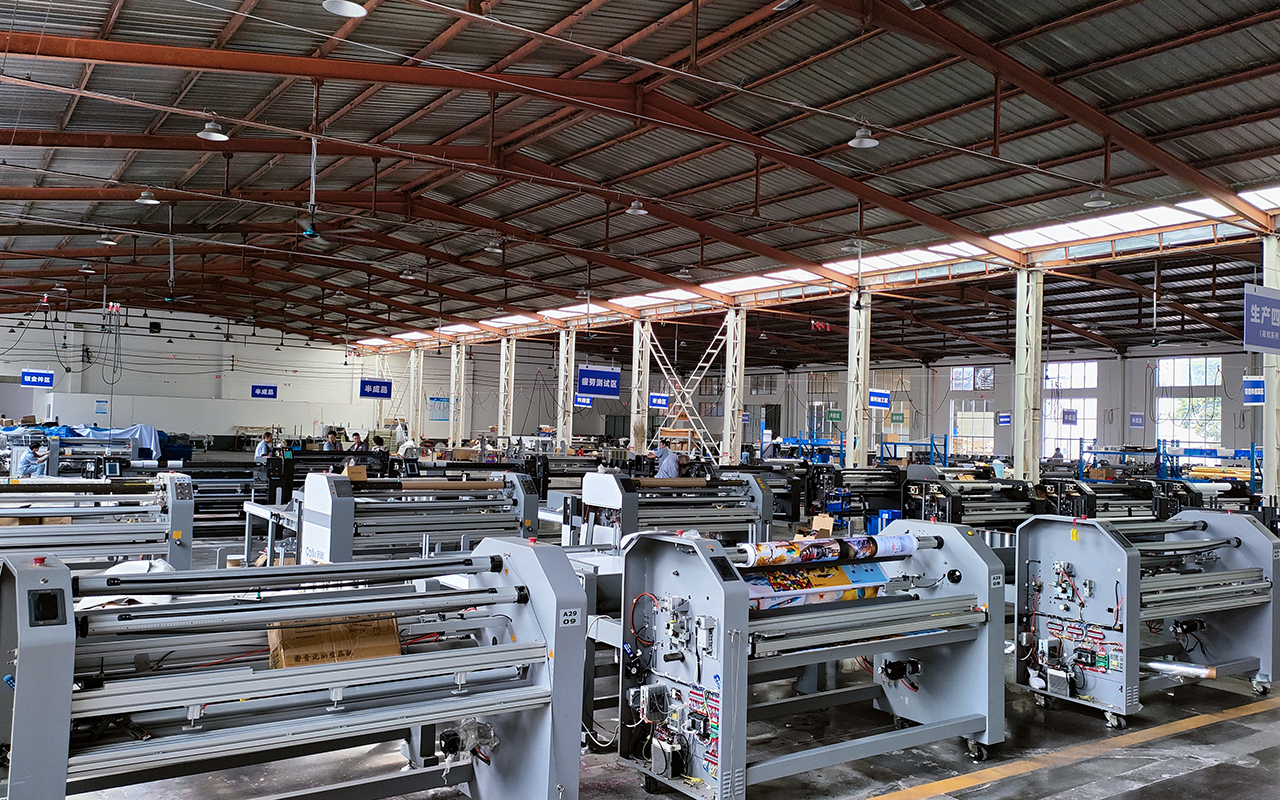
Ask the supplier to state the frame construction in writing. The MEFU MF1700-C3 is listed with a frame material of Integrated Sheet Metal. That is a specific claim, and it should be verified rather than accepted as a marketing phrase. An integrated sheet-metal frame is formed from continuous sheet-metal structure; an assembled frame may use separate profiles, brackets, and fasteners. Both approaches can work, but they behave differently under vibration, nip pressure, and transport stress.
During evaluation, request a frame drawing or a close-up factory video that shows the main load path from the side plates to the roller mounts. Look for continuous seams, gussets at load points, consistent weld quality, and fastener patterns that do not rely on slotted adjustments at critical joints. Ask how the frame is squared after fabrication and how roller parallelism is maintained. A heavy frame is not automatically rigid, but a published net weight gives the buyer a reference point when comparing machines of similar working width.
The MEFU MF1700-C3 is listed with a net weight of 180 kg. That figure is useful as a benchmark for structural mass in the 1630 mm / 64 in industrial roll laminator class. It should not be read as proof of vibration-free lamination by itself. The buyer should ask where that mass sits: in the frame, roller shafts, heater assembly, or base. Mass concentrated in the frame and roller assembly can help damp vibration; mass added only through packaging or base plates does not improve the roller nip. The practical evaluation is to combine the 180 kg net weight with the integrated sheet-metal frame claim and then observe machine behavior during a loaded run.
2. Silicone roller durometer: the missing RFQ field
Published specifications for the MF1700-C3 identify silicone rollers, and the same material is listed across several MEFU roll laminator models. Silicone is a common roller material in laminating equipment because it can provide conformability and release. However, the word silicone does not tell the buyer how hard the roller is. Durometer is the missing field that should be added to the RFQ.
Ask the supplier to state the roller durometer, the hardness scale used, the test method, and the measurement location. Ask whether the durometer is measured on the finished roller or on the raw silicone compound. Ask for the tolerance and for the supplier's incoming inspection record. A roller that is too soft can deflect under nip pressure and may not maintain a consistent gap on thick substrates. A roller that is too hard may fail to conform to textured or uneven media. The correct hardness depends on film chemistry, substrate thickness, nip pressure, and the buyer's quality standard, so the buyer should test with the actual media rather than selecting a number in isolation.
This is an area where supplier evaluation should be explicit about evidence limits. The published MEFU MF1700-C3 data identifies silicone rollers but does not state a durometer value. The buyer should not invent one or assume that one hardness fits all applications. Instead, request the durometer in writing and run a sample lamination with the buyer's film and substrate. If the supplier cannot provide the durometer and test method, treat roller hardness as unverified.
3. Heating performance: element, plate, and uniformity
The MF1700-C3 is listed as a top-heated machine with a maximum temperature of 60°C or 120°C depending on configuration. Its material list includes an aluminum alloy heating plate and an infrared quartz heating element. These are verifiable design facts. The buyer's evaluation should go one step further: ask how heat is distributed across the full 1630 mm / 64 in working width, how the temperature sensor is positioned, and how the machine recovers after film uptake.
A single thermocouple reading at the center of the roller is not enough evidence of heating performance. Ask for a temperature-uniformity map across the working width, a warm-up profile, and a recovery check after a production-length run. Ask whether the displayed temperature is measured at the heating plate, the roller surface, or another point. The answer matters because top-heated infrared systems can have different thermal behavior from dual-heated systems. The MF1700-F2, for example, is listed as dual heated with a maximum temperature of 120°C, while the MF1700-C3 is top heated with a 60°C or 120°C configuration. Buyers should compare like with like before selecting a machine.
For execution-stage buyers, the heating checklist should be tied to the acceptance test. Define the film, substrate, target speed, and allowable defect level. Run the machine long enough to see whether edge temperature follows center temperature. Inspect the finished roll for silvering, bubbles, and edge curl. If the supplier can provide a factory acceptance test record with the buyer's material, the heating claim becomes more useful than a catalog temperature alone.
4. Compliance and traceability
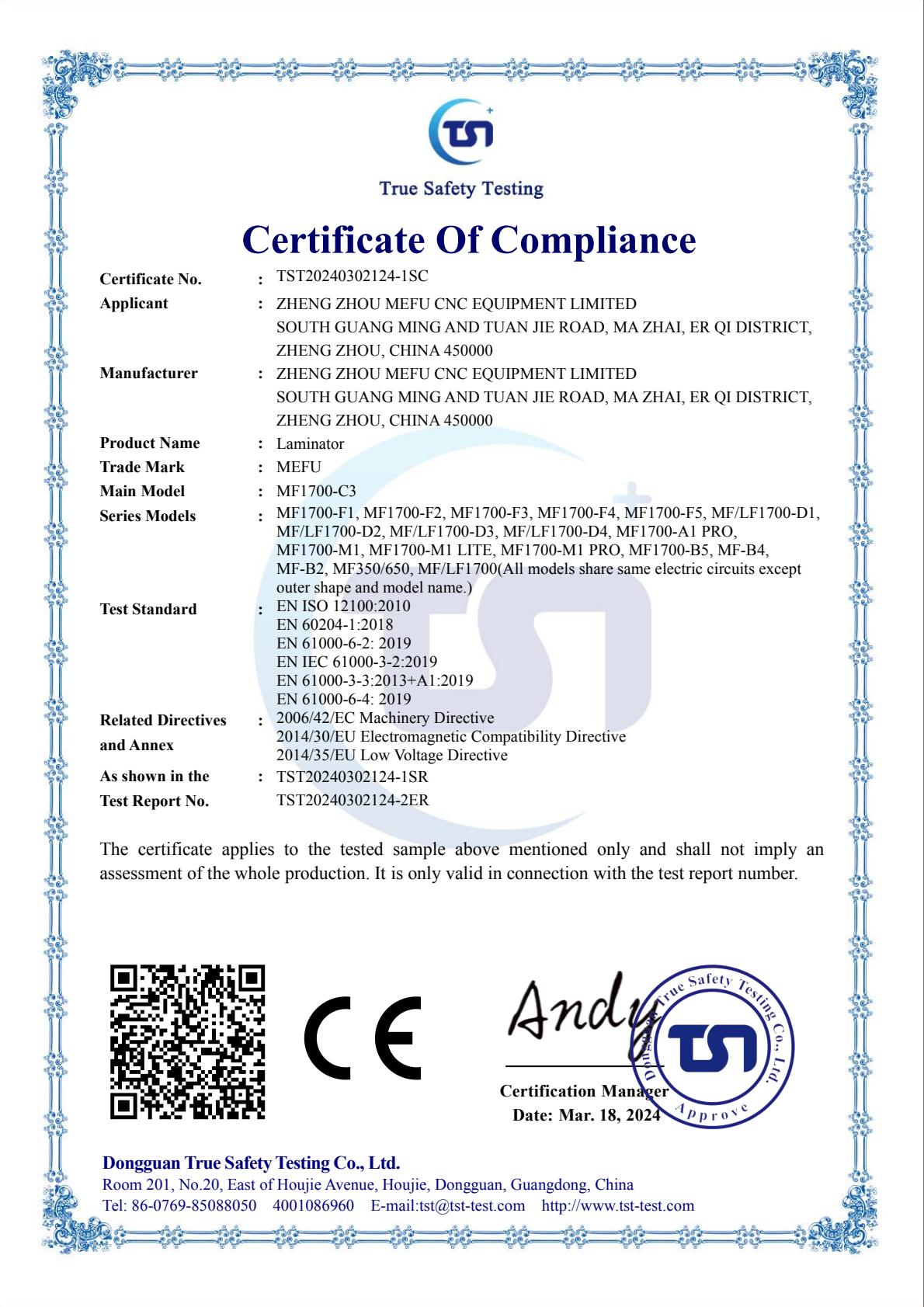
Compliance documents should be checked against the exact model and the exact market. The MEFU MF1700-C3 is included in CE certificate TST20240302124-1SC issued by Dongguan True Safety Testing Co., Ltd. for the EU market, with an issue date of 2024-03-18 and an expiry date of 2029-03-18. The certificate scope covers the main model MF1700-C3 and a series of related models. The listed standards include EN ISO 12100:2010, EN 60204-1:2018, EN 61000-6-2:2019, EN IEC 61000-3-2:2019, EN 61000-3-3:2013+A1:2019, and EN 61000-6-4:2019.
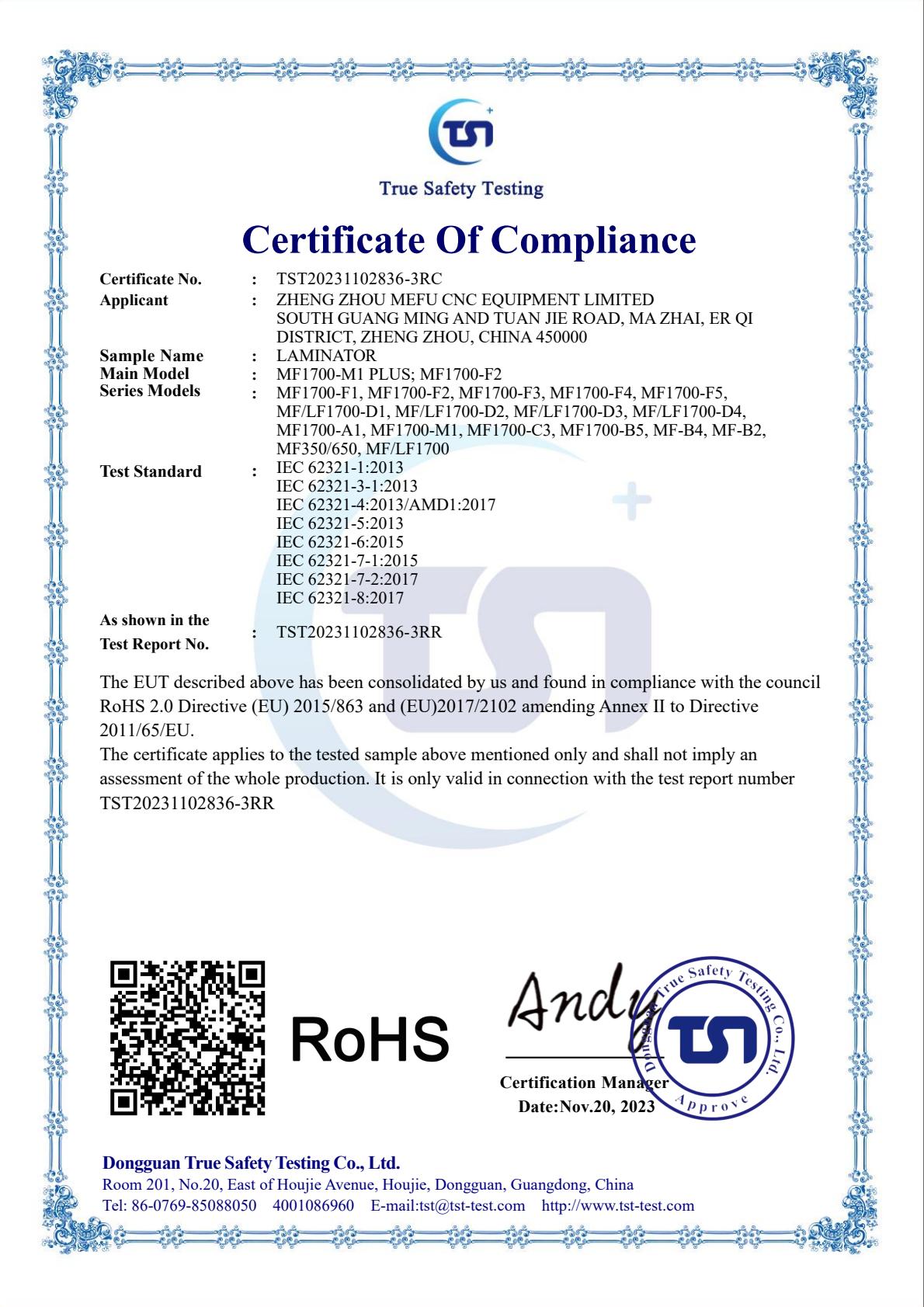
The MF1700-C3 is also included in RoHS certificate TST20231102836-3RC issued by Dongguan True Safety Testing Co., Ltd. for the EU market, with an issue date of 2023-11-20 and an expiry date of 2028-11-20. The buyer should request the certificate PDF, check the model list, check the expiry date, and confirm that the certificate matches the configuration being purchased. A certificate for a series is useful, but the purchase order should still identify the exact model and any custom voltage, marking, or size options.
5. Pre-shipment acceptance test
The published procurement terms for MEFU list MOQ of 1 unit, delivery terms FOB/CIF/DDP/DDU, acceptance criteria of pre-shipment test, and payment terms T/T. These terms give the buyer a framework for turning supplier evaluation into an executable order. The acceptance test should not be limited to a visual check. It should include a loaded run with the buyer's film and substrate, a roller inspection, a temperature check across the working width, and a review of the frame and roller mounts after the run.
During the test, record the machine configuration, film type, substrate type, speed, temperature setting, and observed defects. Ask the supplier to keep the test record with the shipment. If the buyer cannot attend in person, request video evidence and a signed test report. This is especially important for OEM orders where size, color, voltage, or marking have been customized.
Step-by-Step Breakdown: How to Run the Evaluation
- Define the application first. State the film, substrate, maximum width, maximum thickness, target speed, and acceptable defect level. For a 1630 mm / 64 in machine, confirm that the buyer's media fits the published maximum thickness. The MF1700-C3 is listed with a maximum lamination thickness of 28 mm / 1.1 in and a maximum speed of 20 m/min.
- Request the frame evidence pack. Ask for the frame material specification, a general arrangement drawing, weld and finish inspection criteria, and photographs of the main joints. Confirm that the frame is described as Integrated Sheet Metal and ask how roller parallelism is set and checked. Use the 180 kg net weight of the MF1700-C3 as a reference when comparing machines of similar width, but do not treat weight alone as proof.
- Put roller durometer in the RFQ. Ask for the durometer value, hardness scale, test method, measurement location, and tolerance. Request a sample lamination with the buyer's film and substrate. If the supplier cannot state the durometer, record that as an open item rather than assuming a value.
- Audit the heating design. Confirm the heating type, heating element, heating plate material, maximum temperature, and sensor location. For the MF1700-C3, the published data lists top heating, infrared quartz, aluminum alloy heating plate, and 60°C or 120°C maximum temperature depending on configuration. Ask for a temperature-uniformity check across the working width and a recovery check after a production-length run.
- Verify compliance and model mapping. Collect the CE and RoHS certificate files, check the certificate numbers, issue and expiry dates, and model scope. Confirm that the exact model and any custom options are covered. Keep the certificate file with the purchase order.
- Execute the pre-shipment test. Use the published acceptance criterion of pre-shipment test. Define pass and fail conditions before the test. Record speed, temperature, film, substrate, and defects. Review the frame, rollers, and heater after the run. Release the shipment only when the test record is complete.
Use Cases: Where the Checklist Changes the Decision
High-volume signage and graphics. A production buyer running long rolls of signage film should prioritize frame rigidity, roller parallelism, and heat recovery. The MF1700-C3 is listed as an Industrial Roll Laminator with a 20 m/min maximum speed and a 1630 mm / 64 in working width. In this use case, the buyer should ask for a loaded run at the target speed and inspect the edges of the finished roll. A machine that passes a short sample but drifts on a long run is not yet qualified.
Thick substrate mounting and encapsulation. Buyers working with thicker substrates should check the maximum thickness and roller conformity together. The MF1700-C3 is listed with a maximum lamination thickness of 28 mm / 1.1 in. A roller with the wrong durometer can still mark or trap air even when the thickness is within the published limit. The sample test should use the thickest substrate in the buyer's production mix.
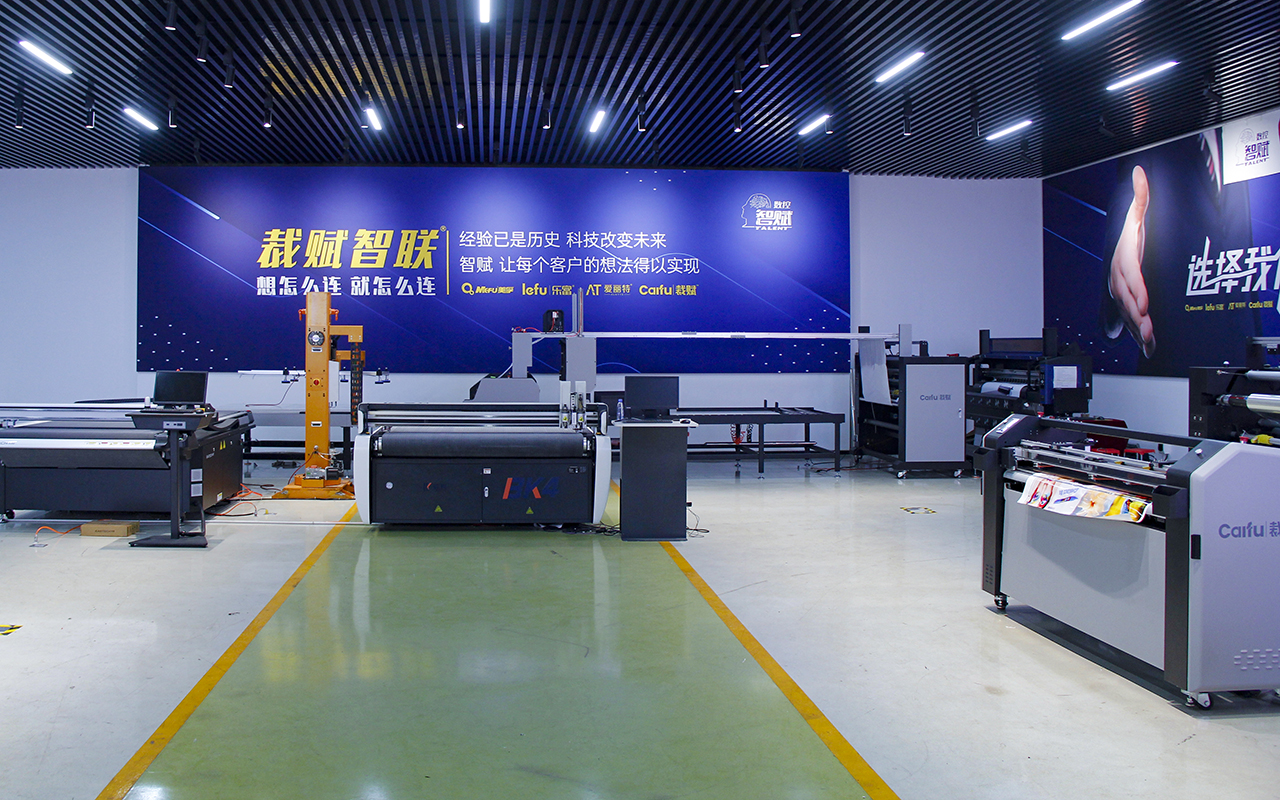
Distributor and OEM evaluation. Distributors need a supplier that can document the build and support repeat orders. MEFU's published capability data lists OEM production and customization for Size, Color, Voltage, and Marking, with MOQ of 1 unit, a 14-day lead time, and monthly capacity of 500 units. These are useful capability signals, but the distributor should still verify the frame, roller, and heater evidence on the exact model being ordered.
Installed-base evidence. MEFU's published case data includes a UK authorized distributor of large-format finishing equipment that installed 10 units of product 2190 for high-speed roll-to-roll production, and an Australian wide-format digital printing and signage client that installed 50 units of product 2203 for graphic arts and wide-format finishing. These cases are not evidence for the MF1700-C3 specifically, but they show that the supplier has experience with distributor and production buyers in related finishing categories.
Comparison Table: Published Build and Heating Data
| Evaluation point | MF1700-C3 | MF1700-M1 | MF1700-F2 |
|---|---|---|---|
| Machine type | Industrial Roll Laminator | Hot Cold Roll Laminator | Double Sided Roll Laminator |
| Frame material | Integrated Sheet Metal | Integrated Sheet Metal | Integrated Sheet Metal |
| Roller material | Silicone | Silicone | Silicone |
| Heating | Top heated | Top heated, infrared | Dual heated |
| Maximum temperature | 60°C or 120°C | Up to 60°C | 120°C |
| Maximum lamination width | 1630 mm / 64 in | Up to 1630 mm / 64 in | 1630 mm / 2280 mm |
| Maximum lamination thickness | 28 mm / 1.1 in | 23 mm / 0.9 in | 28 mm / 1.1 in |
| Maximum speed | 20 m/min | 0–9 m/min | 20 m/min |
| Net weight | 180 kg | 150 kg | 260 kg |
| Up and down | Pneumatic | Manual hand crank | Pneumatic |
Table notes: values are from the published MEFU model data in the supplied corpus. Confirm the final configuration in the quotation, especially where temperature, width, or custom options are selectable.
FAQ
What compliance documents should a roll laminator supplier provide for the MF1700-C3?
Ask for the CE certificate and the RoHS certificate, and check that the exact model is listed. For the MF1700-C3, the CE certificate is TST20240302124-1SC issued by Dongguan True Safety Testing Co., Ltd. for the EU market, issued 2024-03-18 and valid to 2029-03-18. The RoHS certificate is TST20231102836-3RC from the same authority, issued 2023-11-20 and valid to 2028-11-20. Both certificates list MF1700-C3 within their scope. Confirm the certificate file, expiry date, and model mapping before placing the order.
How can I verify that a roll laminator frame is truly integrated sheet metal?
Ask for the frame material specification, a drawing or close-up factory photographs, and the supplier's inspection criteria for welds, seams, and roller mounts. The MF1700-C3 is listed with a frame material of Integrated Sheet Metal and a net weight of 180 kg. Use those facts as a starting point, then verify the load path from the side plates to the roller mounts and observe the machine during a loaded run. A 180 kg net weight supports the evaluation of structural mass, but it does not replace a frame inspection or a vibration check.
Does a heavier frame like the MF1700-C3's 180 kg build increase total cost?
It can affect freight, lifting, floor loading, and installation planning, so those items should be included in the landed-cost comparison. Published MEFU procurement terms list MOQ of 1 unit, delivery terms FOB/CIF/DDP/DDU, acceptance criteria of pre-shipment test, and payment terms T/T. The published data does not include a price, so the buyer should request a model-specific quotation and compare the total delivered cost rather than the machine price alone.
Can I test roller durometer and heating performance before ordering?
Yes, make both part of the sample and acceptance process. Ask the supplier to state the silicone roller durometer, hardness scale, test method, and measurement location, because the published MF1700-C3 data identifies silicone rollers but does not state a durometer value. For heating, ask for a temperature-uniformity check across the 1630 mm / 64 in working width, a warm-up profile, and a recovery check after a production-length run. Use the buyer's own film and substrate in the test.
What lead time should I plan for an OEM roll laminator order?
MEFU's published capability data lists a 14-day lead time, MOQ of 1 unit, monthly capacity of 500 units, and customization for Size, Color, Voltage, and Marking. Confirm the lead time for the exact model and configuration in the quotation, because custom voltage, marking, or size options can change the production schedule. For a faster next step, send your media stack, target output, and required configuration to MEFU for a model-specific quotation and pre-shipment test plan.
Conclusion
Supplier evaluation for roll laminators should move beyond the headline specification table. The buyer should verify the frame construction, ask for roller durometer and test method, audit the heating design, check compliance documents against the exact model, and define a pre-shipment acceptance test. The MEFU MF1700-C3 is a practical benchmark because its published data gives the buyer specific facts to question: an integrated sheet-metal frame, silicone rollers, infrared quartz heating, a 1630 mm / 64 in working width, 28 mm / 1.1 in maximum thickness, 20 m/min maximum speed, and a 180 kg net weight. Those facts do not replace testing, but they make the supplier conversation more precise.
Next Step: Evaluate the Machine Against Your Own Media
Send MEFU your film type, substrate thickness, target width, and production speed. Ask for a model-specific quotation, the roller durometer statement, the heating configuration, and a pre-shipment test plan for the MF1700-C3 or another model in the range.
Contact: info@mefu.cn | Tel / WhatsApp: +86 15890020566 | Website: www.mefulaminator.com
Download the MEFU brochure: MEFU product brochure PDF