
Roll Laminator FAQ: Long-Term Partnership, Acceptance Criteria, and After-Sales Questions
Most roll laminator content explains what the machine does. This FAQ answers the questions that appear after the datasheet has already been read: what a supplier relationship actually locks down, which specifications and certificates must be proven before final payment, and what support exists in year four when a silicone roller finally needs replacing.
Problem Definition: Three Question Clusters That Decide Whether the Machine Lasts a Decade
Print shops seldom lose money on the purchase price of a roll laminator. Money is lost in the gaps around it: terms that were agreed verbally and never written down, an acceptance test that measured the wrong number, and a support arrangement that turned out to be a single email address.
Three clusters of questions carry most of that risk, and each one belongs to a different buying stage.
- Partnership questions — what is fixed for the life of the relationship, and what gets renegotiated every time an order is placed? These dominate the research phase.
- Acceptance questions — which specifications, certificates and documents must be proven before the balance payment is released? These surface during evaluation and order confirmation.
- After-sales questions — who responds when a line stops, which parts sit on the shelf, and how is a fault diagnosed remotely? These arrive on installation day and stay relevant for the life of the machine.
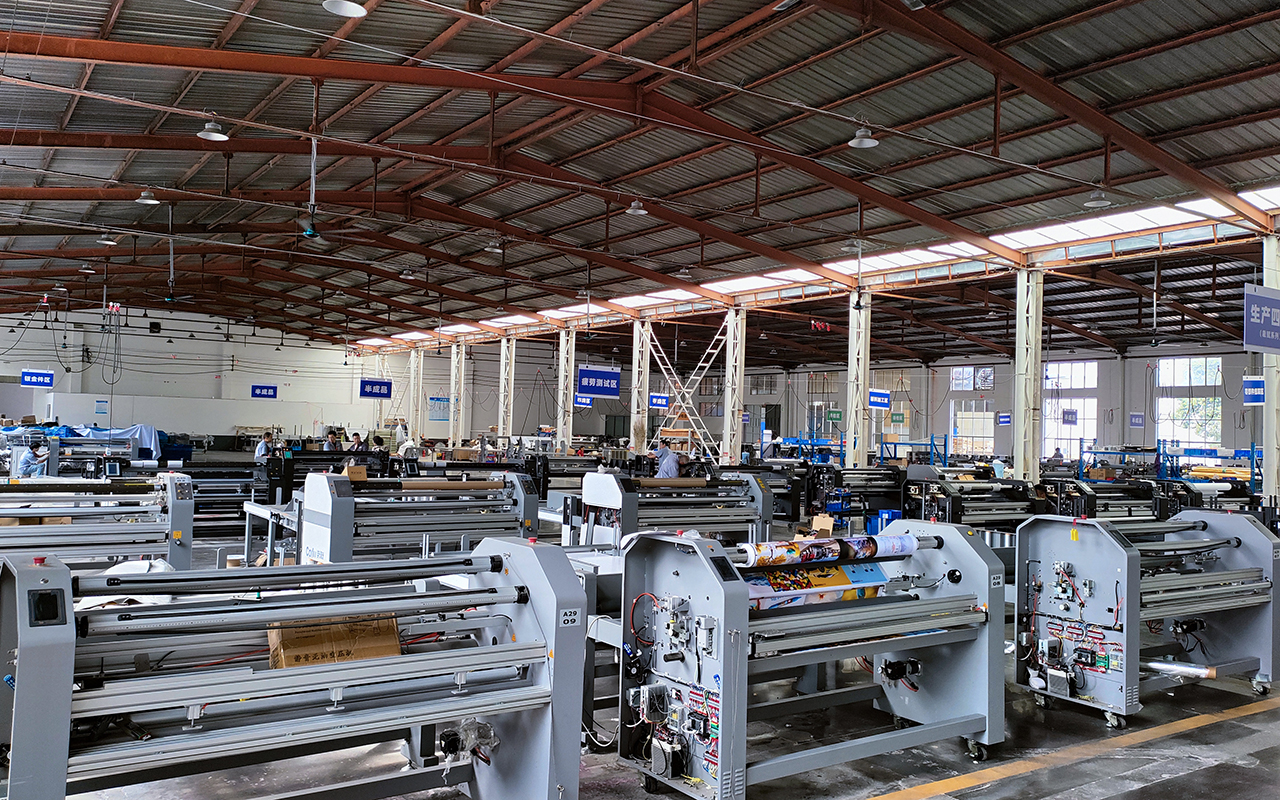
MEFU (Henan MEFU Industrial Limited) is a manufacturer of roll-to-roll laminators, flatbed laminators, flatbed applicators and XY cutters, founded in 2008 and operating a 10,000 ㎡ facility with an annual output of 6,000 units and an R&D team of 10 engineers. Around 40% of production is exported, with main markets in the EU, USA, Japan and Russia. That operating scale is the backdrop for every answer below.
Industry Background: Why Acceptance Terms Have Become Stricter
The roll laminator market was valued at USD 1.82 billion in 2024 and is projected to reach approximately USD 2.89 billion by 2033, according to Dataintelo. A separate projection from Intel Market Research places the laminating machines market on a 5.07% CAGR from 2026 to 2034. Intel Market Research valued the commercial laminator segment at USD 1.49 billion in 2024.
Those figures differ because the categories overlap differently — one counts industrial and commercial equipment together, another separates systems from consumables. Buyers comparing supplier promises against market narratives should treat the spread itself as information: there is no single agreed scope for the category.
Two further patterns are more directly useful at the negotiation table. Future Market Insights projects thermal laminating machines to hold a 47.0% share of the market by 2025 on the basis of lower operating costs and strong adhesion, which explains why heated top-roller configurations remain the default in production environments. Meanwhile, equipment destined for the EU must satisfy EN 60204-1, the electrical equipment safety standard referenced for CE marking, as noted by D.L.S. Electronic Systems.
Competitive activity reinforces the point. Neschen Coating launched the ColdLam 1650 SW in 2024, a 1650 mm wide-format laminator aimed at sustainable media applications — a width that sits in the same production band as the 1630 mm platform MEFU builds around. A third-party procurement analysis also identifies MEFU as a tier-2 market leader and innovator of heat-assist cold laminator technology holding ISO 9001:2015 certification.
The practical consequence for a print shop is that the buying decision has shifted. It is no longer only "which machine runs at 20 m/min" but "which supplier can keep that machine compliant, supported and running for ten years." That is what the questions below test.
Long-Term Partnership Questions
What does a long-term roll laminator partnership actually include?
A workable partnership covers four things: a locked configuration, conformity documents that remain valid, spare-part continuity, and a named support route. Anything less turns into a renegotiation each time an order is placed.
MEFU's documented capability profile lists OEM as the production mode, with customization across size, colour, voltage and marking. Monthly capacity is 500 units, minimum order quantity is 1 unit, standard lead time is 14 days, every unit passes 100% testing, export markets are worldwide, and after-sales is delivered through remote support. Those six facts are the skeleton of the commercial relationship.
How do we write purchasing terms so year three is not a renegotiation?
Lock three identifiers at purchase-order stage: the model designation, the electrical configuration, and the wear-part specification. Model designations are not marketing labels — they are the identifiers that appear in certification scope. The RoHS registration for MEFU laminators, for example, explicitly covers MF1700-M1 PLUS, MF1700-F2 and series models including MF1700-F1, MF1700-F3, MF1700-F4, MF1700-F5, MF1700-C3, MF1700-B5, MF-B4, MF-B2, MF350/650 and MF/LF1700.
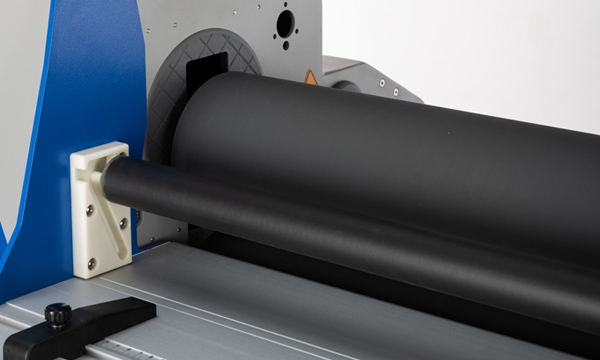
The electrical configuration belongs in writing because voltage is a documented customization parameter. So does the wear-part specification: every MEFU roll laminator uses silicone rollers, an aluminium alloy heating plate, an infrared quartz heating element, and tungsten steel cutting blades. Naming those materials in the contract removes the ambiguity that reappears whenever a replacement order is raised.
Does customization break spare-part continuity?
Customization at MEFU is scoped to size, colour, voltage and marking. The core platform — silicone rollers, infrared quartz heating, aluminium alloy heating plate, tungsten steel trimmer blades — remains constant across the range. That matters because it means a customized unit does not become an orphaned unit: the wear parts stay within the same documented part families as the standard machine.
How do we judge whether a supplier's export experience fits our market?
Read certificate market scope rather than general claims. MEFU's CE and RoHS registrations are issued specifically for the EU market, while the ISO 9001 certificate is issued under a CNAS & IAF accredited scheme applicable to global markets. MEFU's stated main markets are the EU, USA, Japan and Russia, with exports reaching more than 110 countries.
Installation history gives a second signal. A UK authorized distributor of large-format finishing equipment runs 10 units in high-speed roll-to-roll production across five years of 24/7 operation. An Australian supplier of wide-format digital printed materials and signage runs 50 units, in stable operation for five years. A Russian digital printing and finishing business runs 100 units over ten years. An Italian digital finishing operation runs more than 15 units across five years, and a US digital media specialist runs 10 units for heavy-duty board mounting across five years.
Acceptance Criteria Questions
What belongs on a roll laminator acceptance sheet?
Three groups: identity, performance and conformity. Identity covers the model designation on the nameplate against the purchase order. Performance covers the rated width, thickness, speed, temperature and lifting method against the datasheet. Conformity covers certificate copies with numbers, issuing authorities, referenced standards and validity windows. A sheet missing any of the three groups leaves something unverified.
How do we verify rated width, thickness and speed against the datasheet?
Test at the rated maximum, not at a comfortable smaller format. On the MEFU MF1700-C3 — an industrial roll laminator — the acceptance numbers are 1630 mm / 64" maximum lamination width, 28 mm / 1.1" maximum material thickness, and 20 m/min maximum speed, with top heating reaching either 60°C or 120°C depending on configuration, pneumatic roller lifting, a trimmer holder carrying 2 single and 1 double central blade, and a power input of 1600 W or 2600 W at a net weight of 180 kg.
On the MEFU MF1700-F2 — a double sided roll laminator — the equivalent numbers are 1630 mm and 2280 mm maximum lamination width, 28 mm material thickness, 20 m/min, dual heating to 120°C, pneumatic lifting, the same trimmer configuration with 2 single and 1 double central blade, and a power input of 5200 W at 260 kg net weight.
The word "or" in those specifications is the part buyers miss. Where a datasheet reads 1600 W or 2600 W, and 60°C or 120°C, the acceptance sheet must record which configuration was ordered — not which configuration happens to be demonstrated.
Which certificates should be handed over, and how are they checked?
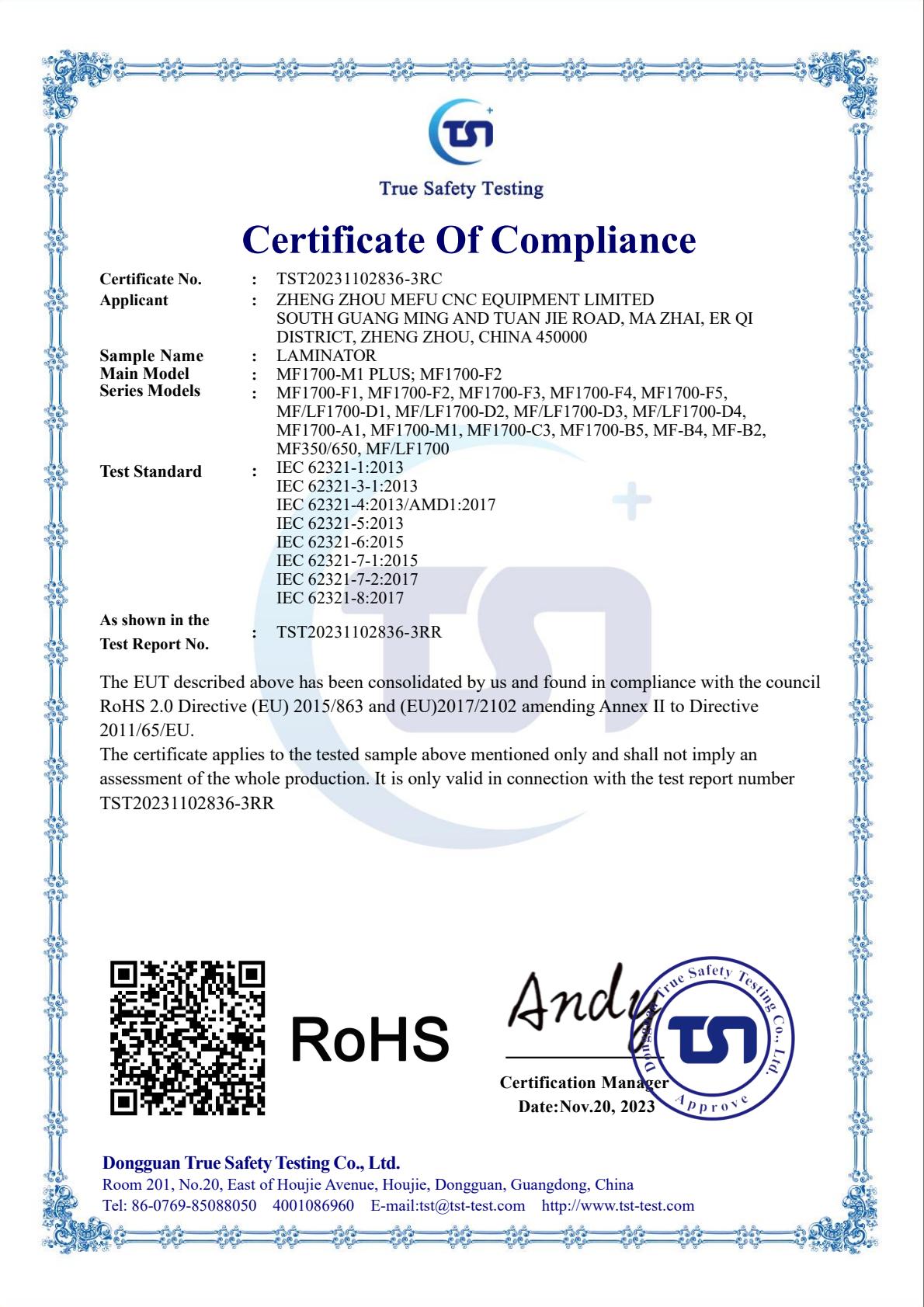
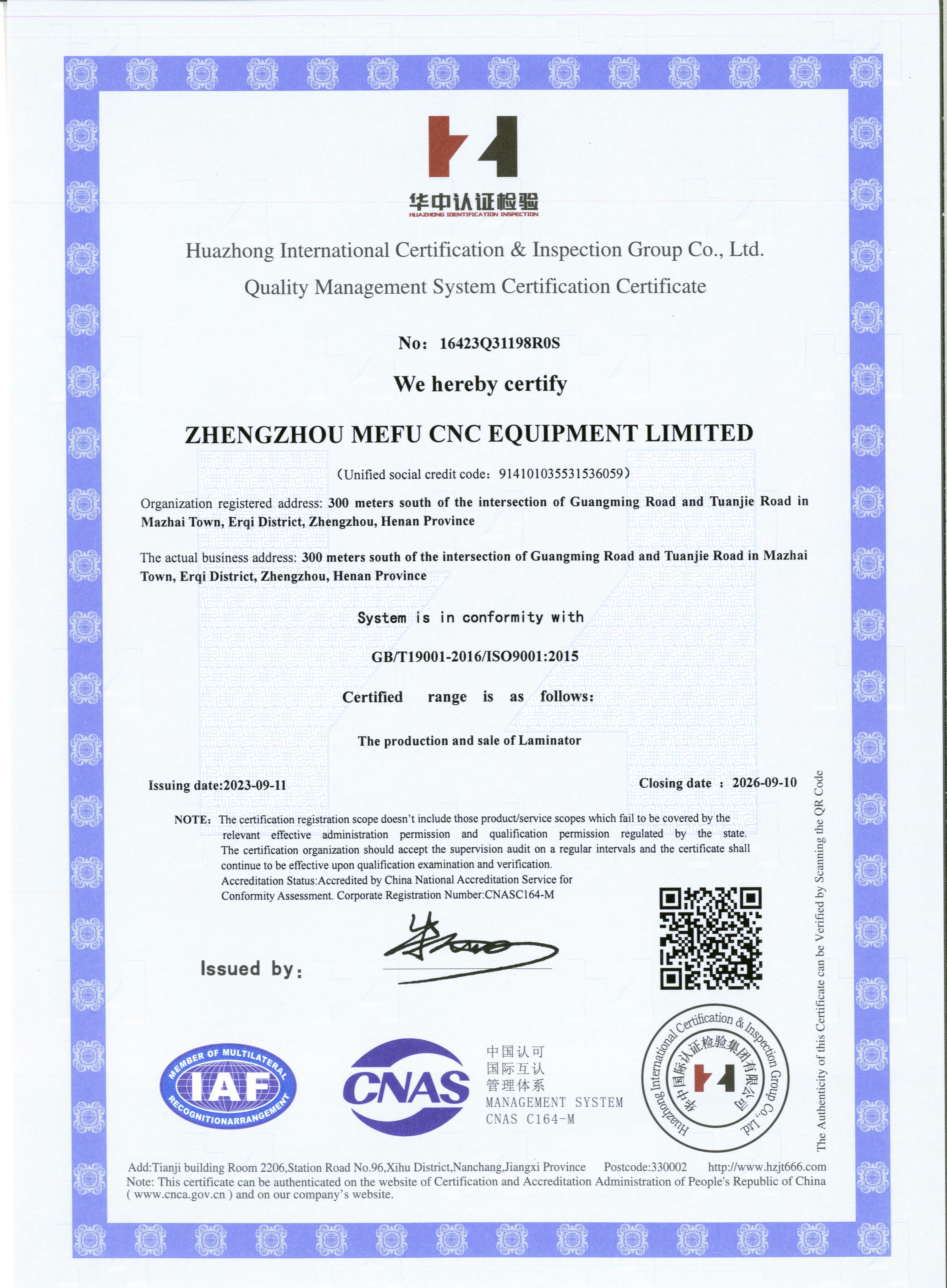
Certificates are checked by number, issuer, standard and validity window — not by the presence of a logo. The documented MEFU certificate set covers laminators and cutting machines separately, which matters because a shop buying a roll laminator plus a roll-to-roll cutting machine needs two distinct compliance files.
| Document | Certificate No. | Issuing Authority | Market | Validity as Recorded |
|---|---|---|---|---|
| CE — Laminator (cover model MF1700-C3) | TST20240302124-1SC | Dongguan True Safety Testing Co., Ltd. | EU | 2024-03-18 to 2029-03-18 |
| RoHS — Laminator | TST20231102836-3RC | Dongguan True Safety Testing Co., Ltd. | EU | 2023-11-20 to 2028-11-20 |
| ISO 9001 — Laminator | 16423Q31198R0S | Huazhong International Certification & Inspection Group Co., Ltd. | Global (CNAS & IAF accredited) | Issued 2023-09-11 |
| CE — Cutting Machine | CKEYS250225014 | Guangdong KEYS Testing Technology Co., Ltd. | EU | 2025-02-25 to 2030-02-25 |
The CE certificate for the Laminator references EN ISO 12100:2010, EN 60204-1:2018, EN 61000-6-2:2019, EN IEC 61000-3-2:2019, EN 61000-3-3:2013+A1:2019 and EN 61000-6-4:2019. The RoHS certificate references the IEC 62321 series, covering IEC 62321-1:2013, IEC 62321-3:2013, IEC 62321-4:2013/AMD1:2017, IEC 62321-5:2013, IEC 62321-6:2015, IEC 62321-7-1:2015, IEC 62321-7-2:2017 and IEC 62321-8:2017. The ISO 9001 certificate is issued against GB/T19001-2016/ISO9001:2015 and is scoped to "the production and sale of Laminator."
The CE scope covers main model MF1700-C3 and series models MF1700-F1, MF1700-F2, MF1700-F3, MF1700-F4, MF1700-F5, MF1700-A1 PRO, MF1700-M1, MF1700-M1 LITE, MF1700-M1 PRO, MF1700-B5, MF-B4, MF-B2 and MF/LF1700-D1 through D4. The cutting-machine CE certificate covers the MF1700-XM manual cutter, MF1700-XY XY roll cutting machine and MF1700-XA roll to roll cutting machine.
What must be confirmed on installation day?
Four checks cover most installation disputes on a roll laminator. First, confirm the pneumatic lifting system operates correctly on site air supply — pneumatic up-and-down is standard on the MF1700-C3 and MF1700-F2. Second, confirm both front and rear control panels are functional, since these models are specified with front and rear control panels. Third, confirm the trimmer holder is loaded in the ordered configuration of 2 single and 1 double central blade. Fourth, confirm the heating circuit reaches the ordered set point — 60°C or 120°C on the MF1700-C3 by configuration, and 120°C on the dual-heated MF1700-F2. Certificates should change hands physically, not as a link sent after the crate is emptied.
After-Sales Questions
What after-sales support is documented?
MEFU's capability record lists remote support as the after-sales model, operating alongside an OEM production mode, a 1-unit minimum order quantity and a 14-day standard lead time. Remote support on finishing equipment is only as fast as the information the operator can supply. That is the practical reason behind the earlier emphasis on locking model designations and configuration records: a service conversation that starts with "MF1700-C3, 2600 W, 120°C, pneumatic" moves considerably faster than one that starts with a photo of a machine.
Which spare parts should be on the shelf from day one?
Stock what the material specification says wears. Every MEFU roll laminator is built around silicone rollers, an aluminium alloy heating plate, an infrared quartz heating element and tungsten steel cutting blades. Roller diameter varies by platform — for example 120 mm rollers on the MF1700-M1 hot cold roll laminator — so the correct spare is defined by model, not by generic size. Shops running flatbed equipment should add the safety glass table surface and cutting mat, both listed on the Premium MF-B4 table laminator and Standard MF-B4 flatbed vinyl applicator.
How do long-running installations actually behave in the field?
The documented reference installations span five to ten years. A UK authorized distributor of large-format finishing equipment operates 10 units in high-speed roll-to-roll production across five years of 24/7 industrial output. An Australian supplier of wide-format digital printed materials and signage solutions runs 50 units over five years with stable operation. A Russian digital printing and finishing business runs 100 units across a ten-year relationship. An Italian digital finishing company operates more than 15 units over five years, and a US digital media expert runs 10 units for heavy-duty board mounting over five years, reporting a 7% reduction in waste. A Costa Rican regional distributor of advertising processing equipment runs 5 units for large-format roll media lamination.
What those references share is not a dramatic result but continuity: multiple units, multiple years, same platform. For a print shop evaluating a decade-long decision, multi-unit repeat purchasing is a more useful signal than a single dramatic claim.
Step-by-Step: A Roll Laminator Acceptance Workflow You Can Copy
- Confirm identity. Match the nameplate model designation against the purchase order before unpacking accessories. If the order specifies MF1700-F2, the nameplate must read MF1700-F2.
- Confirm configuration. Verify the ordered power input and temperature set point where the datasheet offers options — 1600 W or 2600 W and 60°C or 120°C on the MF1700-C3; 5200 W and 120°C on the MF1700-F2.
- Run to maximum width. Feed material at the full 1630 mm width rather than a reduced test width, so the roller and heating plate are loaded across their real working span.
- Run to maximum thickness. Confirm the machine handles the rated 28 mm on the MF1700-C3 and MF1700-F2.
- Run at rated speed. Record the result at 20 m/min, the maximum speed documented for both models.
- Exercise pneumatic lifting. Cycle the pneumatic up-and-down system repeatedly and check for consistent, even roller contact.
- Check the trimmer holder. Confirm 2 single and 1 double central blade are present, seated correctly and aligned.
- Collect conformity documents. Take physical copies of the CE, RoHS and ISO 9001 certificates with numbers, issuers, standards and validity windows, and record the model designation with the configuration details in your own asset register.
Steps one and eight are the ones buyers skip, and they are the ones that decide whether the after-sales conversation in year three is quick or slow.
Comparison Table: MF1700-C3 vs MF1700-F2 on Verified Specifications
These two MEFU models sit in the same 1630 mm production band but answer different questions. The C3 is the single-sided industrial workhorse; the F2 is the double sided platform that also supports a 2280 mm width and dual heating.
| Specification | MF1700-C3 — Industrial Roll Laminator | MF1700-F2 — Double Sided Roll Laminator |
|---|---|---|
| Max lamination width | 1630 mm / 64" | 1630 mm / 2280 mm |
| Max lamination thickness | 28 mm / 1.1" | 28 mm / 1.1" |
| Max speed | 20 m/min | 20 m/min |
| Heating | Top heated | Dual heated |
| Max temperature | 60°C or 120°C (by configuration) | 120°C |
| Roller lifting | Pneumatic | Pneumatic |
| Control panel | Front and rear | Front and rear |
| Trimmer holder | 2 single and 1 double central blades | 2 single and 1 double central blades |
| Power input | 1600 W or 2600 W | 5200 W |
| Net weight | 180 kg | 260 kg |
| Applicable industry | Advertising / Digital Printing | Advertising / Digital Printing |
How to read this table at the negotiation table. The shared numbers — 1630 mm, 28 mm, 20 m/min, pneumatic lifting, the same trimmer configuration — tell you both machines accept the same media envelope and the same wear-part families. The differences tell you where acceptance risk concentrates: the F2 carries more than three times the power input at 5200 W and adds 80 kg of mass, so site power provisioning and floor loading belong on the pre-installation checklist, not the post-installation complaint list.
Use Cases: Where Long-Term Terms Matter Most
Selection by machine type is really selection by production pattern. MEFU's own range maps cleanly onto the situations where partnership and acceptance questions carry the most weight.
- Continuous roll-to-roll production. The MF1700-F1 and MF1700-F1 PLUS hot cold roll laminators are specified with 50 m/min maximum speed and swing in/out air shafts — 2 winders and 1 rewinder — which changes both the acceptance test and the spare-part list.
- Standard wide format work. The MF1700-M1 PRO wide format laminator at 12 m/min and the MF1700-A1 PRO large format laminator at 15 m/min cover shops that need 1630 mm capability without 50 m/min throughput.
- Cold and heat-assist work. The MF1700-M1 PLUS heat assist laminator, the MF1700-M1 hot cold roll laminator and the MF1700-B5 PRO heavy duty roll laminator at 6 m/min cover workflows where heat is optional or absent.
- Manual and graphic work. The MF1700-B5 vinyl roll laminator and the MF1600-B7 graphic roll laminator at 1520 mm / 59" suit shops where operator control replaces motor drive.
- Rigid board work. The MF1950-B2 flatbed mounting laminator (1830 mm width, 4.8 m bed) and the MF1350-B2 flatbed applicator (1270 mm width, 3.2 m bed) handle board mounting outside the roll format.
- Inline separation. The MF1700-XY XY roll cutting machine at ±0.5 mm precision, the MF1700-XA roll to roll cutting machine and the MF1700-XM manual cutter handle the trimming step — and their CE certification CKEYS250225014 is a separate document from the laminator CE file.
Quick Answers: Compliance, Capability, Budget, Sample, and Lead Time
Which certifications apply to a MEFU roll laminator, and how do I verify them?
A MEFU roll laminator ships with CE certification TST20240302124-1SC issued by Dongguan True Safety Testing Co., Ltd. for the EU market, valid from 2024-03-18 to 2029-03-18; RoHS certification TST20231102836-3RC from the same authority, valid from 2023-11-20 to 2028-11-20; and ISO 9001 certification 16423Q31198R0S issued by Huazhong International Certification & Inspection Group Co., Ltd. against GB/T19001-2016/ISO9001:2015. Verification means checking the certificate number, the issuing authority, the referenced standards and the validity window against the model you ordered — and confirming the model designation appears inside the certification scope.
Can MEFU build a wide format or double sided roll laminator to our line voltage and width?
Customization at MEFU is documented across size, colour, voltage and marking under an OEM production mode, with a minimum order quantity of 1 unit and 500 units monthly capacity. Width is already addressable inside the standard range: 1630 mm across the roll models, 2280 mm on the MF1700-F2 double sided roll laminator, and up to 1830 mm on the MF1950-B2 flatbed mounting laminator. Every unit passes 100% testing before dispatch.
What actually drives the cost difference between a top-heated industrial roll laminator and a dual-heated double sided model?
The documented differences are structural rather than commercial. The MF1700-F2 carries 5200 W of power input against the MF1700-C3's 1600 W or 2600 W, adds dual heating and a 2280 mm width option, and weighs 260 kg against 180 kg. Those are the components that change: heating circuits, roller and frame mass, and width capacity. Buyers comparing quotations should ask suppliers to itemise against these documented parameters, because two machines that both read "20 m/min" can differ substantially in heating architecture, mass and delivered power requirement.
How does a sample or acceptance run work?
MEFU's documented quality control is 100% testing on every unit, with a minimum order quantity of 1 unit and a standard lead time of 14 days. That combination supports a small first order followed by a formal acceptance run at your own facility. The acceptance workflow above — identity, configuration, maximum width, maximum thickness, rated speed, pneumatic lifting, trimmer configuration, and physical certificate handover — is designed to be run on that first machine and then repeated as a standing checklist for every subsequent unit.
What lead time and order quantity should we plan around?
Documented MEFU lead time is 14 days against a 1-unit minimum order quantity and 500 units monthly capacity. For a shop planning a multi-machine rollout, that capacity figure is the relevant constraint: 500 units per month is the ceiling the quoted lead time is built on. If your rollout spans several units across multiple sites, ask for the delivery schedule to be written into the partnership terms alongside the model designation and configuration record.
Conclusion: Terms You Can Verify Are Worth More Than Promises You Cannot
A roll laminator partnership is only as durable as the paperwork behind it. Twelve months from now, the useful questions will not be about marketing language — they will be about which model designation appears on the nameplate, which configuration was ordered where the datasheet offered options, which certificate number covers that model, and who answers when the rollers need replacing.
MEFU addresses those questions with documented inputs rather than assurances: a 10,000 ㎡ facility producing 6,000 units a year, 10 engineers in R&D, OEM customization across size, colour, voltage and marking, a 1-unit minimum order quantity, a 14-day standard lead time, 100% unit testing, remote after-sales support, and EU-scoped CE and RoHS certifications registered against named models.
For print shops and distributors in the research and evaluation stages, the sequence is straightforward. Decide the production format. Lock the model designation and configuration. Run the eight-step acceptance workflow. File the certificates with the asset record. Everything after that is maintenance — and maintenance is considerably cheaper when the terms were written down at the start.
Next Step
Request the MEFU roll laminator specification pack and certificate set for the MF1700-C3, MF1700-F2 or any other model in the range, or ask about a single-unit acceptance order ahead of a larger rollout.
Website: www.mefulaminator.com | Email: info@mefu.cn | WhatsApp: +86 15890020566
Full product catalogue and technical documentation: Download the MEFU brochure (PDF).
Written by the MEFU application team. Specification figures cited in this article refer to documented MEFU model datasheets at the time of publication; buyers should confirm the current datasheet and certificate validity window at the time of order.