Maximizing Signage Output: Application Guide for Dual-Sided Roll Laminators with Inline Trimming
Date: 2026-10-07 Categories: Industry News Hits: 62
Maximizing Signage Output: Application Guide for Dual-Sided Roll Laminators with Inline Trimming
Signage output is usually limited by the finishing line, not by the printer. A shop can run a 1,630 mm roll at full press speed and still lose an hour per shift to second-pass lamination, off-line edge trimming, and an operator walking from one end of the machine to the other. This guide is written for production managers, signage converters, and print-finishing buyers who are evaluating a dual-sided roll laminator with inline edge trimming as one production asset rather than as two separate stations.
The short answer: a double-sided roll laminator such as the MEFU MF1700-F2 laminates both faces of the media in one pass using a dual heated configuration with a 120 °C maximum temperature and a 5,200 W power input, and it carries front and rear control panels so the operator can run the machine from either side. Its trimmer holder holds two single blades and one double central blade made of tungsten steel, which means edges can be trimmed immediately after lamination on substrates up to 28 mm (1.1 inch). Industrial models such as the MF1700-C3 use the same inline trimmer arrangement.
The rest of this guide covers where signage output is lost, what published market data says about lamination demand, how the MF1700-F2 and MF1700-C3 fit into a laminate-and-trim workflow, and when a dedicated two-axis cutting stage is the better answer.
The Finishing Bottleneck: Where Signage Output Actually Stalls
Throughput in roll-to-roll signage finishing is lost in four predictable places: handling the roll twice, trimming edges away from the laminator, reaching around a machine whose controls sit on only one side, and reworking edges on thicker substrates. None of these are printing problems. They are layout and configuration problems, which is why the practical fix is usually a machine configuration change rather than a faster printer.
- Double handling on two-pass lamination. When a laminator heats only one side, or applies only one face at a time, the roll has to be re-fed for the second face. Every re-feed adds handling time, adds a chance of contamination, and breaks the production rhythm between the printer and the finishing station.
- Off-line trimming queues. When edge trimming lives on a separate table or cutter, laminated rolls stack up between two stations. The laminator finishes its job, then waits. The cutter finishes its job, then waits. Neither asset runs at its rated speed across a shift.
- Single-side control access. A machine with controls on one side only forces the operator to walk around the frame to check tension, adjust speed, or stop the cycle. On continuous work this becomes a hidden cycle-time cost on every roll.
- Edge rework on thicker substrates. On heavier media and thick laminating stacks, hand trimming away from the machine produces ragged edges and inconsistent widths, which turns into rework rather than output.
The configuration logic follows directly: bring the two finishing operations into one pass, and keep the operator within reach of the controls at all times.
Industry Background: Why Inline Finishing Is Moving onto the Laminator
Lamination demand is growing, and the growth is concentrated in wide-format and industrial finishing rather than in light office equipment. Dataintelo values the global roll laminator market at USD 1.82 billion in 2024, projected to reach approximately USD 2.89 billion by 2033. Intel Market Research projects the global laminating machines market to expand at a CAGR of 5.07% from 2026 to 2034.
Two structural signals matter for buyers planning a finishing line. First, thermal (heat-based) laminating machines are expected to hold a 47.0% share of the market by 2025, a position attributed to lower operating costs and strong adhesion, according to Future Market Insights. Second, Intel Market Research places the commercial laminators market at USD 1.49 billion in 2024 and notes that wide-format segments are gaining traction in emerging markets.
Operationally, that expansion puts pressure on the finishing stage. When print volume rises, the constraint moves downstream, and the laminating and cutting steps become the throughput ceiling. This is the context in which dual-sided lamination and inline trimming stop being conveniences and start being capacity decisions.
The Equipment Answer: Dual-Sided Lamination with Inline Trimming
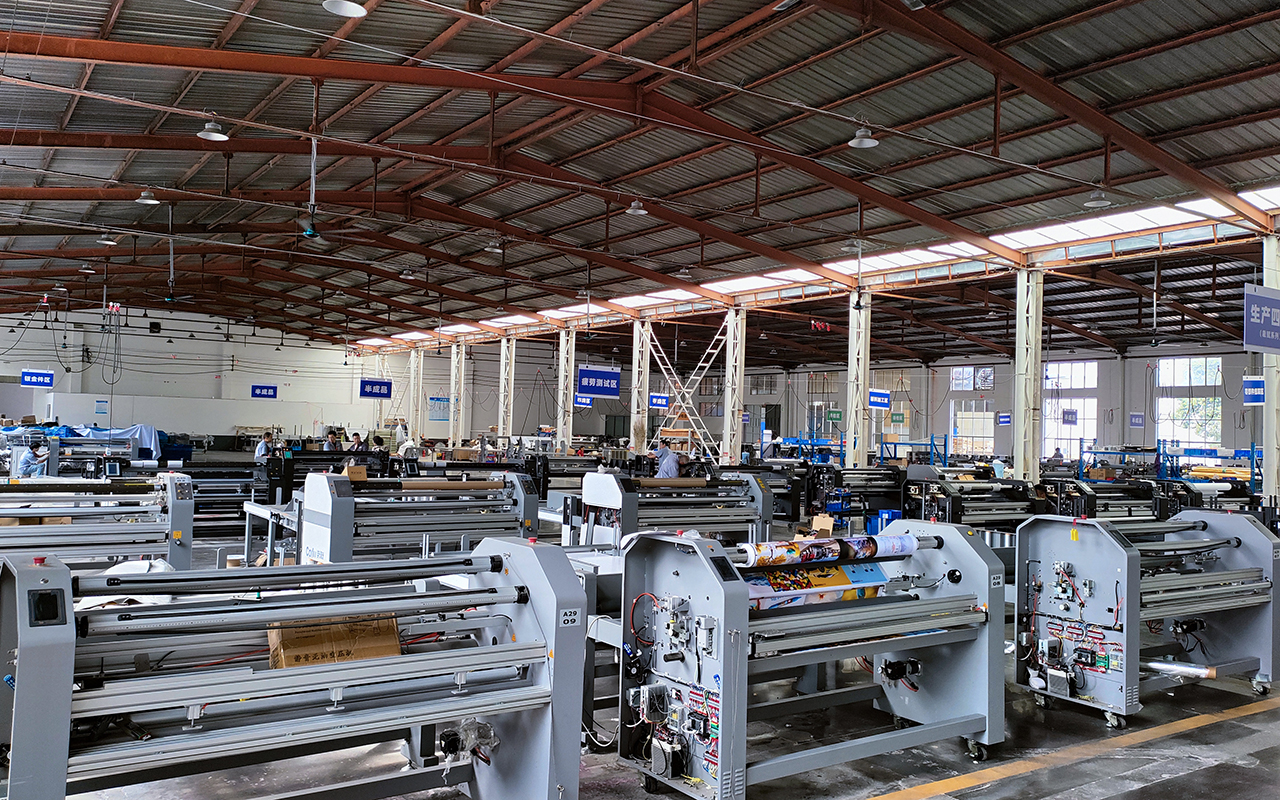
MEFU (Henan MEFU Industrial Limited) is a Chinese manufacturer of roll-to-roll laminators, flatbed laminators, flatbed applicators and XY cutting machines, founded in 2008, operating a 10,000 m² factory with a 10-engineer R&D team and an annual output of 6,000 units. MEFU equipment is used in the advertising and digital printing industry, and the company reports exports to more than 110 countries, with main markets including the EU, USA, Japan and Russia.
What the MF1700-F2 changes in the production line
The MF1700-F2 is a double-sided roll laminator configured for the advertising and digital printing industry. Its published specifications determine what it can and cannot do on a signage line:
- Max lamination width: 1,630 mm / 2,280 mm
- Max lamination thickness: 28 mm / 1.1 inch
- Max speed: 20 m/min
- Heating: dual heated; max temperature 120 °C
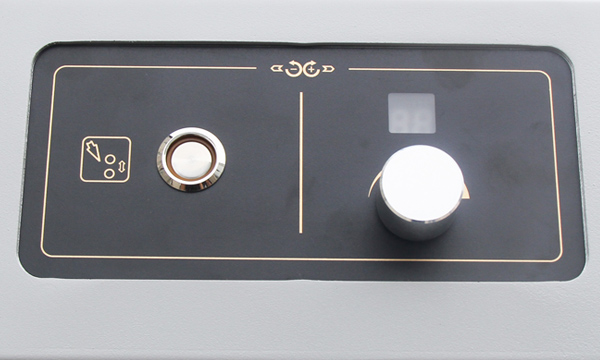
- Control panel: front and rear
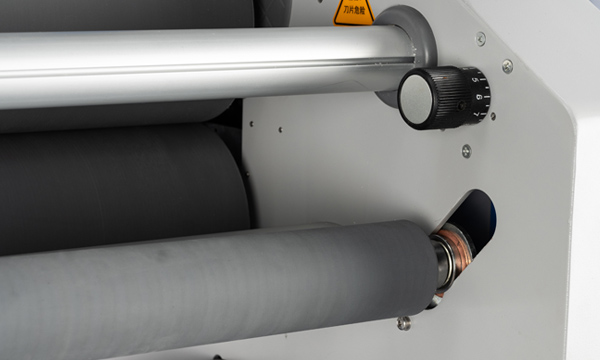
- Roller up and down: pneumatic
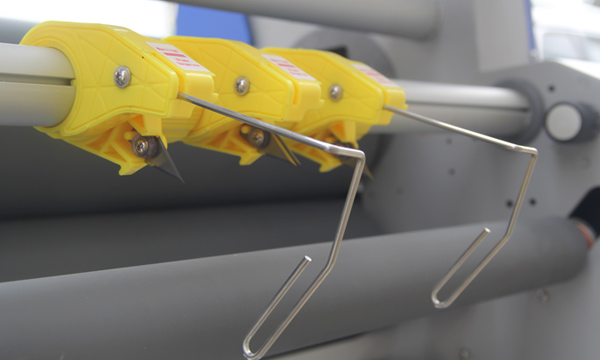
- Trimmer holder: 2 single blades and 1 double central blade
- Power input: 5,200 W
- Net weight: 260 kg
- Construction: integrated sheet metal frame; silicone rollers; aluminium alloy heating plate; infrared quartz heating element; tungsten steel cutting blades
Three of these specifications drive throughput directly. The dual heated configuration applies both faces of the media in a single pass, so there is no second run and no second handling of the roll. The 5,200 W power input is consistent with that dual heating arrangement and with the 120 °C maximum temperature, which matters on thicker laminating stacks where heat transfer is slower. The front and rear control panels remove the walk-around problem entirely: the operator can load, run, adjust and stop from whichever side of the frame the work is actually happening on.
Pneumatic roller lifting and the 20 m/min maximum speed support the same goal from the setup side. Faster, repeatable roller engagement reduces the time between rolls, which is where short-run and mixed-order shops lose most of their finishing capacity.
Where the inline trimmer changes the workflow
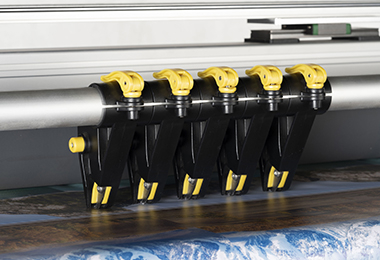
Inline edge trimming is what converts the laminator from a lamination station into a finishing station. The MF1700-F2 carries a trimmer holder with two single blades and one double central blade, and its blade material is tungsten steel. Because the machine handles material thickness up to 28 mm (1.1 inch), the trimmer operates on the same substrate range as the lamination itself.
The MF1700-C3 industrial roll laminator uses the same trimmer holder configuration: two single blades and one double central blade, also in tungsten steel. The C3 is specified at 1,630 mm / 64 inch maximum lamination width, 28 mm / 1.1 inch maximum thickness, 20 m/min maximum speed, top heated with a maximum temperature of 60 °C or 120 °C, pneumatic roller up and down, 1,600 W or 2,600 W power input, and a net weight of 180 kg. For industrial roll lamination projects where edge trimming must happen immediately after lamination on thicker substrates, this is the practical configuration to compare against the dual-sided F2.
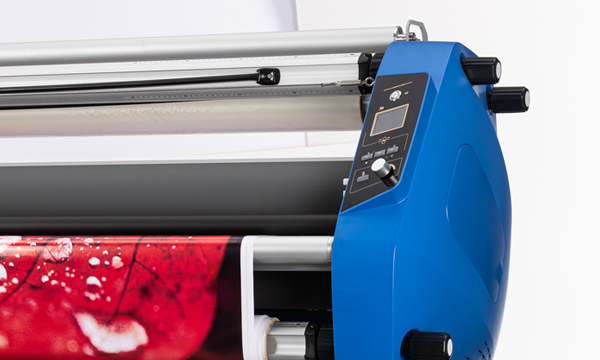
The workflow benefit is a queue that never forms. When trimming happens on the laminator, the roll does not travel to a second station, does not wait for a cutting operator, and does not get handled again before the edge is finished. That is the structural difference between laminating and finishing as two steps and laminating and finishing as one pass.
When inline trimming is not enough
Inline edge trimming handles straight-line edge finishing. Jobs that need two-axis cutting, roll-end cutting, or format cutting still need a dedicated cutting stage, and MEFU builds three options for that position in the line.
The MF1700-XY is an XY roll cutting machine specified with a cutting width up to 1,620 mm, cutting speed of 0–12 m/min, precision accuracy of ±0.5 mm, a 90 mm silicone roller feeding system, pneumatic up and down lifting, double self-sharpening circular blades on the X axis, five tungsten steel blades on the Y axis, auto-stop sensor and safety protection, a maximum roll diameter of 300 mm, and 2,000 W power consumption. It is applied to precision cutting of vinyl, canvas, KT board and DTF film, removing manual bottlenecks and producing clean edges for banners, labels and displays.
The MF1700-XA is a roll-to-roll cutting machine with a maximum width of 1,620 mm, maximum thickness of 10 mm, maximum speed of 1 m/s, mechanical panel, air-driven system, two tungsten steel blades, two-way cutting, foot pedal, roll holder, LED illumination, alignment and emergency button. The MF1700-XM manual cutter covers cut widths of 1,600 mm / 62 inch and 2,600 mm / 102 inch with a maximum thickness of 12 mm on an aluminium alloy working table.
Step-by-Step: Configuring a Laminate-and-Trim Workflow
The following sequence describes how a signage or digital printing operation typically configures a dual-sided lamination and inline trimming workflow, from substrate check to verified output.
- Match the substrate to the machine envelope. Confirm that width and thickness fall inside the machine capability. The MF1700-F2 covers widths of 1,630 mm / 2,280 mm and thickness up to 28 mm (1.1 inch); the MF1700-C3 covers 1,630 mm / 64 inch and the same 28 mm / 1.1 inch thickness.
- Choose the heating configuration for the job. Dual heated machines such as the MF1700-F2 apply both faces in one pass at up to 120 °C. Top heated machines such as the MF1700-C3 offer 60 °C or 120 °C, which suits projects where the second face does not require heated lamination.
- Load the rolls and set pressure. The pneumatic roller up and down on both models provides repeatable engagement pressure, which is the basis for consistent adhesion and fewer bubbles on heavier media.
- Run lamination as a single pass. With the dual heated MF1700-F2, both faces are laminated in the same pass. No re-feeding is required, which removes the second handling cycle and the associated contamination risk.
- Engage the inline trimmer. The trimmer holder on both the MF1700-F2 and MF1700-C3 holds two single blades and one double central blade in tungsten steel, allowing the edge to be trimmed immediately after lamination on substrates up to 28 mm.
- Escalate to a dedicated cutting stage only when required. For two-axis precision work, the MF1700-XY delivers ±0.5 mm accuracy at 0–12 m/min with five tungsten steel Y-axis blades and double self-sharpening circular X-axis blades.
- Verify output and rewind. Check edge quality, register and rewind tension before the roll leaves the station. Because lamination and trimming happen in one pass, defects are visible and correctable within the same cycle rather than after transport to a second station.
Use Cases: Where a Dual-Sided Laminator with Inline Trimming Fits
1. High-volume outdoor advertising roll production
Large-format roll media finishing covers the lamination of vinyl, PP paper and PVC film for billboards, posters, vehicle stickers and outdoor advertising materials. The function in this application is to enhance durability, UV resistance and visual effects. These jobs run in high-efficiency, continuous large-format production environments and operate in 24/7 mode, which makes single-pass dual-sided lamination and immediate edge trimming the difference between a shift that keeps up and a shift that ends with laminated rolls still waiting to be trimmed.
2. Short-run and custom digital print finishing
In digital printing and custom signage, the work arrives in short runs and mixed orders. Here the roll laminator provides one-stop laminating for digital prints, offering surface protection and gloss or matte finishing for custom orders under conditions of instant finishing and short-run, customized production. The front and rear control panels matter more in this scenario than in long-run work, because the operator changes position between jobs and re-setting from the wrong side of the machine is pure lost time.
3. Continuous industrial finishing lines
A UK authorized distributor of large-format finishing equipment deployed 10 units for high-speed roll-to-roll production. Over a five-year period, the result is described as enabling 24/7 industrial production, with industrial precision cited as the determining factor. This is the scenario in which a 5,200 W dual heated machine with a 120 °C ceiling and inline trimming earns its place in the line: the finishing stage has to survive the same calendar as the printer.
4. Label and flexible packaging edge finishing
Where the requirement shifts from lamination to edge quality, the application changes to high-precision trimming. The role of the cutting stage in this scenario is to accurately trim flexible packaging materials and self-adhesive labels, ensuring neat edges and high compatibility with PVC and vinyl. The MF1700-XY is specified for exactly this position, with ±0.5 mm precision accuracy and a pneumatic lifting system that handles rolls up to 300 mm in diameter.
5. Mixed finishing portfolios in European digital print shops
A digital finishing specialist in Italy operates more than 15 units across a five-year period with stable operation, describing the focus as precise and targeted finishing solutions. For buyers building a mixed portfolio of roll and sheet finishing, this pattern is worth noting: a small number of well-specified machines, each covering a defined role in the line, tends to outperform a larger number of general-purpose units.
Comparison Table: Dual-Sided Lamination and Cutting Options
The table below compares the MEFU models most relevant to a laminate-and-trim workflow. All values are published machine specifications.
| Model | Type | Control panel | Max width | Max thickness | Max speed | Heating / max temp | Trimmer holder | Power input |
|---|---|---|---|---|---|---|---|---|
| MF1700-F2 | Double sided roll laminator | Front and rear | 1,630 mm / 2,280 mm | 28 mm / 1.1 in | 20 m/min | Dual heated / 120 °C | 2 single + 1 double central blade | 5,200 W |
| MF1700-C3 | Industrial roll laminator | Front and rear | 1,630 mm / 64 in | 28 mm / 1.1 in | 20 m/min | Top heated / 60 °C or 120 °C | 2 single + 1 double central blade | 1,600 W or 2,600 W |
| MF1700-F1 PLUS | High speed roll laminator | Front and rear | 1,630 mm / 64 in | 28 mm / 1.1 in | 50 m/min | Top heated / 60 °C | 2 single + 1 double central blade | 2,000 W |
| MF1700-XY | XY roll cutting machine | — | Up to 1,620 mm | Max roll diameter 300 mm | 0–12 m/min | — | X: double self-sharpening circular blades; Y: 5 tungsten steel blades | 2,000 W |
| MF1700-XA | Roll to roll cutting machine | Mechanical panel | 1,620 mm / 63 in | 10 mm / 0.3 in | 1 m/s | — | 2 tungsten steel blades, two-way cutting | Air driving system |
Read the table by task, not by size. The MF1700-F2 is the dual-sided option for one-pass lamination of both faces with inline trimming. The MF1700-C3 is the industrial roll laminator for projects where top-heated lamination and the same inline trimmer configuration are sufficient. The MF1700-F1 PLUS prioritises line speed at 50 m/min. The MF1700-XY and MF1700-XA are dedicated cutting stages for format and two-axis work rather than edge trimming.
Frequently Asked Questions
What compliance requirements apply to a roll laminator installed in the EU?
Laminating machines must comply with EN 60204-1 (Safety of machinery – Electrical equipment of machines) for CE marking in the EU, according to D.L.S. Electronic Systems. In practice, compliance is verified at machine level rather than at product-category level, so buyers should confirm the electrical configuration and the accompanying documentation for the destination market before ordering. MEFU supports voltage and marking customization as part of its OEM configuration options, which allows the electrical configuration to be matched to the installation market rather than adapted after delivery.
Can a dual-sided roll laminator trim edges inline, or is a separate cutter always needed?
Inline trimming is built into the laminator itself. The MEFU MF1700-F2 double sided roll laminator carries a trimmer holder with two single blades and one double central blade, and its blade material is tungsten steel. The MF1700-C3 industrial roll laminator uses the same two-single plus one-double central blade arrangement. Because both machines accept material thickness up to 28 mm (1.1 inch), edges can be trimmed immediately after lamination on thicker substrates without moving the roll to another station. A separate cutting stage is only required when the job needs two-axis shape cutting — for example the MF1700-XY, which cuts at ±0.5 mm precision across a width up to 1,620 mm.
What drives the cost and payback of a dual-sided lamination and trimming setup?
Four configuration variables drive the commercial profile. Power and heating configuration is the first: a dual heated machine such as the MF1700-F2 is specified at 5,200 W with a 120 °C ceiling, while a top heated industrial model such as the MF1700-C3 is specified at 1,600 W or 2,600 W with 60 °C or 120 °C. Width capability is the second: 1,630 mm versus 2,280 mm on the F2. The third is whether inline trimming is included on the laminator or handled by a separate cutting stage. The fourth is labour and cycle time — front and rear control panels plus 20 m/min maximum speed and pneumatic roller lifting reduce handling time between rolls. On running cost, thermal laminating machines are expected to hold a 47.0% market share by 2025, a position attributed to lower operating costs and strong adhesion (Future Market Insights). Quotations are issued per configuration rather than from a list price.
Can I validate lamination and trimming on my own media before ordering?
MEFU supports this through a low entry threshold and configurable build: minimum order quantity is 1 unit, production mode is OEM, and customization covers size, colour, voltage and marking. Quality control is 100% test, and after-sales support is provided remotely, which means media and process questions can be worked through without a service visit. Sending actual signage stock — vinyl, PP paper, PVC film or a thicker laminating stack — is the most reliable way to confirm that the trimmer and the lamination settings behave as expected on your material. To arrange a media validation or request a configuration quote, contact the team at info@mefu.cn or message +86 15890020566 on WhatsApp.
What is the lead time, and how is supply continuity handled?
MEFU quotes a 14-day lead time with a monthly capacity of 500 units, and 100% test quality control before shipment. The company reports an export ratio of 40%, products exported to more than 110 countries, and main markets including the EU, USA, Japan and Russia, with remote after-sales support. For distributors and production buyers planning a multi-unit rollout, that combination of stated monthly capacity and a 14-day lead time is the relevant planning input rather than a single-unit delivery date. Full specifications and configuration options are available in the MEFU product catalogue.
Conclusion: One Pass, Two Finishing Steps
Signage throughput improves when lamination and edge trimming stop competing for the same roll. A dual-sided roll laminator applies both faces in a single pass, and a laminator-mounted trimmer finishes the edge before the roll is handled again. The MF1700-F2 combines these in one machine with a 5,200 W power input, dual heated rollers up to 120 °C, front and rear control panels, pneumatic roller lifting, 20 m/min maximum speed, and a trimmer holder with two single blades and one double central blade in tungsten steel. The MF1700-C3 applies the same inline trimmer configuration in an industrial roll laminator specified at 1,630 mm / 64 inch, 28 mm / 1.1 inch thickness and 20 m/min.
Where the job ends in a straight edge, this is the configuration that keeps the finishing stage inside the same cycle as the print. Where the job ends in a shape or a format cut, the MF1700-XY adds two-axis precision at ±0.5 mm on top of the same workflow.
Next step: sample, quote or catalogue
MEFU builds roll-to-roll laminators, flatbed laminators, flatbed applicators and XY cutting machines for the advertising and digital printing industry, with OEM production, a 1-unit minimum order quantity, 100% test quality control and a 14-day lead time.
Request a configuration quote, discuss a media validation run, or download the full catalogue: MEFU product brochure.
Email: info@mefu.cn | WhatsApp / Tel: +86 15890020566 | Website: www.mefulaminator.com