
Roll Laminator Safety and Operational Standards: Navigating Temperature Limits and Control Systems
Date: 2026-10-12 Categories: Industry News Hits: 367
Roll Laminator Safety and Operational Standards: Navigating Temperature Limits and Control Systems
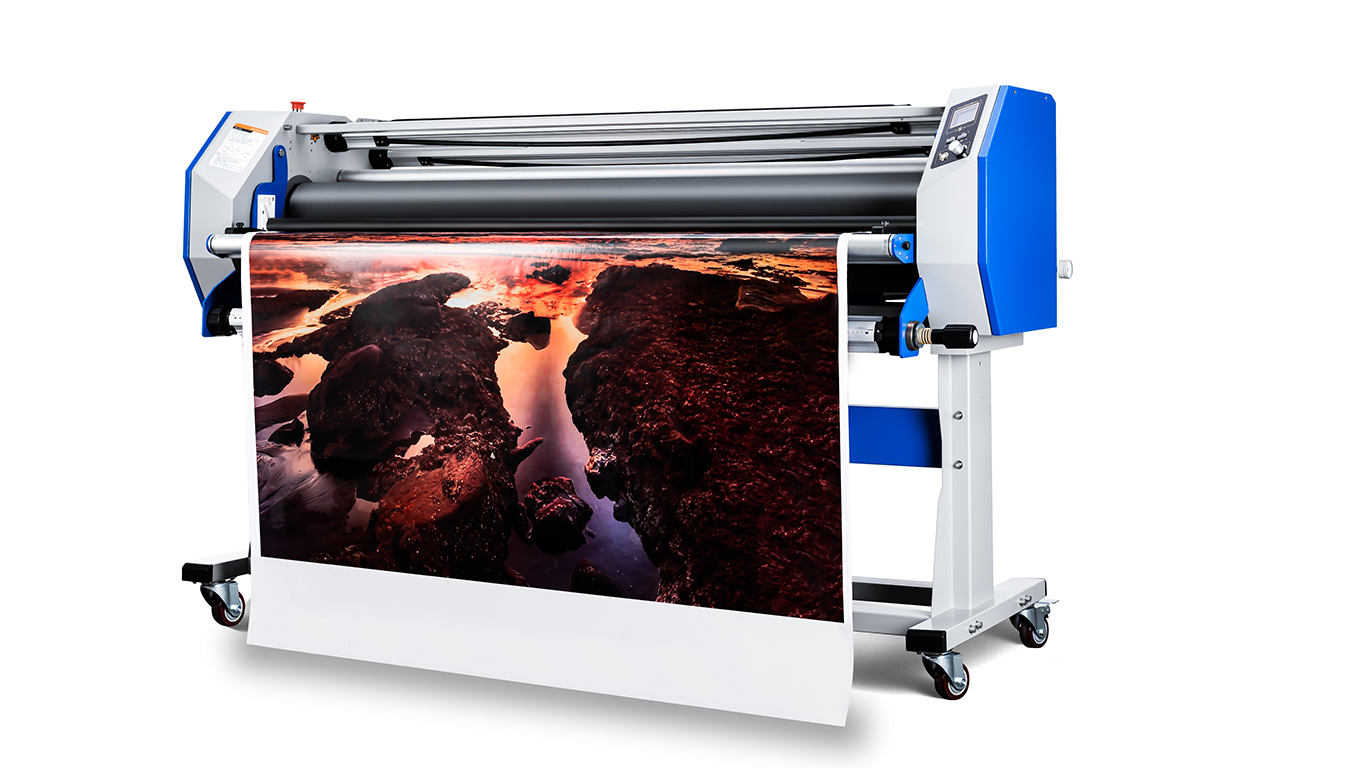
MEFU MF1700-A1 PRO large format laminator — integrated sheet metal frame, pneumatic roller movement, and a 60°C / 120°C temperature ceiling.
Introduction
Every roll laminator is built around two hard limits that decide whether a finished print leaves the machine clean or ruined: the maximum temperature the machine is allowed to reach, and the way its rollers move while material is being loaded. On a wide format laminator, temperature governance is not a preference — it is a specification. Machines capped at 60°C and machines engineered for a 120°C ceiling exist for different media, different adhesives, and different safety margins. Treating either one differently from how it was designed is where most lamination failures begin.
This guide covers the operational side of roll laminator safety rather than the paperwork side. It explains how temperature limits should be understood in daily production, how an integrated sheet metal frame and a pneumatic upper-roller system reduce operator risk during material loading, and how to set up a repeatable workflow on large format and industrial roll laminators.
Problem Definition: The Two Failure Points in Roll Lamination
Lamination defects and near-miss incidents almost always trace back to one of two causes.
The first is temperature. When a laminator runs hotter than the media or the adhesive film can tolerate, the results are visible and expensive: blistered surfaces, adhesive bleed, distorted vinyl, and the haze commonly described as silvering. When a machine runs too cool, the opposite failure appears — weak adhesion, edge lifting, and delamination weeks later in the field. Neither outcome can be corrected downstream. The temperature at which a sheet passes through the rollers is written into the finished product and into the customer relationship.
The second is mechanical. Thousands of cycles of roller movement, web tension, and material loading create predictable risk points. An operator feeding a heavy roll into a 64-inch machine is working close to moving rollers under pressure. If the upper roller drops unexpectedly, or if the frame flexes under load, the safety margin shrinks instantly. That is why roller-actuation method and frame construction belong in the same conversation as temperature setpoints.
The response to both problems is the same engineering logic: define the limits, build the machine around them, and never operate outside them.
Industry Background: Why Temperature and Safety Standards Are Now a Buying Criterion
The global roll laminator market was valued at USD 1.82 billion in 2024 and is projected to reach approximately USD 2.89 billion by 2033, according to Dataintelo. Separately, Intel Market Research projects the global laminating machines market to expand at a CAGR of 5.07% from 2026 to 2034, reaching USD 1.07 billion by the end of that period. Both figures point to sustained demand rather than a one-off spike.
Within that market, thermal laminating machines are expected to dominate with a 47.0% share by 2025, a position attributed by Future Market Insights to lower operating costs and strong adhesion. That detail matters operationally: as more production shifts toward thermal lamination, temperature control stops being a niche engineering topic and becomes a mainstream operator concern.
Regulatory context reinforces the same direction. Laminating machines must comply with EN 60204-1, the standard covering the safety of machinery with respect to electrical equipment, for CE marking in the European Union. Compliance with this standard is not about marketing claims — it concerns the electrical architecture of the machine and how that architecture protects the people using it.
At the same time, machine widths have pushed toward 1630mm (64 inches), and heating architectures have diversified into top-heated, dual-heated, and non-heated configurations. The wider and faster the machine, the more a single temperature or actuation mistake costs. That is why safety parameters deserve to be evaluated before speed or width on any specification sheet.
Detailed Solution: How Temperature Limits and Safety Systems Define Safe Operation
Temperature Governance: Why 60°C and 120°C Are the Two Reference Ceilings
MEFU roll laminators are built around two operating temperature bands. Some models are rated to a single 60°C ceiling; others are rated to a dual 60°C or 120°C ceiling. The distinction is not cosmetic. A 60°C ceiling belongs to heat-assist and hot-cold platforms where the media or adhesive is heat-sensitive and the objective is to soften rather than to bake. A 120°C ceiling belongs to machines designed for stronger thermal adhesion, including dual-heated and industrial-class platforms.
The MF1700-M1 PLUS heat assist laminator is rated to a maximum of 60°C. The MF1700-F1 hot cold roll laminator, the MF1700-M1 LITE roll to roll laminating machine, and the MF1700-M1 PRO wide format laminator are also rated to 60°C. At the other end, the MF1700-C3 industrial roll laminator, the MF1700-M5 pneumatic roll laminator, and the MF1700-A1 PRO large format laminator carry a dual 60°C or 120°C rating, while the MF1700-F2 double sided roll laminator is dual heated with a maximum of 120°C.
The operational rule is straightforward: the rated ceiling is the maximum, not a target. Setting a machine above its rated ceiling is the single most common cause of material damage, and it also pushes the heating elements, the aluminum alloy heating plate, and the silicone rollers beyond the conditions they were designed around.
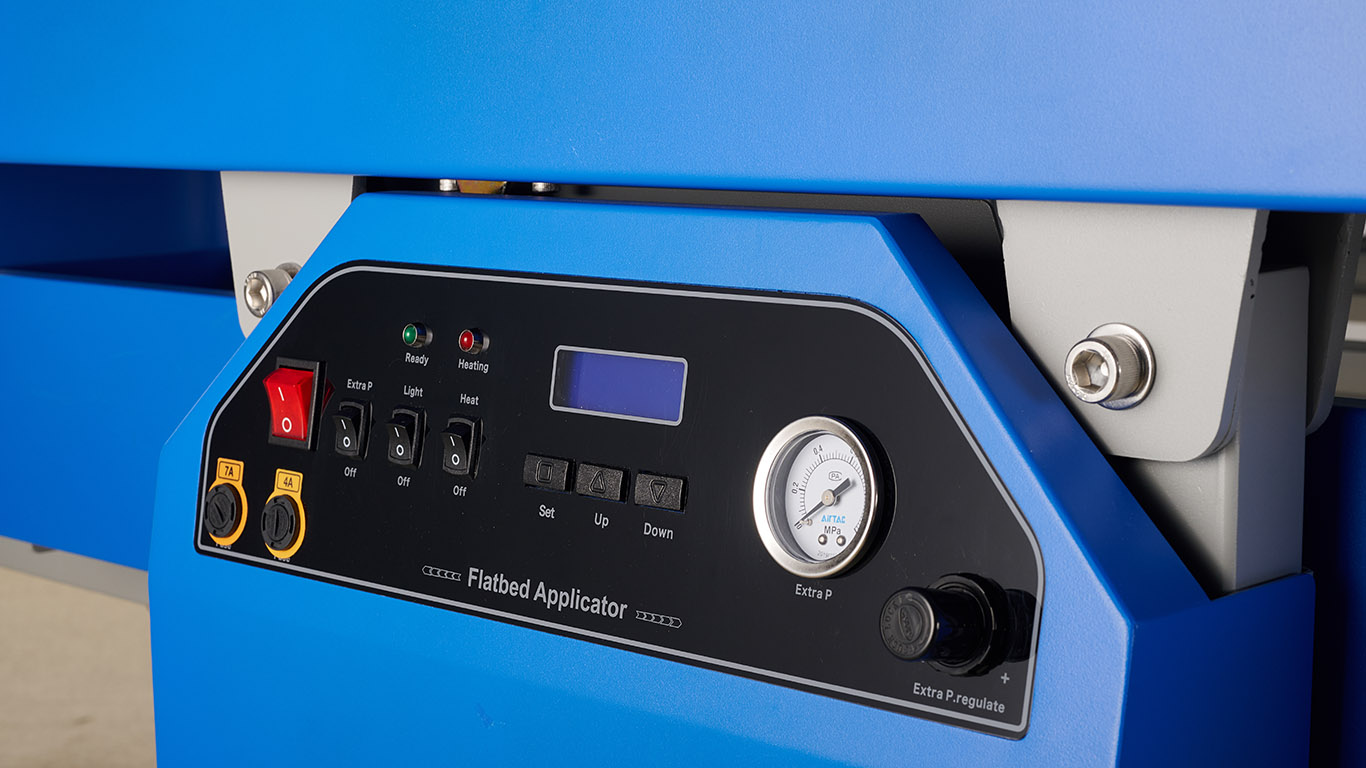
Infrared quartz heating element paired with an aluminum alloy heating plate — the heat source that makes strict temperature governance possible.
Frame Stability: Why Integrated Sheet Metal Construction Matters
Across the MEFU range — from the MF1700-B5 vinyl roll laminator to the MF1950-B2 flatbed mounting laminator — the frame is constructed from integrated sheet metal. This is a stability decision, not a styling one. On a machine that carries a 1630mm (64-inch) working width and can handle material up to 28mm (1.1 inches) thick, the frame has to resist flex under continuous load. An integrated sheet metal structure keeps the rollers parallel and holds the geometry steady whether the machine is running a single poster or a 24/7 production queue.
Frame stability also feeds directly into safety. A frame that flexes under load changes the roller gap, which changes the pressure at the nip point, which changes both the quality of the output and the predictability of the machine's behavior. Stable geometry is what allows an operator to trust the setpoints they entered.
Pneumatic Roller Movement: The Primary Operator-Safety Mechanism
On MEFU pneumatic roll laminators, the vertical (up and down) movement of the rollers is controlled by a pneumatic system rather than by manual effort. This is the core safety mechanism during material loading. The upper roller is raised and lowered under controlled air pressure, so the operator positions and threads the material while the rollers are held clear, then brings the rollers down without forcing them by hand. The hands never need to be inside the nip point.
The same principle is applied across the flatbed platforms. The MF1950-B2 flatbed mounting laminator and the MF1350-B2 flatbed applicator both use pneumatic up-and-down movement and both include an emergency button. The Premium MF-B4 table laminator and the Standard MF-B4 flatbed vinyl applicator are also pneumatically actuated and additionally use safety glass as the table surface with LED illumination for clear visibility of the working area.
It is worth noting the contrast inside the range. The MF1700-M5 pneumatic roll laminator uses a hand crank for vertical movement, as does the MF1700-M1 hot cold roll laminator. Both remain valid machines for their intended workloads, but the actuation method changes the loading procedure the operator must follow. Buyers comparing machines should treat roller actuation as a safety specification, not a convenience feature.
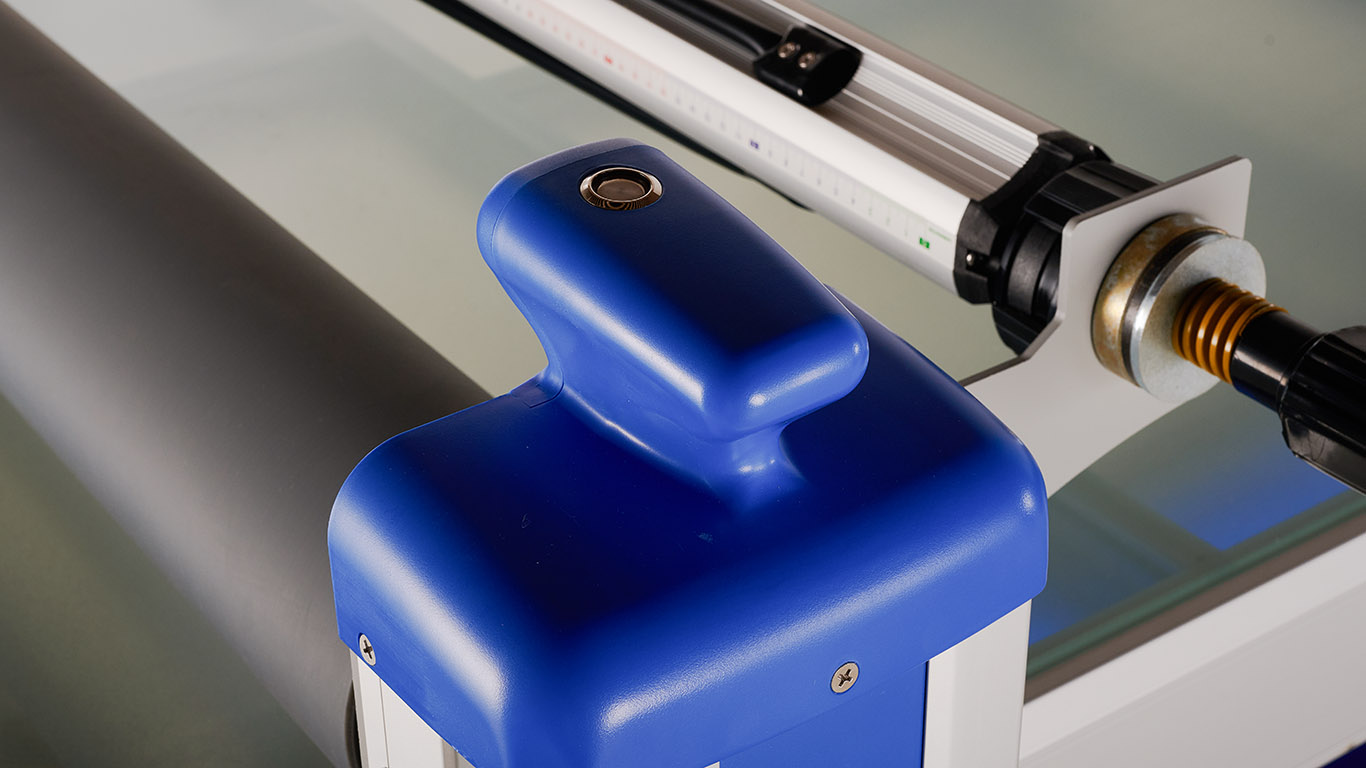
Pneumatic lifting system — upper roller movement is powered by air pressure so the operator's hands stay clear of the nip point during loading.
Control Architecture: Front and Rear Panels and Accessible Setpoints
Control layout is a safety topic as much as a productivity topic. MEFU roll laminators use a control method that includes a front and rear control panel, and models such as the MF1700-C3, MF1700-F1, MF1700-F2, MF1700-M5, and MF1700-A1 PRO list front and rear control panels in their standard configuration. Dual-panel control means the operator can start, stop, and adjust the machine from the side of the machine that is safest for the current task — the loading side, the take-off side, or a position that keeps them away from the roller path.
On the MF1700-M1, the control interface is presented through an LCD panel and a rear control panel, both of which are part of the machine's standard configuration. Clear, readable setpoints reduce the chance of a temperature or speed being entered incorrectly, which in turn reduces the chance of running material outside its tolerance.
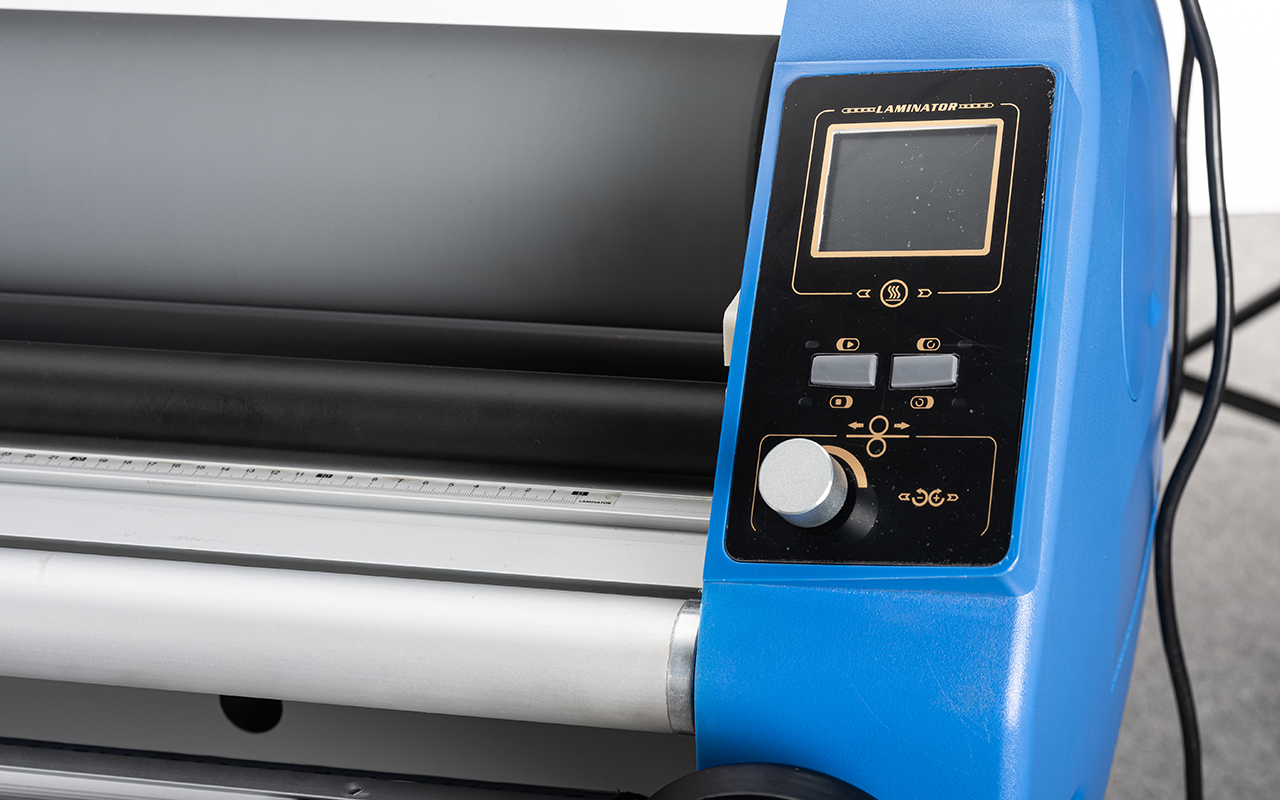
LCD control panel — readable setpoints reduce the risk of running material outside its temperature tolerance.
Step-by-Step Breakdown: Setting Up a Roll Laminator for Safe Operation
The following sequence reflects how MEFU roll laminators are designed to be operated. It assumes an operator who has read the machine documentation and is working with media whose thermal tolerance is known.
- Identify the media and adhesive first. Before touching the machine, establish the thermal limit of the film and the substrate. This single step determines everything that follows.
- Match the machine ceiling to the task. Confirm whether the machine is rated to 60°C only or to 60°C / 120°C. Do not plan a process around a temperature the machine was not built to hold.
- Pre-set the temperature and confirm it. Enter the setpoint through the front or rear control panel and allow the heating plate to reach it before feeding material. The aluminum alloy heating plate and infrared quartz heating element need to be at temperature, not merely commanded to it.
- Raise the rollers before loading. Use the pneumatic system to lift the upper roller. On pneumatically actuated models this is done without manual force; on hand-crank models the crank is used at this stage.
- Thread the material with the rollers clear. Position the web and align the edges while the rollers are up and no pressure is applied at the nip point.
- Lower the rollers using the pneumatic system. Bring the rollers down under controlled air pressure. Do not force a pneumatic roller into position by hand.
- Run at a speed matched to the material. MEFU roll laminators span a wide speed range — 6 m/min on the MF1700-B5 PRO heavy duty roll laminator through to 50 m/min on the MF1700-F1 and MF1700-F1 PLUS. Speed should be selected for the media, not for the fastest number on the sheet.
- Verify the first output before running the batch. Check adhesion, surface clarity, and edge quality on the first sheet. If temperature or speed needs adjustment, stop the run, adjust, and re-verify rather than correcting on the fly.
- Use the emergency stop if anything is unexpected. MEFU flatbed platforms such as the MF1950-B2 and MF1350-B2 include a dedicated emergency button for exactly this purpose.
Use Cases: Where Temperature and Safety Standards Matter Most
Graphic Design and High-End Photo Finishing
In this application, MEFU equipment operates under precision cold/heat lamination conditions and in 24/7 mode. The role of the machine is to laminate photo prints, digital posters, and artworks — preventing fading, maintaining color fastness, and providing high-clarity surface protection. Because the output is judged on visual quality, temperature drift shows up immediately as haze or color shift. This is the environment where a strict 60°C ceiling on heat-assist platforms protects the product.
Signage and Exhibition Display
Signage and exhibition display work involves rigid board finishing and surface mounting projects, including acrylic, PVC, foam board, and ACP. Temperature management matters here because the substrates are often thickness-critical, and MEFU flatbed platforms are rated to handle material up to 50mm thick. Pneumatic roller movement is the safety mechanism that allows a large rigid sheet to be positioned on the table without the operator reaching into a pressurised nip.
Digital Printing and Custom Signage
Digital printing and custom signage production often requires roll-to-roll lamination with short turnaround and frequent material changes. Each material change is a temperature decision. A machine with dual 60°C / 120°C capability gives the operator the range to handle both heat-sensitive and thermally demanding jobs, provided the ceiling is respected in both directions.
Flexible Packaging and Label Manufacturing
Label finishing and packaging prototype cutting demand accurate trimming of flexible packaging materials and self-adhesive labels, with clean edges and high compatibility with PVC and vinyl. In these workflows the laminator and the cutting equipment work as a pair, and both depend on stable, predictable machine behaviour.
Interior Design and Industrial Surface Finishing
Decorative panel enhancement covers decorative panels, wooden boards, metal sheets, and ceramic tiles, with the goal of improving surface aesthetics, scratch resistance, and service life. Because the substrates are rigid and often heavy, frame stability and pneumatic actuation are the two features that keep the process both safe and repeatable.
Comparison Table: Temperature Limits and Safety Architecture Across the MEFU Range
The table below compares temperature ceilings, roller actuation method, and build materials across representative MEFU roll laminator and flatbed models. All values are drawn from published model specifications.
| Model | Category | Max Lamination Width | Max Temperature | Roller Actuation | Frame / Roller Material |
|---|---|---|---|---|---|
| MF1700-F2 | Double Sided Roll Laminator | 1630mm / 2280mm | 120°C (dual heated) | Pneumatic | Integrated sheet metal / silicone |
| MF1700-C3 | Industrial Roll Laminator | 1630mm / 64" | 60°C or 120°C | Pneumatic | Integrated sheet metal / silicone |
| MF1700-A1 PRO | Large Format Laminator | 1630mm / 64" | 60°C or 120°C | Pneumatic | Integrated sheet metal / silicone |
| MF1700-F1 | Hot Cold Roll Laminator | 1630mm / 64" | 60°C | Pneumatic | Integrated sheet metal / silicone |
| MF1700-F1 PLUS | High Speed Roll Laminator | 1630mm / 64" | 60°C | Pneumatic | Integrated sheet metal / silicone |
| MF1700-M1 PRO | Wide Format Laminator | 1630mm / 64" | 60°C | Pneumatic | Integrated sheet metal / silicone |
| MF1700-M1 PLUS | Heat Assist Laminator | 1630mm / 64" | 60°C | Pneumatic | Integrated sheet metal / silicone |
| MF1700-M1 LITE | Roll to Roll Laminating Machine | 1630mm / 64" | 60°C | Pneumatic | Integrated sheet metal / silicone |
| MF1700-M5 | Pneumatic Roll Laminator | 1630mm / 64" | 60°C or 120°C | Hand crank | Integrated sheet metal / silicone |
| MF1700-B5 PRO | Heavy Duty Roll Laminator | 1630mm / 64" | None (cold) | Pneumatic | Integrated sheet metal / silicone |
| MF1950-B2 | Flatbed Mounting Laminator | 1830mm | 100°C | Pneumatic | Integrated sheet metal / silicone |
| MF1350-B2 | Flatbed Applicator | 1270mm | 100°C | Pneumatic | Integrated sheet metal / silicone |
| Premium MF-B4 | Table Laminator | 1325 / 1630 / 1632 | 60°C | Pneumatic | Integrated sheet metal / silicone, safety glass table |
Two patterns are visible in the data. First, every model in the range uses the same frame and roller materials — integrated sheet metal and silicone — so structural stability is a baseline rather than an upgrade. Second, temperature ceilings and actuation methods vary by category: 60°C platforms dominate the heat-assist and hot-cold categories, 120°C capability appears on dual-heated and industrial models, and pneumatic actuation is the standard safety mechanism across the range.
FAQ
1. What temperature limit should be used on a roll laminator — 60°C or 120°C?
The correct limit depends on the machine's rated ceiling and the media being processed. MEFU roll laminator models operate with either a single 60°C ceiling — including the MF1700-F1, MF1700-M1 PLUS, MF1700-M1 LITE, and MF1700-M1 PRO — or a dual 60°C / 120°C ceiling, including the MF1700-C3, MF1700-M5, and MF1700-A1 PRO. The MF1700-F2 double sided roll laminator is dual heated with a maximum of 120°C. Operating above a machine's rated ceiling is the most common cause of material damage, so the rated limit should always be treated as a maximum rather than a target.
2. How does the pneumatic up/down system reduce operator injury risk?
On MEFU pneumatic roll laminators, the vertical (up and down) movement of the rollers is controlled by a pneumatic system rather than by manual force. The upper roller is raised and lowered under controlled air pressure, which keeps the operator's hands clear of the nip point during material loading. The same principle applies to the flatbed platforms: the MF1950-B2 flatbed mounting laminator and the MF1350-B2 flatbed applicator both use pneumatic roller movement and include an emergency button, while the Premium MF-B4 and Standard MF-B4 use pneumatic actuation with a safety glass table and LED illumination. Control is also provided through front and rear control panels, so the operator can work from the safer side of the machine.
3. What determines the cost of a roll laminator?
Cost is driven by the combination of build materials, heating architecture, working width, and automation level. Every MEFU roll laminator shares an integrated sheet metal frame, silicone rollers, and an aluminum alloy heating plate, so the differences sit in the specification details: heating configuration (top heated or dual heated, infrared quartz element), roller actuation (pneumatic or hand crank), width up to 1630mm (64 inches), maximum material thickness up to 28mm (1.1 inches), and speed range from 6 m/min on the MF1700-B5 PRO to 50 m/min on the MF1700-F1. Buyers comparing quotes should compare these specifications line by line rather than comparing headline price alone.
4. Can a roll laminator be validated before a full order?
Yes. Buyers evaluating a roll laminator can request specification documentation and arrange sample validation before committing to production-scale orders. MEFU publishes a downloadable product brochure covering its laminating and cutting ranges, and the technical team can be reached directly at info@mefu.cn or on Tel / WhatsApp at +86 15890020566 to discuss model configuration and sample testing.
5. What should buyers plan for when running a roll laminator in continuous production?
Continuous production places more demand on machine stability than on peak speed. MEFU roll laminators are engineered for precision cold/heat lamination conditions and 24/7 operating modes, and the company's application data lists 24/7 operation across graphic design and high-end photo finishing, signage and exhibition display, and digital printing and custom signage. MEFU products are exported to more than 110 countries worldwide, with major markets including the EU, USA, Japan, and Russia, supported by a global distribution and service network. Buyers planning a long production cycle can request current model availability and configuration guidance through the contact channel above.
Conclusion
Roll laminator safety is decided by two things an operator can see and control: the temperature ceiling the machine is rated to, and the way its rollers move when material is loaded. A 60°C platform and a 120°C-capable platform are not interchangeable — they exist for different media and different adhesion requirements, and the rated ceiling is the boundary of correct operation, not a starting point. Around that boundary, an integrated sheet metal frame keeps the geometry stable, and a pneumatic up/down system keeps the operator's hands out of the nip point.
Henan MEFU Industrial Limited manufactures roll to roll laminators, flatbed laminators, flatbed applicators, and XY cutters, with a 10,000㎡ manufacturing facility, an R&D team of 10 engineers, and products exported to more than 110 countries. Its range covers machines with 60°C ceilings for heat-assist work, dual 60°C / 120°C platforms for mixed production, and non-heated pneumatic models for cold workflows — with the same frame and roller materials across the range.
Planning a safer lamination workflow?
Tell us your media, your production mode, and the temperature band your process requires, and MEFU will recommend the right roll laminator or flatbed platform for the job. Request model specifications, discuss a sample test, or download the full product brochure.
Email: info@mefu.cn | Tel / WhatsApp: +86 15890020566 | Website: www.mefulaminator.com
Product brochure: Download the MEFU laminating and cutting solutions brochure (PDF)
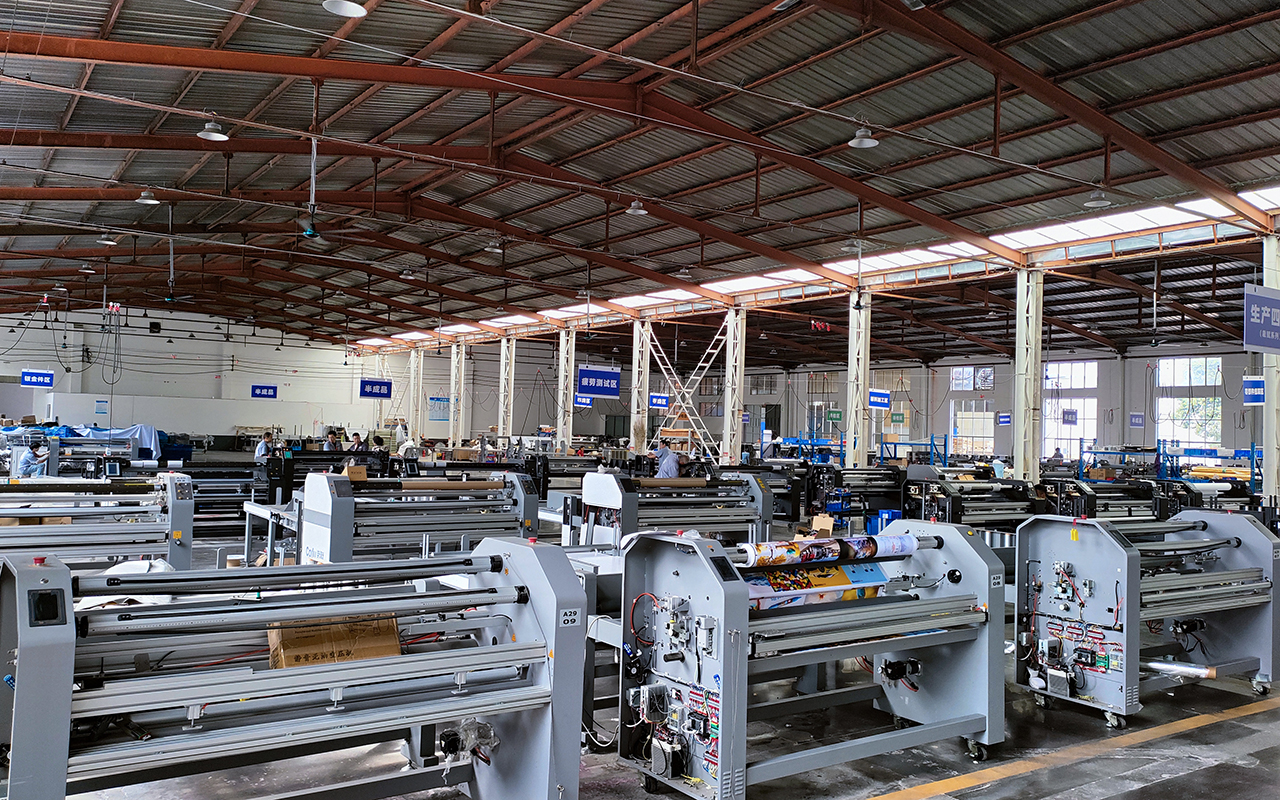
MEFU manufacturing workshop — roll laminators, flatbed laminators, flatbed applicators, and XY cutters built in a 10,000㎡ facility.