
Bubbles, Silvering, or Wrinkles? A Roll Laminator Troubleshooting Guide for Wide-Format Print Shops
Date: 2026-10-07 Categories: Industry News Hits: 108
Bubbles, Silvering, or Wrinkles? A Roll Laminator Troubleshooting Guide for Wide-Format Print Shops
Two hours into a vehicle-wrap panel, the film lifts along one edge. A run of roll-up banners comes off the rollers with a milky haze that no amount of re-rolling removes. A rigid sign exits the nip with a crease running 400 mm in from the left. In a wide-format print shop these are rarely three different problems with three different machines. They are usually four controllable variables telling you which one has moved.
On a wide-format roll laminator, most bubbles, silvering, wrinkles and edge lift trace back to the same short list: nip pressure, surface temperature, roller condition and web speed. Diagnosing them in that order — pressure first, temperature second, rollers third, speed last — resolves the majority of shop-floor faults before anyone reaches for a new roll of film.
This guide walks through a symptom-to-cause sequence built around two reference machines from MEFU’s roll-to-roll range, the MF1700-C3 and the MF1700-F2, and closes with the preventive habits and platform limits every production manager should know before accepting a job. MEFU (Henan MEFU Industrial Limited) is a finishing-equipment manufacturer based in Zhengzhou, China, producing roll-to-roll laminators, flatbed laminators, flatbed applicators and XY cutters for wide-format and small-format print businesses.
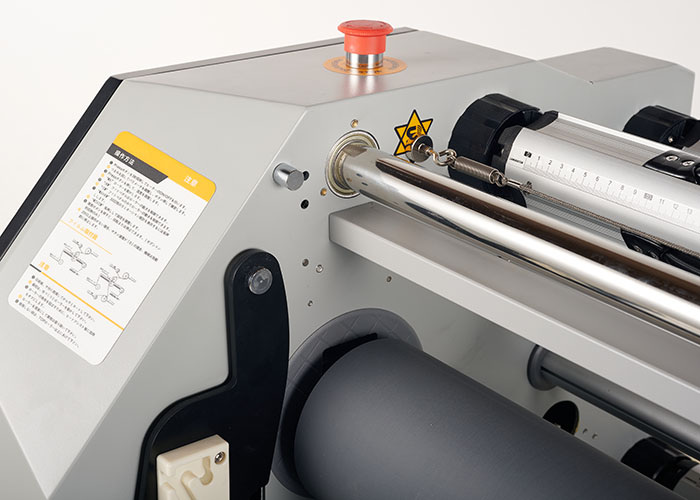
What Bubbles, Silvering, and Wrinkles Are Actually Telling You
Each fault points at a different part of the nip. Reading them correctly is the difference between a five-minute adjustment and an afternoon of rework.
- Bubbles — pockets of air trapped between the adhesive and the print surface. They cluster where nip pressure drops below what the substrate needs, which is why they usually appear in a band rather than at random.
- Silvering — a milky, metallic haze under the laminate. It is not a film defect. It appears when the adhesive does not fully wet out against the printed surface, so light scatters at the adhesive layer instead of passing through it.
- Wrinkles — a tension or tracking fault. The film reaches the nip faster, slower, or at a slightly different angle than the substrate, so the excess material has to go somewhere.
- Edge lift — the laminate climbing off at the border, usually because edge pressure has fallen off or the substrate edge is unsupported.
One practical rule before touching any dial: run a short test strip from the same roll and the same media. Faults that reproduce on the test strip are machine or setting related. Faults that disappear were media, moisture or handling related — and adjusting the machine to chase them simply moves the problem to the next job.
Why Wide-Format Shops Meet These Faults More Often Than Narrow-Format Shops
Demand for laminated wide-format output keeps expanding. The global roll laminator market was valued at USD 1.82 billion in 2024 and is projected to reach approximately USD 2.89 billion by 2033, according to Dataintelo. Intel Market Research projects the global laminating machines market to expand at a CAGR of 5.07% from 2026 to 2034, reaching USD 1.07 billion by the end of that period. Within that market, thermal laminating machines are expected to hold a 47.0% share by 2025, based on Future Market Insights data citing lower operating costs and strong adhesion.
Growth in the category does not make the physics easier. Wide-format lamination differs from narrow-format work in three ways that all increase fault sensitivity. The web is much wider, so any pressure or heat variation across the width becomes visible. Substrates range from thin vinyl to thick rigid boards, so one setting rarely fits two jobs. And runs are short and mixed, which means the machine is re-set many times a day rather than left alone on a single job.
That combination — wide, varied and frequently re-set — is exactly the environment in which pressure, temperature, roller condition and speed drift out of alignment with each other.
The Diagnostic Sequence: Four Variables, Checked in Order
Work through these in order. Changing temperature before you have verified pressure is the most common reason a fault comes back two hours later.
Step 1 — Bubbles: Verify Nip Pressure Before You Touch the Heat
In MEFU’s risk classification for laminating operations, bubbles are treated as a pressure-control issue rather than a temperature issue. The two systems that address it are the pneumatic lifting system and the condition of the silicone rollers.
On the MF1700-C3 and MF1700-F2, roller up/down movement is pneumatic rather than manual. Air pressure raises and lowers the rollers, which produces repeatable, even nip force across the full working width instead of the screw-and-spring arrangement used on lighter machines, where pressure tends to drift as the machine warms up or as an operator tightens a crank by feel. When bubbles appear in a band across the sheet, the first question is whether the pneumatic pressure setting matches the substrate — not whether the film is defective.
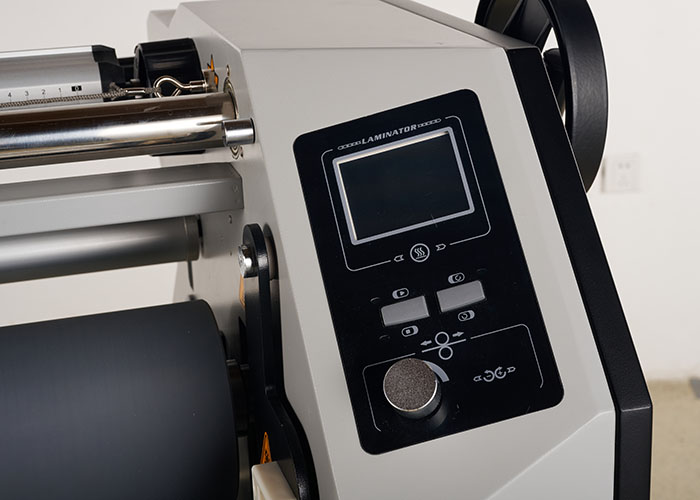
Pressure alone is not the whole picture. A roller that is glazed, nicked or hardened cannot transfer even pressure no matter what the gauge reads, which is why roller inspection sits inside the pressure step rather than at the end of the routine.
Step 2 — Silvering: Check Heat Distribution and Heating Plate Contact
Silvering comes from the adhesive not wetting out fully. Two causes dominate: heat that is too low to let the adhesive flow, and heat that is unevenly distributed across the width.
The reference machines use top-heated infrared quartz as the heat source. In practice, operators work in two bands. Heat-assist cold lamination needs only enough warmth to relax the adhesive and help displace trapped air — around 60°C. Thermal film work needs the adhesive activated, which pushes the setting toward the top of the range, up to 120°C. Running heat-assist work at thermal temperatures, or thermal film at heat-assist temperatures, produces silvering in both directions: too little heat leaves the adhesive unflowed, and too much heat distorts the film and drives moisture into visible haze.
The second half of the silvering check is mechanical. The aluminum alloy heating plate has to sit in full contact with the roller path. If the plate is not making complete contact, one side of the sheet runs cooler than the other and silvering appears on that side only. A fault that is consistently left-heavy or right-heavy is a contact or levelling question, not a temperature-number question. Temperature sensors provide thermal protection so that a contact problem does not become an overheating problem while you are diagnosing it.
Step 3 — Wrinkles and Edge Lift: Roller Condition and Web Tension
Wrinkles are almost always tension and tracking. Before changing any setting, check that the film is loaded squarely, that the roll is not coned, and that the substrate is feeding without a bow. Then inspect the rollers themselves: the reference machines run premium silicone rollers with a 130 mm diameter, and the larger diameter is part of what keeps the web stable at production speed. A 130 mm roller has more contact area at the nip than a small-diameter roller, which spreads the load and reduces the chance that a small tension irregularity becomes a visible crease.
Edge lift usually shares a cause with wrinkles. If the edges of the roller are worn or contaminated, edge pressure drops and the laminate lifts at the border even though the centre of the sheet looks perfect. Clean the rollers, inspect the edges for damage, and confirm the substrate is centred rather than running to one side of the working width.
Step 4 — Speed: Respect the 20 m/min Ceiling
Speed interacts with all three faults because it controls dwell time in the nip. The reference machines have a top speed of 20 m/min. Pushing past that ceiling does not produce more output; it produces less contact time, which shows up as bubbles that return, silvering that reappears, or wrinkles that start at the unwind and run the length of the sheet.
Speed control on these machines is deliberate rather than incidental. Abnormal speed is a classified risk in MEFU’s control framework, addressed through a laser sensor, a reset emergency button, and active speed buttons positioned at both the front and the rear of the machine so an operator never has to walk around the machine to correct a feed problem mid-run.
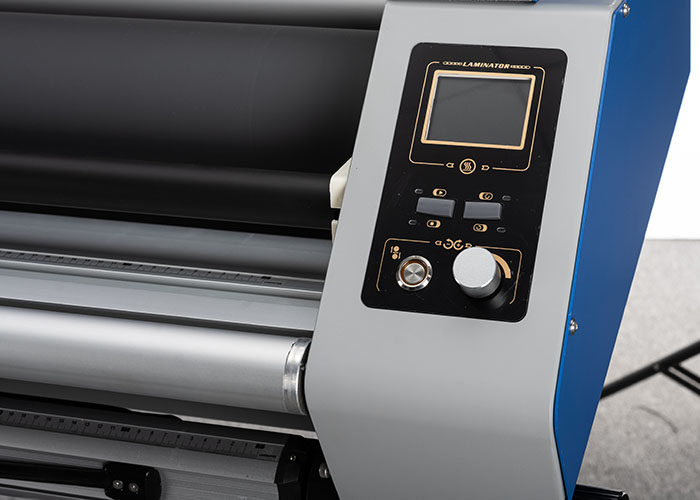
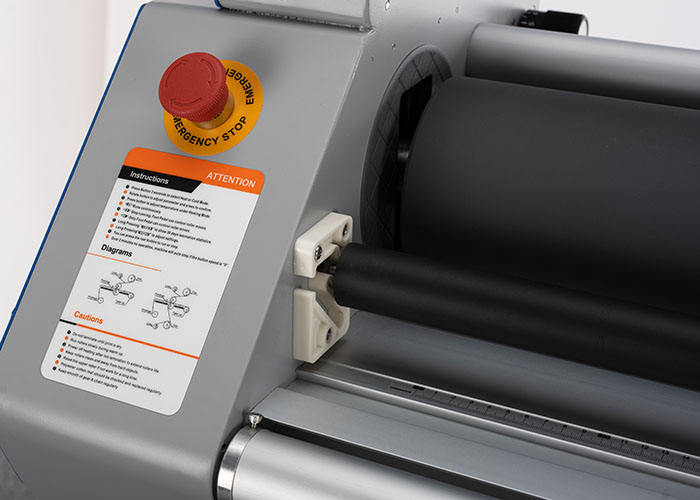
If operators are consistently running at the ceiling, the honest answer is usually that the job mix has outgrown a single-pass routine — not that the machine needs to run faster than its rating.
Step 5 — When the Job, Not the Machine, Is the Problem
Before spending an hour re-tuning, confirm the job fits the platform. The reference machines work to a maximum width of 1630 mm and a maximum material thickness of 28 mm. A job that exceeds either limit will show symptoms that look exactly like machine faults — edge lift on a substrate too wide for even pressure, or wrinkles on a board too thick to pass cleanly through the nip. No pressure, temperature or speed adjustment fixes a job that is outside the machine’s working envelope.
A 20-Minute Diagnostic Routine for the Shop Floor
- Stop and mark the sheet (0–1 min). Note where the fault starts and stops. A repeating pattern points to a roller; a random pattern points to pressure or heat; a one-sided pattern points to levelling or plate contact.
- Confirm the job envelope (1–2 min). Check width against 1630 mm and thickness against 28 mm. If the job exceeds either, stop and re-plan it.
- Run a test strip (2–6 min). Same film, same media, same settings. Isolate whether the fault is machine-side or material-side.
- Check pressure (6–9 min). Confirm the pneumatic lifting system is set for the substrate at hand and that the pressure reading is stable while the rollers are engaged.
- Check temperature (9–12 min). Verify the infrared quartz setting matches the film type — heat-assist work around 60°C, thermal work toward 120°C. Confirm the temperature sensors read consistently during the run, not just at start-up.
- Check the heating plate (12–14 min). Look for full contact along the aluminum alloy plate. A left/right fault split usually ends here.
- Check the rollers (14–16 min). Inspect the silicone surface for glazing, nicks and edge wear. The 130 mm diameter rollers should run clean and even across the width.
- Check speed (16–18 min). Confirm you are below the 20 m/min ceiling for the media in front of you, and use the front or rear active speed buttons so corrections happen without stopping the run.
- Log the result (18–20 min). Record substrate, film, temperature band, pressure setting and speed. After a few weeks this log becomes the fastest diagnostic tool in the shop.
Preventive Maintenance That Keeps the Machine in Production
Troubleshooting recovers a job. Maintenance prevents the fault from costing you the job in the first place — and on a machine expected to run for years, maintenance is also what protects uptime and cost per square metre.
Trimmer holder blades
Machines fitted with inline trimming carry a trimmer holder that uses two single blades plus one double central tungsten steel blade. Tungsten steel holds an edge well, but it does not hold an edge forever. A dull trimmer shows up as ragged edges, drag marks, or trimmed waste that will not separate cleanly — symptoms operators often misread as lamination faults. Check the two single blades and the central double blade as part of a scheduled inspection and replace them as a set; replacing one blade at a time produces uneven cutting pressure across the trim.
Silicone rollers
Clean the rollers on a schedule rather than when a fault appears. Glaze and adhesive build-up are the leading cause of pressure faults that survive a setting change.
Pneumatic system and cylinders
The pneumatic lifting system on the reference machines uses industrial cylinders designed to run without routine lubrication maintenance, which removes a common source of inconsistency on manual machines. Check for air leaks and confirm that pressure holds steady when the rollers are down.
Thermal protection and self-diagnostics
Temperature sensors exist to catch overheating before it damages film; verify that readings stay consistent between runs, because a slow drift is far easier to catch on a log sheet than on a finished print. Machines with digital self-diagnostics report faults before they become visible on the substrate, so treat diagnostic output as a maintenance trigger rather than background noise.
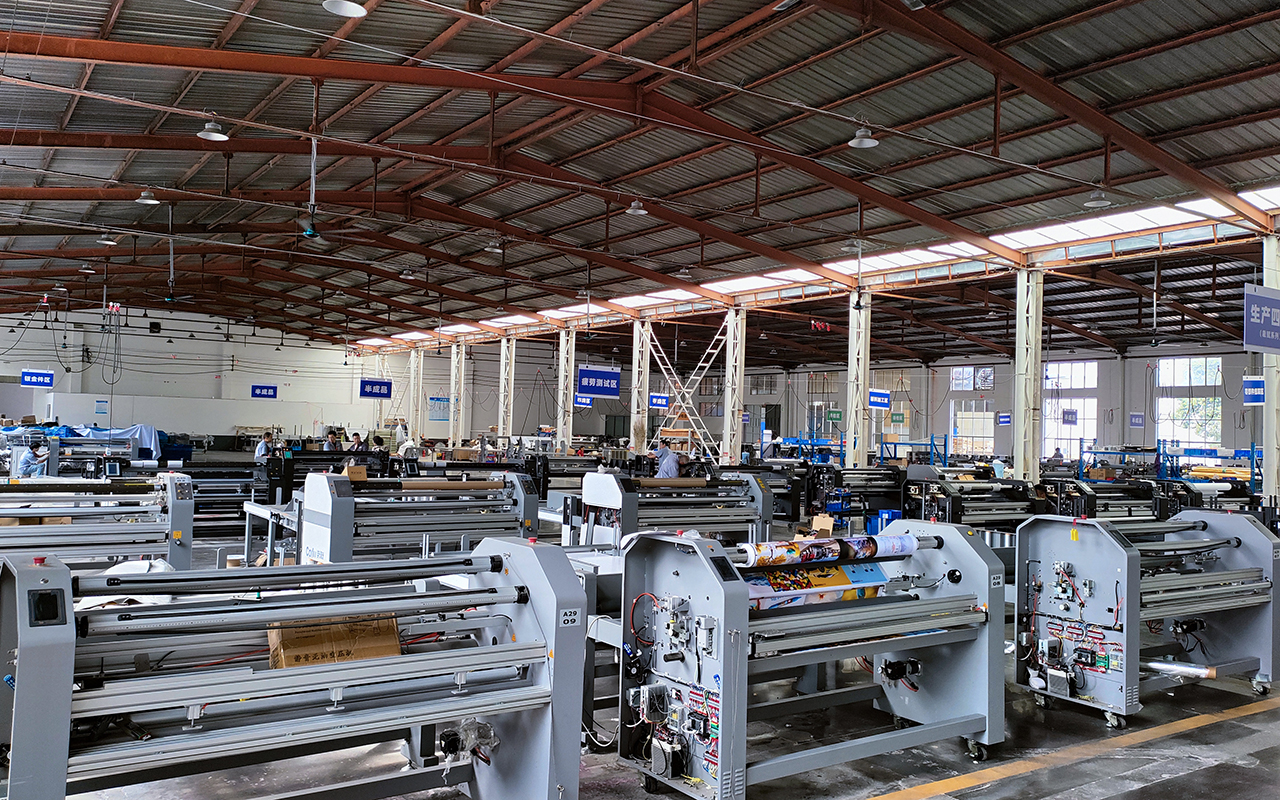
The payoff of this discipline shows up over years, not weeks. In MEFU’s European installations, projects completed over a five-year duration have been reported as running with stable operation, and customer feedback from those projects points to a successful long-term partnership. Equivalent durations also appear across UK, US and Russian installations, ranging from five years to ten years. MEFU’s monthly production capacity of 500 units is the manufacturing side of the same idea: a machine that is adjusted by habit and maintained by schedule is a large part of why those field numbers look the way they do.
Where These Symptoms Show Up: Three Shop Scenarios
Vehicle wrap and vinyl graphics
Vinyl workloads are pressure-sensitive. Bubbles and edge lift dominate, temperature usually sits in the lower heat-assist range, and speed stays well under the 20 m/min ceiling because the media is unforgiving. Most faults trace back to roller condition and pressure rather than heat.
Rigid signage and mounting
When the shop mounts prints onto rigid boards, thickness becomes the limiting variable. Jobs near the 28 mm platform limit demand careful pressure and a slow feed; jobs beyond it need a different process entirely rather than a different setting.
High-volume roll-to-roll display graphics
Long runs of display work push speed and thermal stability. Here silvering and slow pressure drift are the risks, and the case for pneumatic pressure control and a large-diameter roller is at its strongest: consistent nip force across a wide web is what keeps scrap rate down when the machine runs continuously.
Comparison Table: Symptom, Controlled Variable, and Design Response
| Symptom | Primary controlled variable | Control approach |
|---|---|---|
| Bubbles | Nip pressure | Premium silicone rollers plus pneumatic lifting system |
| Silvering | Heat distribution and wet-out | Top-heated infrared quartz with temperature sensors for thermal protection |
| Wrinkles / tracking | Web tension and roller condition | 130 mm premium silicone rollers; pneumatic roller engagement |
| Edge lift | Edge pressure and alignment | Pneumatic lifting system; square loading across the working width |
| Abnormal speed | Dwell time in the nip | Laser sensor, reset emergency button, active speed buttons front and rear |
Comparison Table: Industrial-Class vs Standard Electric or Manual Laminators
| Comparison basis | Standard electric / manual laminator | MEFU industrial roll laminator |
|---|---|---|
| Pressure control | Manual or electric roller control | Precise pneumatic pressure system |
| Roller specification | Standard rollers | Premium 130 mm diameter silicone rollers |
| Scrap rate | Baseline | Scrap rate reduced by 90% |
| Efficiency | Baseline | 50% higher efficiency |
| Labor cost | Baseline | 50% labor cost reduction with smart control system |
| Total cost of ownership | Baseline | 30% lower TCO; 10-month ROI |
| Maintenance | Manual adjustment and lubrication | Maintenance-free industrial cylinders; maintenance interval extended by 50%; digital self-diagnostics |
| Typical duty | Standardized digital workflow | 24/7 industrial production |
Frequently Asked Questions
MEFU holds ISO 9001:2015 certification and has been identified in third-party procurement analysis as a tier-2 market leader and innovator in heat-assist cold laminator technology. For European installations, laminating machines are generally expected to comply with EN 60204-1, the standard covering safety of machinery and electrical equipment of machines for CE marking. Buyers should confirm that the specific configuration they order is documented against the standards applicable in their market, and that documentation is reviewed as part of the specification stage rather than after delivery.
Yes, and the pressure side is what makes it possible. Pneumatic roller up/down control keeps nip force repeatable across the working width, and premium 130 mm diameter silicone rollers maintain web stability at speed. Measured against standard electric or manual laminators, MEFU’s industrial configuration is associated with a scrap rate reduction of up to 90%, 50% higher efficiency, and maintenance-free industrial cylinders — a combination suited to 24/7 industrial production. MEFU’s monthly production capacity of 500 units reflects a manufacturing operation built around that duty cycle.
Labor, scrap and maintenance. A smart control system is associated with a 50% labor cost reduction compared with manual cold or heat laminators. The precise pneumatic pressure system supports a 10-month ROI with 30% lower total cost of ownership, and combining a 130 mm silicone roller set with maintenance-free industrial cylinders extends the maintenance interval by 50%. Scrap reduction is often the largest single line item, because every re-run consumes film, ink and press time as well as operator hours.
Standard purchasing terms are MOQ 1 unit; delivery terms FOB, CIF, DDP or DDU; payment terms T/T; and acceptance criteria based on pre-shipment test. Buyers who want to validate a configuration before committing to a production order can request a sample or quotation through MEFU’s contact channels at info@mefu.cn or +86 15890020566, and the full specification is available in the downloadable product brochure.
MEFU products are exported to more than 110 countries, supported by online platforms, international exhibitions and authorized dealers. Long-term field data supports this: European projects completed over a five-year duration have been reported as running with stable operation, with customer feedback pointing to successful long-term partnerships, and comparable five-year and ten-year durations appear in UK, US and Russian installations. For operators, the practical value is that the diagnostic and maintenance routine in this guide keeps its meaning over years of service rather than months.
Conclusion
Bubbles, silvering, wrinkles and edge lift are not four separate problems. They are one machine telling you which of four variables has moved: pressure, temperature, roller condition, or speed. Check them in that order, confirm the job sits inside the 1630 mm width and 28 mm thickness envelope, and most faults resolve inside twenty minutes.
The habits that keep them resolved are unglamorous: clean rollers, a pneumatic system that holds pressure, an infrared quartz setting matched to the film, a speed that respects the 20 m/min ceiling, and a trimmer holder whose two single blades and one double central tungsten steel blade are replaced as a set. Shops that run this discipline for years are the ones whose machines still hold tolerance in year five.
Spec Sheet, Sample, or Quote?
MEFU supplies roll-to-roll laminators, flatbed laminators, flatbed applicators and XY cutters to print finishing businesses in more than 110 countries. If you are matching a machine to a specific media mix, start with the full specification.
Download the MEFU product brochure (PDF) · www.mefulaminator.com · info@mefu.cn · +86 15890020566 · NO.20 XUEYUAN ROAD, ERQI DISTRICT, ZHENGZHOU, HENAN, CHINA