
Infrared Quartz vs. Standard Heating: Roll Laminator Temperature Control
Date: 2026-09-27 Categories: Industry News Hits: 104
Infrared Quartz vs. Standard Heating: Roll Laminator Temperature Control
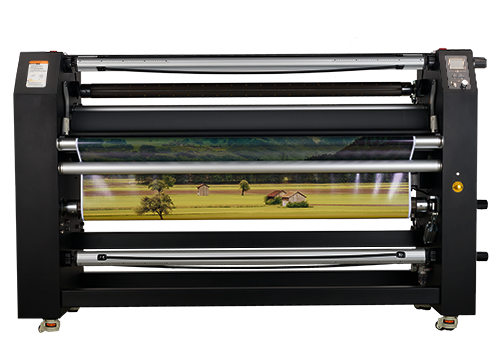
In roll lamination, the heating method is the first variable to isolate — not the film brand, not the operator. It decides whether a thermal adhesive activates fully and evenly across a 1630 mm web, and whether that result holds through a full production shift.
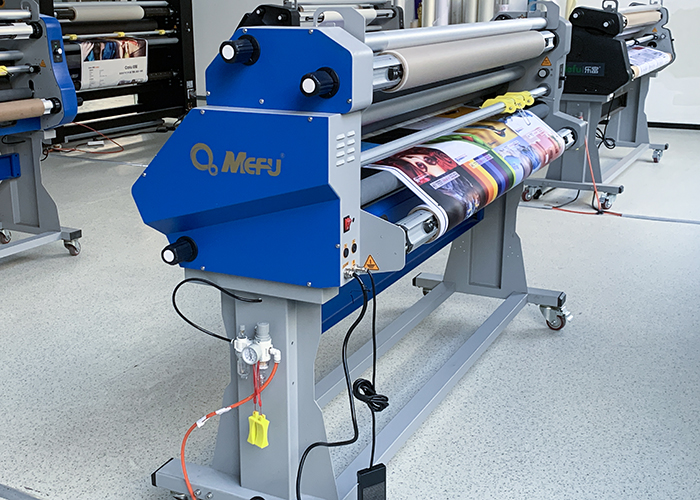
MEFU builds roll laminators around a top-heated infrared quartz element positioned behind an aluminum alloy heating plate, with published maximum temperature settings of 60°C or 120°C depending on model and configuration. Machines without a controlled top-heating stage — including several models in MEFU’s own range, where the heating field is listed as “None” — rely on roller pressure and the adhesive’s own chemistry instead.
The practical difference appears early in an evaluation, well before price enters the comparison. This guide explains what changes when infrared quartz heating is measured against standard heating approaches, how the aluminum alloy heating plate keeps heat distribution stable, and how to set, validate, and document temperature control so the same job repeats on a second machine or in a second shift.
Why Heating Method, Not Film Choice, Decides Adhesion Quality
Three defect patterns account for most reject material in thermal roll lamination, and all three are temperature-control symptoms rather than film problems.
- Incomplete adhesive activation — clouding, silvering, or edge lift where the film bonded only partially to the print.
- Thermal distortion — ripples, curl, or dimensional movement in the printed media.
- Run-to-run drift — early output in a shift passes inspection, and defects appear only after the machine has been running for a while.
Incomplete activation means the heat delivered at the nip sat below what the adhesive required. Distortion means the surface ran above what the media could tolerate. Drift means the heat source and the surrounding metal had not settled into equilibrium with the value shown on the control panel.
“Standard heating” in this guide therefore describes a category, not one single design: any configuration where heat is absent, delivered without a documented maximum, or applied through contact with a roller or plate whose construction is not specified. On models where MEFU lists the heating field as “None” — the MF1700-B5, MF1700-B5 PRO, and MF1600-B7 roll laminators, plus the Standard MF-B4 flatbed applicator — there is no temperature setting to correct. Remaining control variables are roller pressure, running speed, and adhesive selection. That is a legitimate configuration for cold processes and cold film, but it cannot be tuned to rescue an under-activated thermal adhesive, because the heat is simply not in the process.
The evaluation question is not “does this machine have heat?” It is: how is the heat generated, how is it distributed across the working width, and what ceiling is documented in writing?
How Demand for Controlled Heat Is Moving in the Roll Laminator Market
Market data supports treating heat as a specification rather than an accessory. Dataintelo valued the global roll laminator market at USD 1.82 billion in 2024 and projects approximately USD 2.89 billion by 2033. Intel Market Research puts the commercial laminators market at USD 1.49 billion in 2024 and projects a 5.07% CAGR for the laminating machines market from 2026 to 2034, reaching USD 1.07 billion by the end of that period. Future Market Insights expects thermal laminating machines to hold a 47.0% share by 2025, driven largely by lower operating costs and strong adhesion.
Cold systems have not disappeared alongside that growth — Neschen Coating introduced the ColdLam 1650 SW, a 1650 mm wide-format laminator designed for sustainable media applications, in 2024 — but they are positioned for specific media and process requirements rather than as a direct replacement for controlled heat inside thermal workflows. For buyers in the evaluation stage, the practical reading is straightforward: heat control remains the specification most directly linked to adhesion outcomes, which is why it belongs at the center of the purchase decision instead of on a features list.
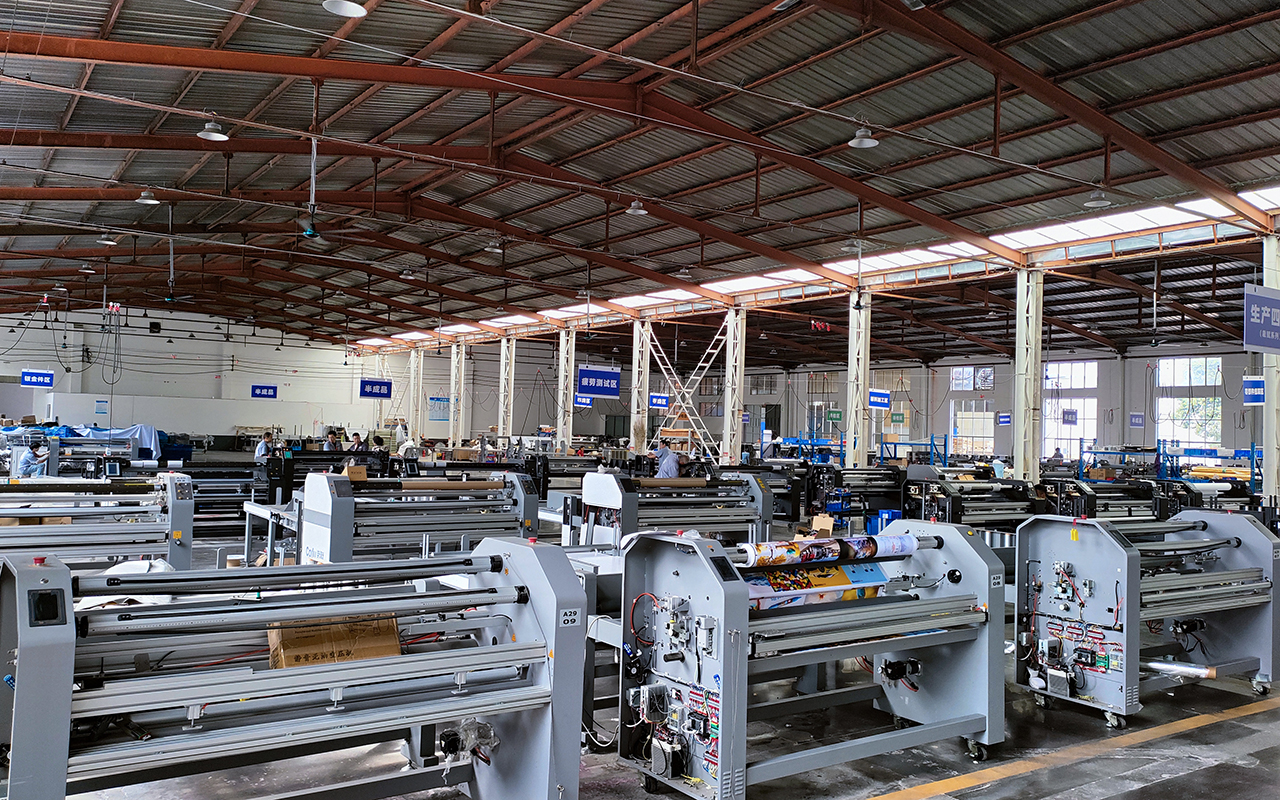
MEFU (HENAN MEFU INDUSTRIAL LIMITED) has manufactured in this category since 2008, operating a 10,000 m² facility with 100 employees, an annual output of 6,000 units, and a 10-engineer R&D team. Around 40% of production is exported, with the EU, USA, Japan, and Russia as principal markets, and products reach more than 110 countries through authorized dealers and online platforms. An industry procurement analysis describes MEFU as a tier-2 market leader and innovator of heat-assist cold laminator technology.
What Top-Heated Infrared Quartz With an Aluminum Alloy Heating Plate Actually Does
Four physical layers define a roll laminator’s thermal behavior, and all four appear in the published specifications of MEFU’s industrial range.
The emitter: infrared quartz
In MEFU’s top-heated models, the heating element type is specified as Infrared Quartz. Radiant infrared energy raises the temperature of the film-and-media stack immediately before it enters the roller nip, without the emitter touching the material. Because energy transfers by radiation rather than contact, the emitter can be mounted behind a distribution layer and does not introduce an additional mechanical contact point into the material path.
The spreader: aluminum alloy heating plate
Across the MEFU industrial series — from the 9 m/min MF1700-M1 up to the 50 m/min MF1700-F1 PLUS and the dual-heated MF1700-F2 — the heating plate material is specified as Aluminum Alloy. This is the component that turns “heat is present” into “heat is stable.” The plate receives energy from the quartz emitter and redistributes it across the full working width, buffering the localized intensity of individual emitter elements so the web passes beneath an even thermal band instead of a sequence of hot zones.
Aluminum alloy is a high-conductivity material: it reaches thermal equilibrium quickly and holds a consistent surface temperature across the plate. In a physical evaluation, this is one of the few heating components you can inspect directly. A thin plate and a solid machined alloy plate behave very differently when a 1630 mm (64”) web is drawn beneath them at production speed.
The mechanical layer: pneumatic pressure versus hand crank
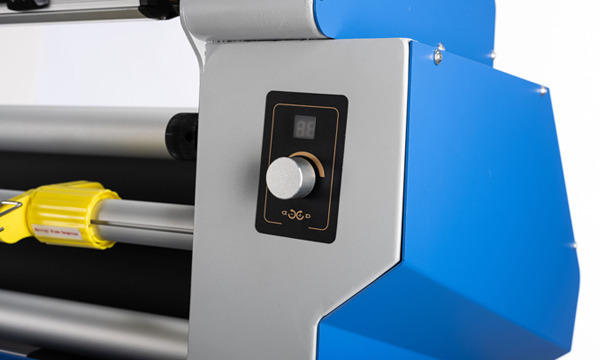
Heat only produces adhesion when it is paired with controlled pressure at the nip. Most MEFU roll models close pneumatically, but this point should be checked unit by unit on the datasheet rather than assumed from the model name. The MF1700-M1, a hot cold roll laminator rated to 60°C, uses a manual hand crank for up/down movement. The MF1700-M5, listed as a pneumatic roll laminator, also specifies a hand crank for vertical movement. Where repeatability across shifts matters most, pneumatic closure removes the operator from the pressure side of the equation.
Roller material is specified as silicone across the range, with a 120 mm roller diameter on the MF1700-M1. Silicone tolerates sustained heat without the hardening that lower-grade elastomers show, which matters when the same roller is expected to hold its geometry across years of thermal cycling.
The ceiling: 60°C or 120°C
MEFU documents maximum temperature as a fixed figure rather than a range: 60°C on the heat-assist and wide format classes, and a selectable 60°C or 120°C on the MF1700-A1 PRO, MF1700-M5, and MF1700-C3. The MF1700-F2 double sided roll laminator is dual heated with a 120°C maximum. That ceiling defines which adhesive systems and material combinations a machine can be trusted to process — it is a capability boundary, not a marketing number.
| Temperature class | Documented models | Heating configuration | Max temperature |
|---|---|---|---|
| No heated stage | MF1700-B5, MF1700-B5 PRO, MF1600-B7, Standard MF-B4 | None — cold process | Not applicable |
| 60°C top-heated | MF1700-M1, MF1700-M1 LITE, MF1700-M1 PLUS, MF1700-M1 PRO, MF1700-F1, MF1700-F1 PLUS | Top heated, infrared quartz element, aluminum alloy heating plate | 60°C |
| 60°C or 120°C selectable | MF1700-A1 PRO, MF1700-M5, MF1700-C3 | Top heated, infrared quartz element, aluminum alloy heating plate | 60°C or 120°C |
| Dual heated | MF1700-F2 | Dual heated, infrared quartz element, aluminum alloy heating plate | 120°C |
| Infrared flatbed | Premium MF-B4 | Infrared heating, aluminum alloy heating plate, safety glass table | 60°C |
| Infrared flatbed | MF1350-B2, MF1950-B2 | Infrared heating, aluminum alloy heating plate | 100°C |
The control layer: front and rear panels
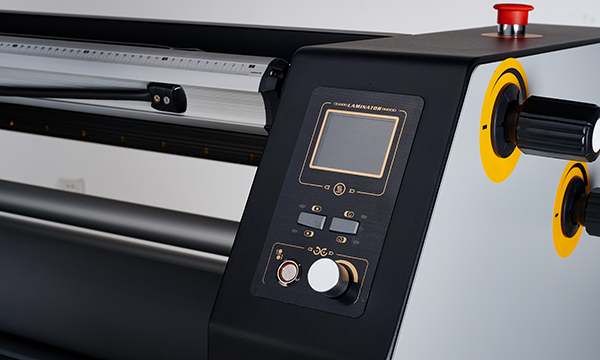
Across the MEFU industrial series, including the MF1700-M1 PRO, MF1700-A1 PRO, and MF1700-C3, the specification lists front and rear control panels. In production terms this is a temperature-control feature, not a convenience one: the operator can read and adjust settings from the output side during a run instead of walking around the machine, which shortens the correction loop when a material changeover produces early defects.
Step-by-Step: Setting and Validating Roll Laminator Temperature Control
A documented setting is what converts a single acceptable sample into a repeatable process. The sequence below follows the order in which the variables actually interact.
- Classify the media and film first. Confirm whether the film requires thermal activation at all. If it is a cold film, a no-heat configuration such as the MF1700-B5 PRO or MF1600-B7 is the correct match and temperature control is not part of the job.
- Select the temperature class, not a temperature number. Choose between the 60°C class and the selectable 60°C/120°C class by looking at the thickest and most thermally demanding material in your current mix — and at what you expect to run in two years, since the ceiling cannot be upgraded later.
- Set within the documented maximum, not at it. The published ceiling is a boundary. Operating below it leaves margin for material variation between batches; operating exactly at it removes that margin.
- Match running speed to heat exposure. The F1 and F1 PLUS run at up to 50 m/min, the C3 and F2 at 20 m/min, the M1 class at 9 m/min. A setting validated on a 9 m/min platform is not transferable to a 50 m/min platform, because time under the heating plate differs. Re-validate whenever the machine class changes.
- Confirm the pressure method. Verify whether the unit closes pneumatically or by hand crank, and whether the vertical movement is motorised or manual. Pneumatic closure holds a consistent nip through the run; a hand crank depends on operator feel.
- Test with production material, not with paper. Run the actual film and the actual printed media through the machine, then inspect for clouding, silvering, and edge lift immediately after cooling, not while the sheet is still warm.
- Record the setting as an acceptance baseline. Write down model, temperature setting, speed, pressure mode, and media. That record becomes the reference for the second machine, the second shift, and the next order — and it is the only way to tell an equipment issue apart from a material change.
Use Cases: Where Temperature Control Decides the Outcome
Deployment patterns in MEFU’s case record show how differently the same thermal principle is applied across markets and production models.
United Kingdom — high-speed roll-to-roll. An authorized distributor of large-format finishing equipment installed 10 units for high-speed roll-to-roll production. The installation has supported 24/7 industrial production over five years, with industrial precision cited as the highlight. High-speed, continuous operation is exactly the scenario where a stable thermal band matters most: at the upper end of the speed range, dwell time under the heating plate is short, so any temperature drift shows up as adhesion variation rather than as a visible machine fault.
Italy — digital finishing. Digital finishing clients deployed more than 15 units for digital printing finishing over a five-year period, with stable operation and a focus on precise, targeted finishing solutions. The associated platform is the MF1700-M1 PRO wide format laminator, which runs at up to 12 m/min with a top-heated 60°C ceiling and a 1630 mm (64”) lamination width.
Russia — finishing and board mounting. Digital printing and finishing solutions clients installed 100 units used for finishing solutions and board mounting, with stable operation over a ten-year period and high stability as the stated highlight. The related flatbed platform is the MF1350-B2, which applies infrared heating through an aluminum alloy heating plate to a 100°C maximum over a 3.2 m working length.
Australia — graphic arts and wide format finishing. A client from the wide-format digital printing and signage industry installed 50 units for graphic arts and wide format finishing solutions, reporting stable operation over five years and time and effort saved in daily production.
United States — heavy-duty board mounting. A digital media expert client installed 10 units of the Premium MF-B4 flatbed laminator for heavy-duty board mounting. Over five years of operation the installation reduced waste by 7%, with a tilted table design, an LED-illuminated bed, and pneumatic constant pressure cited as key features. The heated version of that table applies infrared energy through an aluminum alloy heating plate to a 60°C maximum.
Costa Rica — lean-team operation. A regional distributor of advertising processing equipment installed 5 units for laminating large-format roll media. The project was completed within one year and delivered efficiency for a lean team, using premium silicon rollers, front and rear control panels, and a safety vertical cutter. For a small crew, front and rear panel access is a temperature-control advantage: one operator can correct a setting without leaving the output side of the machine.
Heating Configuration Comparison Across the MEFU Roll Laminator Range
Preference patterns inside a published range are themselves useful evaluation data. Of the 17 MEFU roll and flatbed models with a documented heating field, 9 are top-heated, 1 is dual heated, 3 flatbed models use infrared heating, and 4 have no heated stage at all. The heated configurations dominate the range, which reflects where production demand sits rather than a preference for complexity.
| Model | Machine type | Heating | Max temp | Heating element / plate | Power input | Max speed |
|---|---|---|---|---|---|---|
| MF1700-F1 PLUS | High Speed Roll Laminator | Top heated | 60°C | Infrared Quartz / Aluminum Alloy | 2000W | 50 m/min |
| MF1700-F1 | Hot Cold Roll Laminator | Top-heated | 60°C | Infrared Quartz / Aluminum Alloy | 2000W | 50 m/min |
| MF1700-C3 | Industrial Roll Laminator | Top heated | 60°C or 120°C | Infrared Quartz / Aluminum Alloy | 1600W or 2600W | 20 m/min |
| MF1700-F2 | Double Sided Roll Laminator | Dual heated | 120°C | Infrared Quartz / Aluminum Alloy | 5200W | 20 m/min |
| MF1700-A1 PRO | Large Format Laminator | Top heated | 60°C or 120°C | Infrared Quartz / Aluminum Alloy | 1600W or 2600W | 15 m/min |
| MF1700-M1 PRO | Wide Format Laminator | Top heated | 60°C | Infrared Quartz / Aluminum Alloy | 1600W | 12 m/min |
| MF1700-M5 | Pneumatic Roll Laminator | Top heated | 60°C or 120°C | Infrared Quartz / Aluminum Alloy | 1600W / 2600W | 12 m/min |
| MF1700-M1 PLUS | Heat Assist Laminator | Top heated | 60°C | Infrared Quartz / Aluminum Alloy | 1600W | 9 m/min |
| MF1700-M1 | Hot Cold Roll Laminator | Top heated (infrared) | 60°C | Infrared Quartz / Aluminum Alloy | 1600W | 0–9 m/min |
| MF1700-M1 LITE | Roll to Roll Laminating Machine | Top heated | 60°C | Infrared Quartz / Aluminum Alloy | 1600W | 9 m/min |
| MF1700-B5 PRO | Heavy Duty Roll Laminator | None | Not applicable | — | 120W | 6 m/min |
| MF1700-B5 | Vinyl Roll Laminator | None | Not applicable | — | — | Manual |
| MF1600-B7 | Graphic Roll Laminator | None | Not applicable | — | — | Manual |
| Premium MF-B4 | Table Laminator (flatbed) | Infrared | 60°C | Infrared Quartz / Aluminum Alloy | — | — |
| MF1350-B2 | Flatbed Application Table | Infrared | 100°C | Infrared Quartz / Aluminum Alloy | 2500W | 7 m/min |
| MF1950-B2 | Flatbed Mounting Laminator | Infrared | 100°C | Infrared Quartz / Aluminum Alloy | 2500W | 7 m/min |
| Standard MF-B4 | Flatbed Vinyl Applicator | None | Not applicable | — | — | — |
Frequently Asked Questions
Do MEFU infrared quartz roll laminators meet EU compliance requirements?
MEFU’s laminator range is covered by CE certificate TST20240302124-1SC, issued on 18 March 2024 by Dongguan True Safety Testing Co., Ltd. and valid to 18 March 2029. The scope covers the main model MF1700-C3 together with the series models MF1700-F1, MF1700-F2, MF1700-F3, MF1700-F4, MF1700-F5, MF/LF1700-D1 through MF/LF1700-D4, MF1700-A1 PRO, MF1700-M1, MF1700-M1 LITE, MF1700-M1 PRO, MF1700-B5, MF-B4, MF-B2 and MF, tested against EN ISO 12100:2010, EN 60204-1:2018, EN 61000-6-2:2019, EN IEC 61000-3-2:2019, EN 61000-3-3:2013+A1:2019 and EN 61000-6-4:2019. Separately, RoHS certificate TST20231102836-3RC, issued on 20 November 2023 and valid to 20 November 2028 by Dongguan True Safety Testing Co., Ltd., covers the laminator range including the MF1700-M1 PLUS, MF1700-F2 and the MF1700 series models. EN 60204-1 is the standard EU buyers most often reference for the electrical equipment of machines when verifying CE marking, so the certificate scope and the listed standards are the two fields to check first when you request documentation.
How does the aluminum alloy heating plate affect temperature stability?
The aluminum alloy heating plate is the layer between the infrared quartz emitter and the material path, and it is the component that converts localized emitter energy into a uniform temperature band across the working width. MEFU specifies Aluminum Alloy as the heating plate material and Infrared Quartz as the heating element across the industrial series — including the MF1700-M1, MF1700-M1 PRO, MF1700-A1 PRO, MF1700-C3, MF1700-F1 PLUS and MF1700-F2. Because the plate is a high-conductivity metal that reaches equilibrium quickly, the web passes under a stable surface temperature rather than a series of hot and cool zones. That is what allows the documented 60°C or 120°C maximum to function as a repeatable production setting rather than a peak figure reached only briefly.
What drives the cost difference between a 60°C and a 120°C configuration?
Documented power input rises with the temperature class and with the machine platform: the 60°C MF1700-M1 class is rated at 1600W, the 60°C MF1700-F1 and MF1700-F1 PLUS at 2000W, the selectable 60°C/120°C MF1700-A1 PRO, MF1700-M5 and MF1700-C3 at 1600W or 2600W, and the dual heated 120°C MF1700-F2 at 5200W. Further cost drivers visible in the published specifications are the closure system (pneumatic versus hand crank), the speed class (from 6 m/min on the MF1700-B5 PRO to 50 m/min on the MF1700-F1 PLUS), the trimmer configuration, and net weight. The buying decision should follow the media and adhesive mix rather than the highest available figure: specify the 120°C class when the production mix genuinely needs that headroom, and stay with the 60°C class when it does not.
Can heating performance be validated before placing a full order?
MEFU’s production capability data states a minimum order quantity of 1 unit, with OEM customization in size, color, voltage and marking, 100% testing, a monthly capacity of 500 units, and remote after-sales support. That makes single-unit validation practical. A buyer can run production material on one machine, record the temperature setting, speed and pressure mode that produced acceptable adhesion, and use that record as the acceptance baseline for the remaining units. Because the setting is documented and the aluminum alloy plate reproduces the thermal band, the same job can then be transferred to additional machines using recorded values instead of operator experience.
What is the lead time, and what support follows delivery?
Documented lead time for MEFU roll laminator orders is 14 days, supported by a monthly production capacity of 500 units, with remote after-sales support after delivery. Buyers who need to confirm configuration before ordering — heating class, closure system, trimmer layout, voltage — can review the full product brochure at MEFU product brochure, and send configuration questions to info@mefu.cn or via WhatsApp at +86 15890020566.
Next Step: Match the Temperature Class to Your Production Mix
If your process depends on thermal adhesion, the useful conversation is not about which machine is largest, but about which heating class, ceiling, and pressure system your media actually requires. MEFU publishes the full specification set — temperature ceiling, heating element and plate material, power input, and speed range — for every model in the range.
Request the configuration sheet, arrange a single-unit validation, or discuss OEM requirements (size, color, voltage, marking) directly: www.mefulaminator.com | info@mefu.cn | WhatsApp +86 15890020566. Brochure download: MEFU product brochure (PDF).
Conclusion
Temperature control is the specification that separates a roll laminator that produces acceptable samples from one that produces acceptable production. The difference is not whether heat exists, but whether it is generated by a defined element, spread evenly by a known material across the full working width, and capped at a documented figure. On MEFU’s industrial series, that combination is a top-heated infrared quartz element behind an aluminum alloy heating plate, with maximum settings of 60°C or 120°C depending on model — and with pneumatic closure, silicone rollers, and front and rear control panels supporting it.
The evaluation sequence follows directly from that: choose the temperature class against the media mix, verify the heating element and plate material on the datasheet, confirm the pressure method, then validate with production material and record the settings as your baseline. A machine that cannot document its heating architecture cannot be validated at all — and that, more than any single specification, is what separates the options worth shortlisting from the ones worth skipping.