
Infrared Quartz vs. Standard Heating: A Technical Guide to Roll Laminator Temperature Control
Adhesion quality on a roll laminator is decided before the media ever reaches the nip. It is decided by how the machine creates, spreads, and holds heat. A top-heated system that radiates energy from infrared quartz elements onto an aluminum alloy heating plate delivers a stable, evenly distributed surface temperature across the full working width. A standard system — an unheated roll-to-roll machine, or a design that depends on conduction through the roller alone — offers no comparable thermal reference, and the operator compensates with speed, pressure, or rework.
This guide compares the two approaches at specification level. It explains the temperature classes used in MEFU's heated machines (60°C, or 60°C and 120°C), the engineering role of the aluminum alloy heating plate in the MEFU industrial series, and the practical steps for setting and verifying temperature so a lamination job repeats the same way on the next shift.
The comparison matters most during equipment evaluation. Two machines can share the same 1630mm working width, the same integrated sheet metal frame, and the same silicone rollers, and still behave completely differently on the same vinyl, film, or mounting board — because one controls heat and the other does not.
Problem Definition: Why Temperature, Not Pressure, Sets Adhesion Quality
Lamination adhesion is the product of three variables: heat, dwell time in the nip, and nip pressure. Of the three, heat has the narrowest tolerance and the slowest response. Pressure is mechanical and immediate — a pneumatic system raises or lowers the roller in seconds. Dwell time is a direct consequence of line speed. Temperature, however, must build, spread, and then hold. When it does not, the failure appears on the finished sheet rather than on the machine display.
- Under-heated adhesive: silvering, hazy patches, lifting edges, and delamination after trimming, mounting, or outdoor exposure.
- Uneven heat across the width: one side of a 1630mm sheet bonds while the other lifts — a defect that is frequently misdiagnosed as insufficient roller pressure or poor film quality.
- Excess heat on thin or heat-sensitive media: curl, wavy edges, and dimensional distortion.
- Drifting temperature over a long run: the first sheets pass inspection, and the following batch does not.
On a standard unheated system, none of these variables is controllable from the panel, because there is no heating setpoint to control. Where a design depends on conduction through a heated roller, response is slower and the roller surface loses energy the moment a cold substrate enters the nip. Operators work around the limitation by slowing the machine, which reduces throughput without guaranteeing repeatability between operators or shifts.
The evaluation question is therefore not "does this roll laminator have heat?" but "how is heat generated, how evenly is it distributed across the working width, and what maximum temperature can the machine hold?"
Industry Background: A Thermal Market with a Compliance Floor
Third-party research places the global roll laminator market at USD 1.82 billion in 2024, with a projected value of approximately USD 2.89 billion by 2033 (Dataintelo). A separate estimate from Intel Market Research projects the global laminating machines market to expand at a CAGR of 5.07% from 2026 to 2034. Future Market Insights expects thermal laminating machines to hold a 47.0% share of the market by 2025, attributing that position to lower operating costs and strong adhesion.
The direction of the data is consistent: heat-based lamination remains the dominant configuration because heat is what makes demanding substrates bond reliably. Wide-format and industrial buyers are not choosing between "heated" and "unheated" in the abstract — they are choosing which heating architecture to purchase, and how that architecture behaves at production speed.
Heated machines also sit inside a regulatory frame. CE marking for machinery in the EU requires compliance with EN 60204-1, the standard covering the electrical equipment of machines. A heated laminator adds a controlled power input — 1,600W to 5,200W across the MEFU range — and a temperature control circuit to that electrical scope. Certification evidence therefore belongs in the technical comparison, not in an appendix.
Competitive activity points the same way. Neschen Coating launched the ColdLam 1650 SW in 2024, a 1650mm wide-format laminator designed for sustainable media applications. Wide-format lamination is being re-engineered around media and process requirements, and heating method is a visible part of that competition.
HENAN MEFU INDUSTRIAL LIMITED has manufactured finishing equipment since 2008 from a 10,000㎡ facility in Zhengzhou, Henan, China, with 100 employees, a 10-engineer R&D team, and an annual output of 6,000 units. Around 40% of production is exported, with main markets in the EU, USA, Japan, and Russia, and products shipped to more than 110 countries. The portfolio covers roll to roll laminators, flatbed laminators, flatbed applicators, and XY cutters — which is why the heating comparison below can be made across an entire machine family rather than a single model.
Detailed Solution: Infrared Quartz Top Heating and the Aluminum Alloy Heating Plate
How a top-heated infrared quartz system is built
Across MEFU's heated machines the specification reads the same way: heating is top-heated, the heating element is infrared quartz, and the heating plate is aluminum alloy. The quartz elements radiate energy downward; the aluminum alloy plate absorbs and redistributes it; the media and adhesive film pass beneath the plate and into the nip. Heat is applied to the material surface before the bonding point, rather than arriving only through roller contact at the moment of pressure.
Why the heating plate material determines heat distribution stability
Aluminum alloy is specified for the plate because it spreads thermal energy laterally far more readily than the surrounding structure. The plate acts as a thermal equalizer, so the temperature at the centre of a 1630mm working width and the temperature at the edges stay inside one workable band. The same plate also provides thermal mass. When a cold substrate or a fresh roll of film enters the machine, the plate releases stored energy instead of dropping sharply — and that is what keeps the setpoint stable during continuous production rather than only on the first few sheets.
The operational consequences are concrete: fewer edge-lift rejects on wide sheets, less operator intervention to re-run jobs, and settings that can be written down and repeated across shifts. The identical construction logic applies to MEFU's heated flatbed platforms, where the heating plate is specified as aluminum alloy with infrared quartz elements — including the Premium MF-B4 table laminator with a 60°C maximum, and the MF1350-B2 and MF1950-B2 flatbed applicators, which use infrared heating with a 100°C maximum.
Two temperature classes: 60°C and 120°C
MEFU heated roll laminators ship in two thermal classes. The 60°C class covers the heat-assist and wide-format models — MF1700-M1, MF1700-M1 LITE, MF1700-M1 PLUS, MF1700-M1 PRO, MF1700-F1, and MF1700-F1 PLUS — and is intended for standard heat-assisted lamination where the adhesive needs a moderate, stable surface temperature.
The 60°C or 120°C class raises the ceiling on MF1700-M5, MF1700-C3, and MF1700-A1 PRO, which matters when thicker film, higher line speed, or a more demanding substrate requires more available energy. The MF1700-F2 goes further again: dual heating with a 120°C maximum and 5,200W of power input, for double-sided work where both faces must reach temperature.
Not every job needs heat
MEFU also builds unheated machines: MF1700-B5, MF1700-B5 PRO, and MF1600-B7. These are pressure-based units for cold lamination, where the adhesive is activated mechanically. Treating heat as an optional upgrade rather than a default is part of a correct specification — a vinyl roll laminator used for pressure-activated film at low volume does not need an infrared quartz system, and paying for one does not improve the output.
Heating specifications across the MEFU roll laminator range
| Model | Machine type | Heating | Max temp. | Max speed | Power input |
|---|---|---|---|---|---|
| MF1700-F1 PLUS | High Speed Roll Laminator | Top heated | 60°C | 50 m/min | 2000W |
| MF1700-F1 | Hot Cold Roll Laminator | Top-heated | 60°C | 50 m/min | 2000W |
| MF1700-M1 PRO | Wide Format Laminator | Top heated | 60°C | 12 m/min | 1600W |
| MF1700-M1 PLUS | Heat Assist Laminator | Top heated | 60°C | 9 m/min | 1600W |
| MF1700-M1 LITE | Roll to Roll Laminating Machine | Top heated | 60°C | 9 m/min | 1600W |
| MF1700-M1 | Hot Cold Roll Laminator | Top heated (infrared) | Up to 60°C | 0–9 m/min | 1600W |
| MF1700-M5 | Pneumatic Roll Laminator | Top heated | 60°C or 120°C | 12 m/min | 1600W/2600W |
| MF1700-C3 | Industrial Roll Laminator | Top heated | 60°C or 120°C | 20 m/min | 1600W or 2600W |
| MF1700-A1 PRO | Large Format Laminator | Top heated | 60°C or 120°C | 15 m/min | 1600W or 2600W |
| MF1700-F2 | Double Sided Roll Laminator | Dual heated | 120°C | 20 m/min | 5200W |
| MF1700-B5 PRO | Heavy Duty Roll Laminator | None | — | 6 m/min | 120W |
| MF1700-B5 | Vinyl Roll Laminator | None | — | Manual | — |
| MF1600-B7 | Graphic Roll Laminator | None | — | Manual | — |
All heated models above share a 1630mm/64" maximum lamination width (MF1700-F2 supports 1630mm/2280mm), up to 28mm/1.1" maximum lamination thickness, silicone rollers, and an aluminum alloy heating plate with infrared quartz elements. MF1700-M1 is rated to 23mm/0.9" material thickness with a 120mm roller diameter; MF1700-M5 shares the 23mm/0.9" figure.
Step-by-Step Breakdown: Setting and Verifying Temperature on a Heated Roll Laminator
The procedure below applies to any top-heated infrared quartz machine in the MEFU range, from a 9 m/min heat assist laminator to a 50 m/min high speed roll laminator. The order matters: temperature class first, then dwell time, then pressure.
- Match the temperature class to the adhesive, not to the machine maximum. If a 60°C machine produces clean adhesion on the film in use, there is no benefit in specifying the 60°C/120°C class. Reserve the higher ceiling — MF1700-M5, MF1700-C3, MF1700-A1 PRO, or the dual-heated MF1700-F2 — for thicker films, faster lines, or substrates that genuinely need more energy.
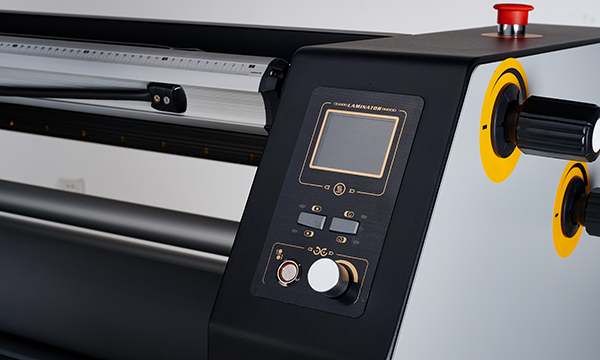
- Confirm the setpoint from both ends of the machine. MEFU heated models use front and rear control panels, so the operator loading at the rear and the operator inspecting at the front are reading the same value.
- Verify plate warm-up across the full width. The aluminum alloy heating plate must reach its setpoint at the edges as well as the centre before production starts. A scrap test at left, centre, and right is the fastest confirmation, and it is the step that prevents edge-lift rejects later in the run.
- Set speed for dwell time, not for the fastest possible output. A 50 m/min line gives the material far less time under heat than a 9 m/min line. Increasing speed without adjusting temperature is the most common cause of silvering on a heat-assisted machine.
- Set nip pressure with the pneumatic up/down system. Pneumatic lifting is standard on most MEFU heated models; MF1700-M1 uses a manual hand crank, and MF1700-M5 uses a hand crank for up/down as well. Constant pressure and constant temperature must be established together.
- Run a scrap trial of the exact media and film combination. Adhesive response varies by film thickness and substrate. Test the job, not a substitute.
- Record the settings per job. Temperature, speed, and pressure should be written into the job sheet. A controlled heating plate only delivers repeatability if the setpoint is repeated.
- Re-check after the first reel. Confirm that the plate has held temperature through continuous running — the condition that separates thermal mass from a simple heating element.
Use Cases: How Heated and Standard Systems Are Deployed
High-speed roll-to-roll production — United Kingdom
An authorized distributor of large-format finishing equipment in the United Kingdom installed 10 units for high-speed roll-to-roll production. The installation has supported 24/7 industrial production for five years. This is the duty profile of the MF1700-F1 and MF1700-F1 PLUS class, where a 50 m/min maximum speed is only usable if the heating plate holds temperature under continuous load.
Wide-format digital finishing — Italy
A digital finishing client in Italy deployed more than 15 units for digital printing finishing, running stably for five years. Heat-assisted wide-format work at moderate speed is the natural application for the MF1700-M1 PRO (12 m/min, 60°C) and the MF1700-M1 PLUS heat assist laminator.
Finishing and board mounting at volume — Russia
Digital printing and finishing clients in Russia installed 100 units used for finishing solutions and board mounting, with stable operation reported over ten years. At this scale, repeatable temperature settings matter more than any single machine feature, because output is judged by consistency across shifts.
Graphic arts and signage — Australia
A client from the wide-format digital printing and signage industry in Australia installed 50 units for graphic arts and wide-format finishing solutions, with stable operation over five years. Graphic roll laminator and wide format laminator duties typically combine heat-assisted film work with pressure-based mounting.
Heavy-duty board mounting — United States
A digital media expert client in the United States installed 10 units of the Premium MF-B4 for heavy-duty board mounting over five years, reporting a 7% reduction of waste. The installation relies on a tilted table design, an LED-illuminated bed, and pneumatic constant pressure — with a 60°C maximum table temperature supported by the aluminum alloy heating plate.
Efficiency for a lean team — Costa Rica
A regional distributor of advertising processing equipment completed an installation of 5 units within one year, using premium silicon rollers, front and rear control panels, and a safety vertical cutter. The project delivered efficiency for a lean team — a reminder that a heat assist laminator with clear front and rear controls reduces the training burden on small crews.
Comparison Table: Infrared Quartz Top Heating vs. Standard Systems
| Criterion | Infrared quartz top heating (aluminum alloy plate) | Standard unheated / roller-only system |
|---|---|---|
| Heat source | Infrared quartz elements radiating onto an aluminum alloy heating plate | No heating element; bonding relies on pressure and adhesive chemistry |
| Temperature reference | Defined setpoint: 60°C, or 60°C and 120°C depending on model | No temperature setpoint to record or repeat |
| Heat distribution | Spread laterally by a conductive plate across up to 1630mm (2280mm on MF1700-F2) | No plate; distribution depends on roller contact only |
| Throughput reference | Up to 50 m/min (MF1700-F1 / F1 PLUS) | Manual operation, or up to 6 m/min on MF1700-B5 PRO |
| Power input | 1,600W to 5,200W depending on model | 120W on MF1700-B5 PRO; manual models without power drive |
| Typical fit | Heat-activated film, thick substrates, high-speed or dual-sided production | Pressure-activated cold lamination, low volume, thin media |
| MEFU models | MF1700-F1, F1 PLUS, M1, M1 LITE, M1 PLUS, M1 PRO, M5, C3, A1 PRO, F2 | MF1700-B5, MF1700-B5 PRO, MF1600-B7 |
FAQ
Which certifications should a heated roll laminator carry?
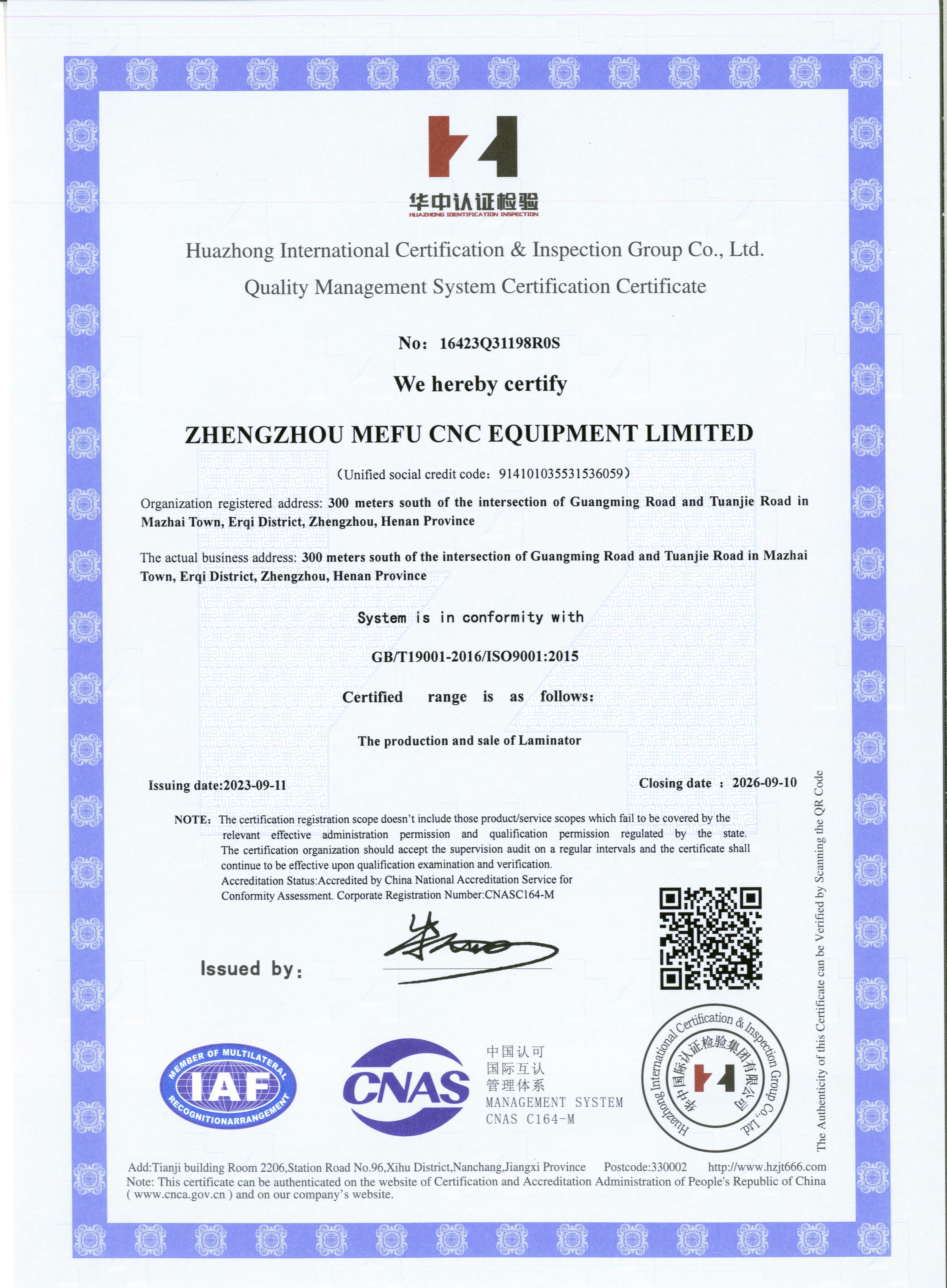
For the EU and global markets, MEFU laminators are covered by CE certificate TST20240302124-1SC issued by Dongguan True Safety Testing Co., Ltd., valid from 2024-03-18 to 2029-03-18, covering models including MF1700-C3, MF1700-F1, MF1700-F2, MF1700-A1 PRO, MF1700-M1, MF1700-M1 LITE, MF1700-M1 PRO, MF1700-B5, MF-B4 and MF-B2. The tested standards include EN ISO 12100:2010 and EN 60204-1:2018 for machinery safety and electrical equipment, together with EN 61000-6-2:2019, EN IEC 61000-3-2:2019, EN 61000-3-3:2013+A1:2019 and EN 61000-6-4:2019. RoHS compliance is covered by certificate TST20231102836-3RC from Dongguan True Safety Testing Co., Ltd. (2023-11-20 to 2028-11-20), and quality management by ISO 9001:2015 certificate 16423Q31198R0S issued by Huazhong International Certification & Inspection Group Co., Ltd. (2023-09-11 to 2026-09-10), scoped to the production and sale of laminators.
Can a heated roll laminator handle full 1630mm width and thick substrates?
Yes. MEFU's heated models share a 1630mm/64" maximum lamination width, with the MF1700-F2 supporting 1630mm/2280mm. Maximum lamination thickness is 28mm/1.1" on models such as MF1700-C3, MF1700-A1 PRO, MF1700-M1 PRO, MF1700-F1, MF1700-F1 PLUS and MF1700-F2; MF1700-M1 and MF1700-M5 are rated to 23mm/0.9". MF1700-M1 uses a 120mm roller diameter, and silicone rollers are used across the range, with pneumatic up/down on most heated models.
What actually drives the cost of an infrared quartz heated laminator?
Four specification items account for most of the cost difference between models: the temperature class (60°C versus 60°C/120°C), the power input (1,600W versus 2,600W, rising to 5,200W on the dual-heated MF1700-F2), the speed class (9 m/min on heat assist models up to 50 m/min on MF1700-F1 and F1 PLUS), and the working width (1520mm on MF1600-B7, 1630mm across most models, 2280mm on MF1700-F2). The lifting system also differs — pneumatic up/down on most heated models, manual hand crank on MF1700-M1. Buyers should specify to the substrate and duty cycle rather than to the highest number on the sheet.
How can temperature control be validated before committing to a purchase?
Validate with the exact media and film combination that will run in production. MEFU's OEM program supports customization of size, colour, voltage and marking, with a minimum order quantity of 1 unit, a monthly capacity of 500 units, and 100% testing of units before shipment. Requesting recorded temperature, speed, and pressure settings for your substrate — and running a trial batch on that basis — is the practical way to confirm that the aluminum alloy heating plate holds distribution across the working width.
What is the lead time, and what support follows delivery?
Standard lead time is 14 days, supported by a monthly capacity of 500 units, with remote after-sales support and worldwide export. Because heated machines are configured by temperature class, voltage, and width, the fastest next step is to confirm the substrate and duty cycle first: email info@mefu.cn or message +86 15890020566 on WhatsApp with the film type and running speed, and the appropriate 60°C or 60°C/120°C configuration can be specified directly. The full product brochure is available for download at MEFU product brochure (PDF).
Conclusion: Specify the Heating Architecture, Then the Machine
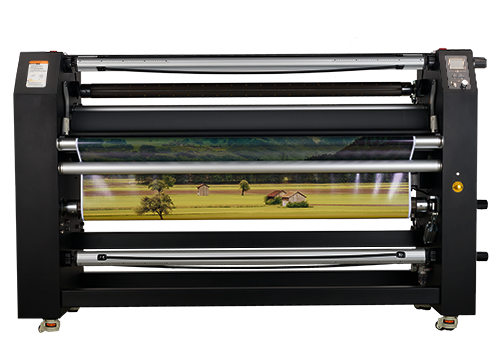
The comparison between infrared quartz top heating and standard systems resolves into a single procurement rule: decide how heat will be generated and distributed before comparing frames, rollers, or speeds. A top-heated infrared quartz system with an aluminum alloy heating plate gives the operator a defined setpoint — 60°C, or 60°C and 120°C — that holds across a 1630mm working width and through continuous production, whether the machine is a 9 m/min heat assist laminator or a 50 m/min high speed roll laminator. A standard unheated machine gives no such reference and should be specified only where pressure-activated cold lamination is the intended process.
For evaluation-stage buyers, the practical next step is to state the film, the substrate, and the required running speed, then match that profile to the correct temperature class inside the MEFU range — and to validate the settings on a real production sample before the line goes into service.
MEFU — HENAN MEFU INDUSTRIAL LIMITED, established 2008, 10,000㎡ manufacturing facility, Zhengzhou, Henan, China. Email: info@mefu.cn | Tel / WhatsApp: +86 15890020566 | Website: www.mefulaminator.com | Brochure: download PDF