
Top 5 Roll Laminator Features for High-Volume Ad Production
Date: 2026-09-17 Categories: Industry News Hits: 365
Top 5 Roll Laminator Features for High-Volume Ad Production
Five features decide whether a roll laminator survives a high-volume advertising production schedule: dual-sided heating that reaches 120℃, sustained output at 20 m/min, media capacity up to 28 mm (1.1 in) thick, a pneumatic up/down lifting system, and integrated trimming with roll handling. This ranking orders those five features by the operational risk they remove from a running production line, and every threshold below is tied to a published MEFU specification rather than to a sales claim.
MEFU (HENAN MEFU INDUSTRIAL LIMITED) is a manufacturer of roll-to-roll laminators, flatbed laminators, flatbed applicators and XY cutting machines, founded in 2008 with a 10,000 ㎡ facility and a 10-engineer R&D team in Zhengzhou, Henan, China. Its parameter tables are used as the reference here because they document heating configuration, maximum speed, material thickness, lifting mechanism and power input as separate fields — exactly the level of detail a production manager needs before writing a specification document.
Why High-Volume Work Breaks Laminators That Look Fine on Paper
Most specification failures in advertising production do not come from buying a bad machine. They come from buying on two numbers — web width and a headline top speed — while ignoring the four fields that actually govern continuous output. A laminator that is fast on a demo sheet can still bottleneck a line within a single shift if heat does not penetrate thick media, if the operator has to crank the rollers down by hand several hundred times a day, or if edge trimming has to be moved to a separate downstream station.
The operating envelope this ranking assumes is documented in MEFU's own application data: large-format roll media finishing that runs 24/7, laminating vinyl, PP paper and PVC film for billboards, posters, vehicle stickers and outdoor advertising material, with large-format inkjet printers and XY trimmers as matched upstream and downstream equipment. In that environment the laminator is judged on continuous behaviour, not peak behaviour.
One boundary is worth stating early, because it changes which machine class a buyer should be evaluating. Rigid substrates — acrylic, PVC board, foam board and ACP for indoor and outdoor signage — are the domain of flatbed laminators and applicators, which are specified to handle boards up to 50 mm thick, and in the case of the MEFU MF1950-B2 up to 1830 mm wide. A roll laminator is the correct tool when the work arrives on a roll and leaves on a roll.
Industry Background: Thermal Capacity Is Where Demand Is Concentrated
Market data supports the prioritisation that follows. Dataintelo valued the global roll laminator market at USD 1.82 billion in 2024 and projected it to reach approximately USD 2.89 billion by 2033. Intel Market Research projects the broader laminating machines market to expand at a CAGR of 5.07% from 2026 to 2034, reaching USD 1.07 billion, and separately valued commercial laminators at USD 1.49 billion in 2024. Future Market Insights projected thermal laminating machines to hold a 47.0% share of the market by 2025, citing lower operating costs and strong adhesion as the drivers.
Those figures should be read with a caveat: published market sizes differ by scope. Dataintelo's USD 1.82 billion figure includes industrial roll systems, while a systems-only estimate from Custom Market Insights places the same category at USD 407.4 million. The directional conclusion is stable even when the absolute numbers are not — thermal and heat-capable machines carry the majority of demand, and wide-format segments are the ones gaining traction.
Compliance is the second external constraint. Laminating machines supplied into the EU must comply with EN 60204-1, the standard for electrical equipment of machines used as part of CE marking, according to the testing consultancy D.L.S. Electronic Systems. That makes certification documents a specification item, not an afterthought, which is why they are treated as a verification step later in this article.
The Top 5 Roll Laminator Features, Ranked
The ranking below is a priority order for specification, not a claim about any single machine being superior to another. It reflects how much production risk each feature removes in a 24/7 advertising workflow.
1Dual-Sided Heating to 120℃
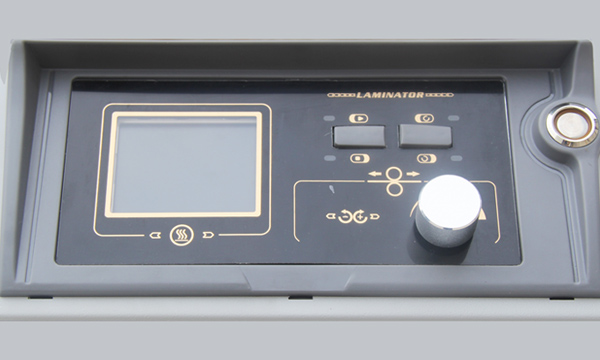
Heat configuration is ranked first because it is the feature that cannot be added later. On MEFU's roll laminator line, the MF1700-F2 is specified as a dual-heated machine with a maximum temperature of 120℃ and a 5200 W power input. Applying heat from both faces of the web reduces reliance on a single-sided heat path through thick substrates, which matters when the production mix includes laminated banners, heavy vinyl and multi-layer advertising media.
The rest of the line shows how clear the temperature tiers are. Top-heated models — MF1700-F1, MF1700-F1 PLUS, MF1700-M1, MF1700-M1 LITE, MF1700-M1 PLUS and MF1700-M1 PRO — are rated to 60℃ maximum. A middle group offers selectable 60℃ or 120℃ top heating: the MF1700-C3, the MF1700-A1 PRO and the MF1700-M5.
The trade-off is electrical. The dual-heated MF1700-F2 draws 5200 W, against 1600 W or 2600 W for the top-heated MF1700-C3 and MF1700-A1 PRO. A production manager specifying the 120℃ tier should confirm supply capacity and running cost, not only the lamination result.
2Sustained Throughput at 20 m/min
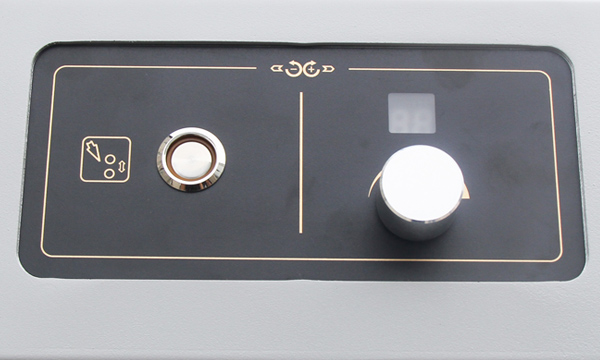
Twenty metres per minute is the practical threshold for a laminator that has to keep pace with a wide-format printer in continuous production. Two MEFU models sit exactly on that figure: the MF1700-C3 Industrial Roll Laminator and the MF1700-F2 Double Sided Roll Laminator, both rated at a maximum speed of 20 m/min.
Speed in this line is tiered, and the tiers correlate with heat capability rather than with price positioning. Above the 20 m/min group sit the MF1700-F1 and MF1700-F1 PLUS, both rated at 50 m/min — but both are top-heated with a 60℃ maximum, so they are the right choice when speed dominates and dual-side heat is not required. Below them, the MF1700-A1 PRO runs at 15 m/min, the MF1700-M1 PRO and MF1700-M5 at 12 m/min, the MF1700-M1, MF1700-M1 LITE and MF1700-M1 PLUS at 9 m/min, and the MF1700-B5 PRO at 6 m/min.
The selection rule is simple: match the laminator's rated speed to the actual sustained output of the printer feeding it, then subtract the time lost to roll changes, temperature recovery and trimming. A 20 m/min machine paired with a slower printer wastes capability; a 9 m/min machine behind a fast printer becomes the constraint in the room.
3Media Handling up to 28 mm (1.1 in) Thickness
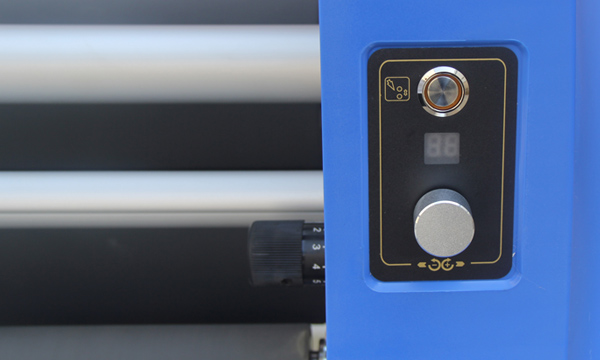
Media capacity is ranked third because it determines which jobs can be accepted without a second machine. A maximum lamination thickness of 28 mm (1.1 in) appears across the majority of MEFU's roll laminator range: the MF1700-F2, MF1700-C3, MF1700-F1, MF1700-F1 PLUS, MF1700-A1 PRO, MF1700-M1 PRO, MF1700-M1 LITE, MF1700-M1 PLUS, MF1700-B5, MF1700-B5 PRO and MF1600-B7. Two models cap lower, at 23 mm (0.9 in): the MF1700-M5 and the MF1700-M1.
Web width follows the same logic. 1630 mm (64 in) is the standard working width across the line, the MF1700-F2 extends to a 2280 mm configuration, and the MF1600-B7 is specified at 1520 mm (59 in). Roller hardware scales with the class of machine: silicone rollers are standard throughout, documented at 120 mm diameter on the MF1700-M1 and MF1600-B7 and at 130 mm diameter on the MF1700-B5 PRO, the flatbed applicators and the flatbed laminators.
Thickness and width should be specified together with the media list, because a machine rated to 28 mm is only useful if its rollers and frame can carry that thickness at the required width and speed. The 28 mm figure is also where the roll laminator category ends: above it, rigid board work moves to flatbed equipment, which is specified up to 50 mm on the MF-B4 series.
4Pneumatic Up/Down Lifting
Lifting mechanism looks like a minor field on a specification sheet and behaves like a production variable on the floor. A pneumatic up/down system is listed on the MF1700-F2, MF1700-C3, MF1700-F1, MF1700-F1 PLUS, MF1700-A1 PRO, MF1700-M1 PRO, MF1700-M1 LITE, MF1700-M1 PLUS, MF1700-B5, MF1700-B5 PRO and MF1600-B7. Two models are documented with a hand crank instead: the MF1700-M1 and the MF1700-M5.
Verification note for buyers: read the lift field itself and do not infer it from the model name or the category label. The MF1700-M5 is described as a Pneumatic Roll Laminator type, yet its published parameter table lists 'Up and down: Hand Crank'. On MEFU's specification sheets the lift mechanism is a separate data point, which is precisely why it should be extracted line by line during evaluation.
The reason this ranks fourth rather than lower is workload. In signage and exhibition applications, MEFU documents pneumatic pressure adjustment as the stated special requirement for achieving bubble-free lamination on rigid surfaces. Pneumatic control gives the operator repeatable pressure setting instead of a manual judgement call repeated across hundreds of cycles, and it removes the physical effort of lifting and lowering the roller assembly between passes in a continuous workflow.

5Integrated Trimming and Roll Handling
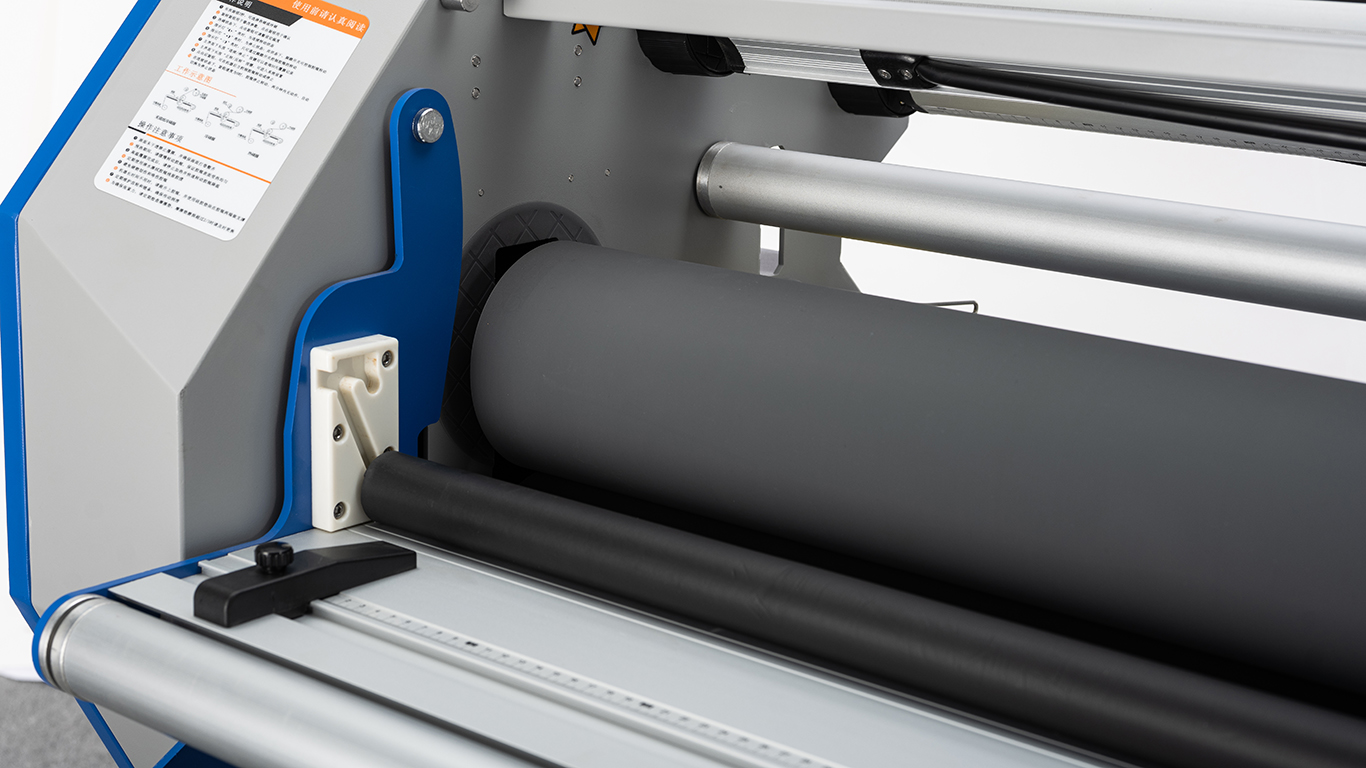
The fifth feature is the one that decides whether lamination stays a single-pass operation. A trimmer holder carrying 2 single and 1 double central blades is specified on the MF1700-F2, MF1700-C3, MF1700-F1, MF1700-F1 PLUS, MF1700-A1 PRO, MF1700-M1 PRO and MF1700-M1 LITE, with tungsten steel blades listed as the cutting material. Edge trimming performed on the laminator means laminated rolls move directly into packing rather than into a separate cutting queue.
Roll handling completes the loop. The MF1700-F1 and MF1700-F1 PLUS are specified with swing-in and swing-out air shafts configured as 2 winder and 1 rewinder, which supports the 50 m/min output those models are rated for. The MF1700-B5 PRO documents auto-locked exchangeable roll shafts. Where downstream precision cutting is required at higher volume, MEFU's MF1700-XY Roll Cutting Machine is specified to cut up to 1620 mm width at 0 to 12 m/min with plus or minus 0.5 mm precision, pneumatic lifting and an auto-stop sensor.
How to Apply This Ranking: A Step-by-Step Evaluation
- Define the production envelope first. List the media actually run — vinyl, PP paper, PVC film, banners, vehicle graphics — with maximum thickness, maximum roll width and required finish. The 28 mm and 1630 mm figures are only meaningful against a real media list.
- Set the temperature requirement. If the mix includes thick or multi-layer media, specify the 120℃ tier and decide whether it must be dual-heated (MF1700-F2) or whether selectable 60℃/120℃ top heating (MF1700-C3, MF1700-A1 PRO, MF1700-M5) is sufficient.
- Match speed to the printer, not to the brochure. Compare the laminator's rated speed with the sustained output of the upstream printer. The 20 m/min tier is served by the MF1700-C3 and MF1700-F2; the 50 m/min tier by the MF1700-F1 and MF1700-F1 PLUS.
- Confirm thickness and width limits together. 28 mm (1.1 in) at 1630 mm (64 in) is the standard envelope; the MF1700-F2 extends to 2280 mm width, and the MF1600-B7 is specified at 1520 mm (59 in).
- Extract the lift mechanism as its own line item. Confirm 'Pneumatic' in the parameter table rather than assuming it from the model name or type description.
- Decide how trimming and roll handling are performed. Check whether the machine carries 2 single and 1 double central blades, and whether air-shaft winding suits the roll sizes in production.
- Verify compliance documents against the certificate number. Request CE, RoHS and quality-system certificates and match certificate numbers, issuing bodies and expiry dates to the model being quoted.
- Confirm commercial terms. MEFU documents an MOQ of 1 unit, a 14-day lead time, OEM customisation of size, colour, voltage and marking, 100% testing, and a monthly production capacity of 500 units.
Use Cases: Where These Thresholds Actually Get Tested
24/7 large-format roll media finishing
Billboards, posters, vehicle stickers and outdoor advertising material are laminated from vinyl, PP paper and PVC film in a continuous cycle, with large-format inkjet printers upstream and XY trimmers downstream. This is the application where the 20 m/min tier and 28 mm thickness capacity matter most, because downtime for roll changes and trimming directly reduces delivered square metres.
Short-run digital printing and custom signage
In roll-to-roll lamination for digital prints, the machine provides one-stop surface protection and gloss or matte finishing for custom orders. Here the pneumatic lift and a rear control panel matter more than peak speed, because a single operator runs the machine alongside other finishing steps.
Photo and poster finishing
Precision cold and heat lamination of photo prints, digital posters and artworks uses the same roll laminator platform to prevent fading and maintain colour fastness. The lower speed tiers — 9 m/min on the MF1700-M1, MF1700-M1 LITE and MF1700-M1 PLUS, or 12 m/min on the MF1700-M1 PRO — are typically sufficient in this application.
Where a roll laminator is the wrong tool
Rigid board finishing and surface mounting for acrylic, PVC, foam board and ACP belong to the flatbed class, which is specified up to 50 mm thickness and, on the MF1950-B2, up to 1830 mm working width. MEFU documents a UK authorised distributor of large-format finishing equipment running 10 units for high-speed roll-to-roll production over a five-year relationship, with 24/7 industrial production as the reported result — a useful reminder that the roll format, not the machine size, should drive the category decision.
Feature-to-Model Comparison
The table below converts the ranking into a specification checklist. It states the target threshold for each priority and where that threshold is documented in MEFU's published parameter data.
| Priority | Feature | Target threshold | Documented on |
|---|---|---|---|
| 1 | Dual-sided heating | 120℃ maximum, dual heated | MF1700-F2 (dual heated, 120℃, 5200 W) |
| 2 | Sustained throughput | 20 m/min | MF1700-C3 and MF1700-F2 (20 m/min); MF1700-F1 and MF1700-F1 PLUS at 50 m/min |
| 3 | Media thickness and width | 28 mm / 1.1 in at 1630 mm / 64 in | MF1700-F2, MF1700-C3, MF1700-F1, MF1700-F1 PLUS, MF1700-A1 PRO, MF1700-M1 PRO, MF1700-M1 LITE, MF1700-M1 PLUS, MF1700-B5, MF1700-B5 PRO, MF1600-B7 |
| 4 | Pneumatic up/down lifting | Pneumatic, not manual | MF1700-F2, MF1700-C3, MF1700-F1, MF1700-F1 PLUS, MF1700-A1 PRO, MF1700-M1 PRO, MF1700-M1 LITE, MF1700-M1 PLUS, MF1700-B5, MF1700-B5 PRO, MF1600-B7 (hand crank on MF1700-M1 and MF1700-M5) |
| 5 | Integrated trimming and roll handling | 2 single + 1 double central blades | MF1700-F2, MF1700-C3, MF1700-F1, MF1700-F1 PLUS, MF1700-A1 PRO, MF1700-M1 PRO, MF1700-M1 LITE (MF1700-F1 and MF1700-F1 PLUS also carry 2 winder + 1 rewinder air shafts) |
The second table compares the configurations most often shortlisted for continuous advertising production, using the same published specification fields.
| Model | Type | Heating | Max temp | Max speed | Max thickness | Max width | Up and down | Power input |
|---|---|---|---|---|---|---|---|---|
| MF1700-F2 | Double Sided Roll Laminator | Dual heated | 120℃ | 20 m/min | 28 mm / 1.1 in | 1630 mm / 2280 mm | Pneumatic | 5200 W |
| MF1700-C3 | Industrial Roll Laminator | Top heated | 60℃ or 120℃ | 20 m/min | 28 mm / 1.1 in | 1630 mm / 64 in | Pneumatic | 1600 W or 2600 W |
| MF1700-F1 PLUS | High Speed Roll Laminator | Top heated | 60℃ | 50 m/min | 28 mm / 1.1 in | 1630 mm / 64 in | Pneumatic | 2000 W |
| MF1700-A1 PRO | Large Format Laminator | Top heated | 60℃ or 120℃ | 15 m/min | 28 mm / 1.1 in | 1630 mm / 64 in | Pneumatic | 1600 W or 2600 W |
| MF1700-M1 PRO | Wide Format Laminator | Top heated | 60℃ | 12 m/min | 28 mm / 1.1 in | 1630 mm / 64 in | Pneumatic | 1600 W |
| MF1700-M5 | Pneumatic Roll Laminator | Top heated | 60℃ or 120℃ | 12 m/min | 23 mm / 0.9 in | 1630 mm / 64 in | Hand crank | 1600 W or 2600 W |
| MF1700-M1 | Hot Cold Roll Laminator | Top heated (infrared) | 60℃ | 0 to 9 m/min | 23 mm / 0.9 in | 1630 mm / 64 in | Hand crank | 1600 W |
Certifications and Documents to Attach to the Specification File
For EU-bound advertising production equipment, the compliance record is part of the technical specification. MEFU's laminator line holds CE certification number TST20240302124-1SC issued by Dongguan True Safety Testing Co., Ltd., valid for the EU market from 2024-03-18 to 2029-03-18, covering standards EN ISO 12100:2010, EN 60204-1:2018, EN 61000-6-2:2019, EN IEC 61000-3-2:2019, EN 61000-3-3:2013+A1:2019 and EN 61000-6-4:2019.
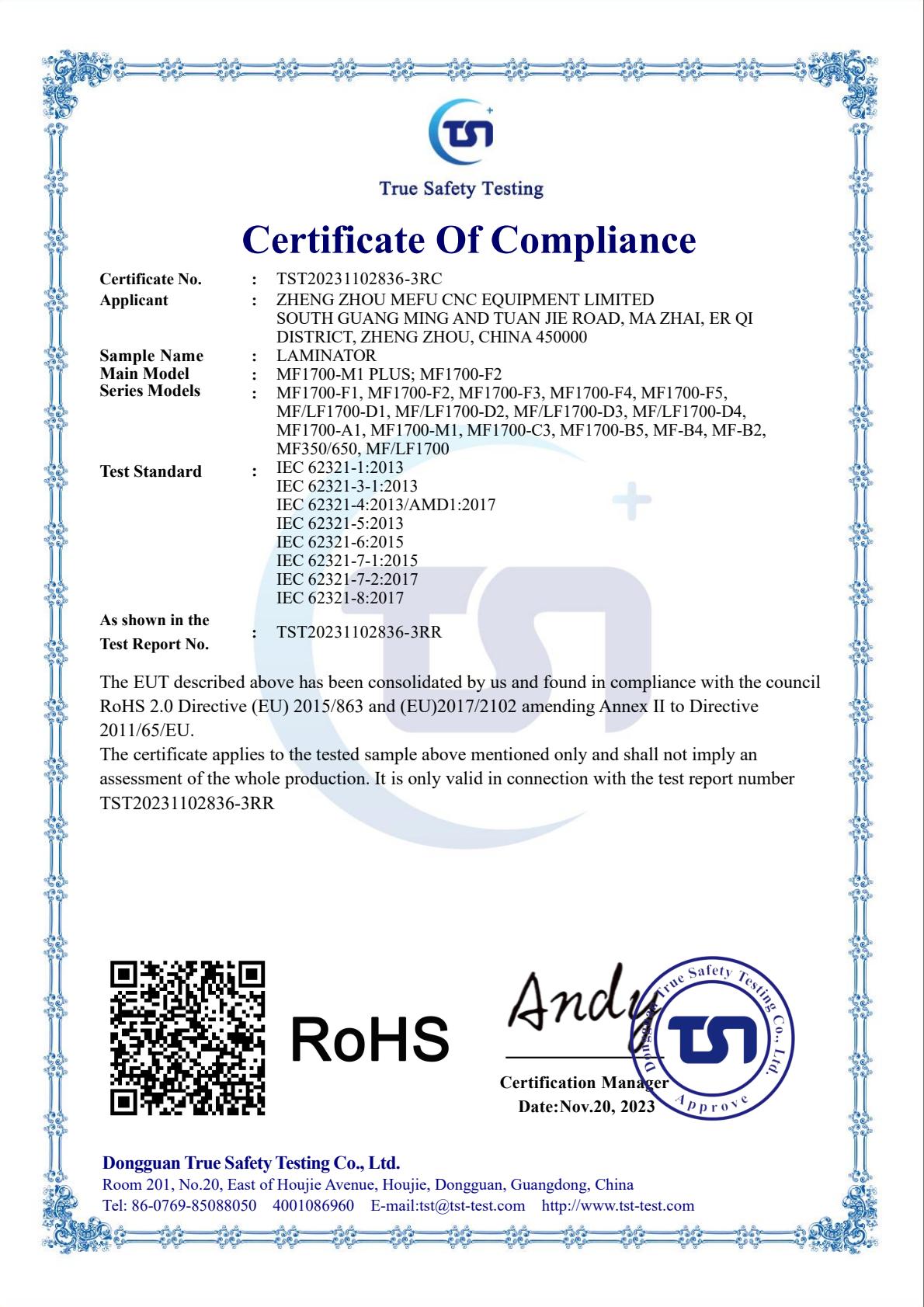
The same line holds RoHS certification number TST20231102836-3RC issued by Dongguan True Safety Testing Co., Ltd., valid from 2023-11-20 to 2028-11-20 and tested against the IEC 62321 series (IEC 62321-1:2013, IEC 62321-3:2013, IEC 62321-4:2013/AMD1:2017, IEC 62321-5:2013, IEC 62321-6:2015, IEC 62321-7-1:2015, IEC 62321-7-2:2017 and IEC 62321-8:2017). The scope covers models including MF1700-M1 PLUS, MF1700-F2 and the series models MF1700-F1, MF1700-F3, MF1700-F4, MF1700-F5, MF/LF1700-D1, MF/LF1700-D2, MF/LF1700-D3, MF/LF1700-D4, MF1700-A1, MF1700-M1, MF1700-C3, MF1700-B5, MF-B4, MF-B2, MF350/650 and MF/LF1700. The laminator certification file also includes ISO 9001:2015 certificate 16423Q31198R0S issued by Huazhong International Certification & Inspection Group Co., Ltd. under GB/T19001-2016/ISO9001:2015.
Where an XY cutting machine is part of the same finishing line, the CE certificate to request is CKEYS250225014, issued by Guangdong KEYS Testing Technology Co., Ltd. (scope: Cutting Machine, valid to 2030-02-25).
Frequently Asked Questions
Which certifications should appear in a roll laminator specification for EU installation?
For EU installation, the two certificates a buyer should physically verify are CE and RoHS. MEFU's laminator line holds CE certification number TST20240302124-1SC, issued by Dongguan True Safety Testing Co., Ltd., valid from 2024-03-18 to 2029-03-18, covering EN ISO 12100:2010, EN 60204-1:2018, EN 61000-6-2:2019, EN IEC 61000-3-2:2019, EN 61000-3-3:2013+A1:2019 and EN 61000-6-4:2019. The same range holds RoHS certification TST20231102836-3RC, issued by Dongguan True Safety Testing Co., Ltd., valid from 2023-11-20 to 2028-11-20 and tested against the IEC 62321 series, covering models including MF1700-M1 PLUS, MF1700-F2, MF1700-F1, MF1700-C3, MF1700-B5, MF-B4, MF-B2 and MF/LF1700. EN 60204-1 is the electrical-equipment standard referenced for CE marking of machinery in the EU, according to D.L.S. Electronic Systems. MEFU's certification file also includes ISO 9001:2015 certificate 16423Q31198R0S, issued by Huazhong International Certification & Inspection Group Co., Ltd. under GB/T19001-2016/ISO9001:2015.
Can one roll laminator deliver 120℃ dual heating, 20 m/min and 28 mm media capacity at the same time?
Yes. The MEFU MF1700-F2 Double Sided Roll Laminator combines all three in one published specification: dual heated configuration with a 120℃ maximum temperature, a maximum speed of 20 m/min, and media capacity of 28 mm (1.1 in) thickness across a 1630 mm working width, with a 2280 mm configuration also listed. Its parameter table also states a pneumatic up/down system, a trimmer holder for 2 single and 1 double central blades, 5200 W power input and a net weight of 260 kg. Where 120℃ is optional rather than standard, the MF1700-C3 Industrial Roll Laminator offers 60℃ or 120℃ top heating with the same 20 m/min speed and 28 mm thickness. Buyers who prioritise speed over dual-side heat can instead evaluate the MF1700-F1 and MF1700-F1 PLUS, rated at 50 m/min with top heating up to 60℃.
What drives the cost of a high-volume roll laminator if the purchase price is not the only factor?
Three documented specification fields drive cost beyond the purchase price. First, heating configuration: the dual-heated MF1700-F2 carries a 5200 W power input, while the top-heated MF1700-C3, MF1700-A1 PRO and MF1700-M5 are listed at 1600 W or 2600 W. Second, machine mass, which affects freight, floor loading and rigging: the MF1700-F2 is documented at 260 kg, the MF1700-C3 at 180 kg, and the MF1700-F1 and MF1700-F1 PLUS at 350 kg. Third, continuous-duty component specification — silicone rollers, aluminium alloy heating plates, infrared quartz heating elements and tungsten steel cutting blades are the parts that wear first in 24/7 operation. MEFU does not publish list prices in its product data; its documented commercial terms are an MOQ of 1 unit, a 14-day lead time, and OEM customisation of size, colour, voltage and marking.
How can a production manager validate these thresholds before ordering?
Validation starts with a configuration request rather than a catalogue order. MEFU documents OEM customisation across size, colour, voltage and marking, an MOQ of 1 unit, 100% testing, and remote after-sales support, with a monthly production capacity of 500 units across export markets worldwide. That means a print shop can specify the exact media envelope — for example 1630 mm wide, 28 mm thick, 120℃ maximum temperature — and confirm the quotation is built against those values before committing capital.
What lead time and order quantity should be planned for a high-volume roll laminator?
MEFU's capability data states a 14-day lead time with an MOQ of 1 unit and 100% testing, at a monthly capacity of 500 units, with remote after-sales support and worldwide export markets. Because the MOQ is a single unit, a first order can be structured as a validation unit configured to the exact specification under review. The practical next step is to send your media list, target speed and required temperature to MEFU at info@mefu.cn or through www.mefulaminator.com, and request a configuration quote or sample evaluation against those parameters.
Conclusion: Specify the Five Thresholds, Then Verify the Documents
High-volume advertising production rewards a narrow specification. Dual-sided heating to 120℃ removes the risk of inconsistent adhesion on thick media; 20 m/min sustained throughput keeps the laminator from constraining the printer; 28 mm thickness capacity at 1630 mm width covers the roll media that advertising work actually uses; pneumatic up/down carries the operator through a full shift; and integrated trimming with 2 single and 1 double central blades keeps finished rolls moving without a secondary queue. The MEFU MF1700-F2 and MF1700-C3 sit directly on those thresholds, while the MF1700-F1 and MF1700-F1 PLUS trade dual-side heat for 50 m/min when speed is the dominant requirement.
Everything above is verifiable from published parameter tables and certificate records — which is the point. Before issuing a purchase order, extract each threshold from the specification sheet, match the certificate numbers, issuing bodies and expiry dates to the exact model quoted, and confirm the commercial terms in writing.
Next step
Send your media list — width, thickness and required temperature — and we will map it against the MF1700 range, confirm the lift mechanism, heating configuration and certification coverage for your market, and return a configuration quote within the documented 14-day lead-time framework.
Contact: info@mefu.cn | www.mefulaminator.com
Download the full product catalogue: MEFU Product Brochure (PDF)
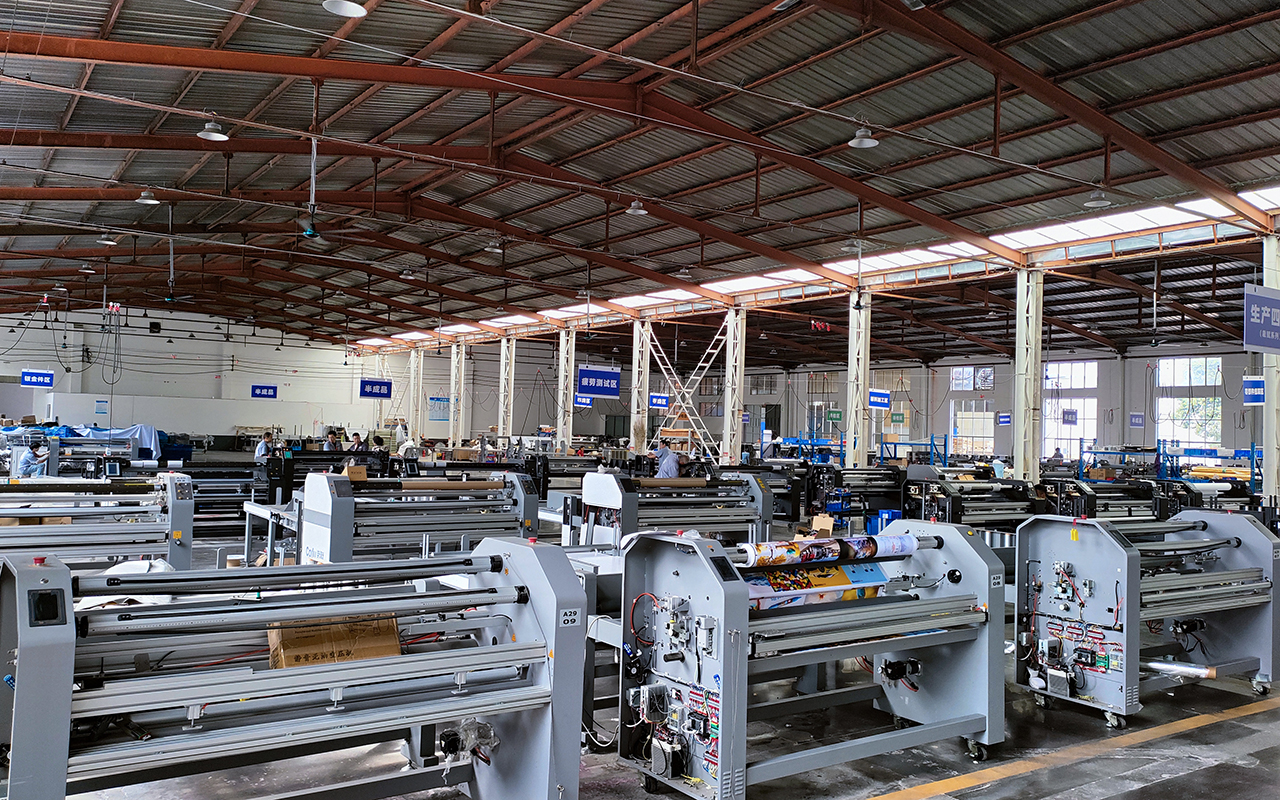
MEFU (HENAN MEFU INDUSTRIAL LIMITED) manufactures roll-to-roll laminators, flatbed laminators, flatbed applicators and XY cutting machines. All specifications, certificate numbers and commercial terms cited in this article are taken from MEFU product, certification and capability documentation. Third-party market and standards references are attributed in the text.