
Cold vs Warm vs Hot Lamination: Which One Do You Need for Your Print Shop?
Date: 2026-08-28 Categories: Industry News Hits: 417
Introduction
If you run a print shop, signage business, or graphics studio, you know that lamination can make or break your finished product. A properly laminated print lasts longer, looks sharper, and commands a higher price. But here is where many shop owners get confused: lamination is not just "cold vs hot" — there is a third, increasingly popular option that sits right in the middle.
We are talking about “warm lamination”(also called heat-assist lamination). It combines the safety and simplicity of cold lamination with the speed and bond quality of hot lamination — and it has become the preferred choice for many professional print shops worldwide.
In this guide, we will break down all three types: “cold, warm (heat-assist), and hot lamination”. You will learn how each one works, the real-world pros and cons, a side-by-side comparison, and a straightforward decision framework to help you pick the right laminator for your shop. We will also show you which MEFU models fit each category, based on 18+ years of serving print shops in over 110 countries.
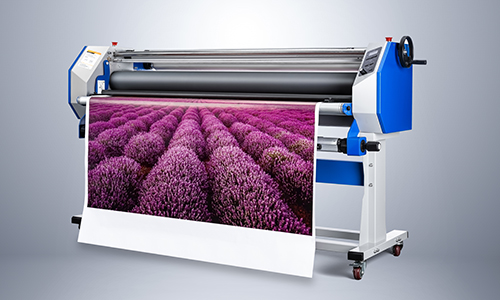
What is Cold Lamination?
Cold lamination uses “pressure-sensitive adhesive (PSA)” films that bond to the substrate using only roller pressure- no heat at all. The adhesive is already coated onto the film and protected by a release liner. When the film and print pass through the laminator's silicone rollers, the pressure activates the bond, and the release liner is peeled away simultaneously.
How It Works
1.The print is fed into the laminator at room temperature
2.The cold laminate film is aligned on top, release liner facing down
3.Silicone rollers apply consistent pressure (pneumatic or manual)
4.The pressure-sensitive adhesive bonds to the print surface
5.The finished print exits the other side — no warm-up, no heat
Because there is no heating element, pure cold laminators are often the simplest and most affordable type. They are also the safest for extremely heat-sensitive materials.
Pros of Cold Lamination
· Zero heat risk: Completely safe for even the most heat-sensitive materials—certain inkjet prints, photographs, thin papers, and heat-reactive vinyls
· Instant operation: No warm-up time at all—turn it on and start laminating immediately
· Lowest energy consumption: No heating elements means minimal electricity use
· Simplest operation: Fewest settings to adjust; easiest for less experienced staff
· Lowest equipment cost: Pure cold laminators are generally the most affordable.
Cons of Cold Lamination
· Slower production speed: Without heat to soften the PSA adhesive, you must run at slower speeds to ensure a proper bond — typically 2–5 m/min
· Higher bubble risk: Cold lamination is more prone to trapped air bubbles, especially with thicker films or uneven substrates
· Lower bond strength: Pressure-only bonding can lead to edge lifting over time, particularly at the corners
· Limited outdoor durability: Most cold laminate films are rated for indoor or short-term outdoor use
· Higher film cost: Premium PSA cold laminate films can be more expensive per square meter
· Best for: Photo labs, small copy shops, and businesses that work almost exclusively with ultra-heat-sensitive materials and produce low volumes.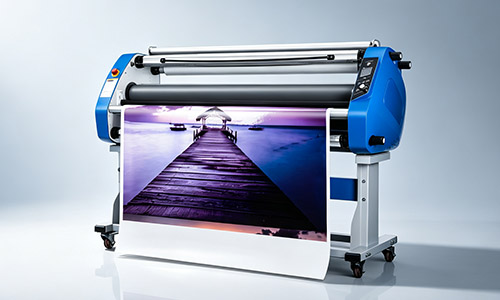
What is Warm / Heat-Assist Lamination?
This is the category that many people overlook — but it is rapidly becoming the industry standard for professional print shops. Warm lamination (also called heat-assist lamination) uses low-level heat (typically 40–60°C / 104–140°F) to soften the pressure-sensitive adhesive on “cold lamination film”, while still operating well below the temperatures that would damage heat-sensitive materials.
The key insight is this: warm laminators still use PSA (cold lamination) film, not hot lamination film. The gentle heat simply makes the PSA adhesive flow better, resulting in faster speeds, stronger bonds, and fewer bubbles — without the risks of full hot lamination.
How It Works
1.The laminator is turned on, and the top roller heats to a low temperature (usually 40–60°C).
2.Warm-up is fast — typically 5–10 minutes, much faster than a hot laminator.
3.The print and cold laminate (PSA) film are fed together through the warmed roller.
4.The low heat softens the PSA adhesive, allowing it to wet out and bond more aggressively.
5.Roller pressure ensures even contact; the finished print exits smoothly.
Warm laminators like the MEFU MF1700-C3 feature digital temperature control, front and rear panels, and lamination statistics displays. Many models can also run in pure cold mode (heat off) for maximum flexibility.
Pros of Warm / Heat-Assist Lamination
· Faster than cold lamination: The softened PSA adhesive allows significantly higher speeds, up to 20 m/min on models like the MF1700-C3, and even 50 m/min on industrial models like the MF1700-F1 PLUS.
· Better bond quality than cold: The heat helps the PSA adhesive flow evenly, resulting in stronger bonds and less edge lifting.
· Fewer bubbles than cold: Warmth reduces air trapping, producing smoother, more professional finishes.
· Still safe for heat-sensitive materials: At 40–60°C, warm lamination is well below the damage threshold for most inkjet prints, photos, and standard vinyls.
· Uses affordable cold laminate film: No need for expensive hot lamination film — standard PSA cold film works perfectly.
· Fast warm-up: Ready in 5–10 minutes, compared to 15–20 minutes for a hot laminator.
· Versatile: Most warm laminators can run with heat off (pure cold mode) for ultra-sensitive materials.
· Lower energy than hot: Minimal heating compared to full hot lamination.
Cons of Warm / Heat-Assist Lamination
· Slight warm-up needed: Not instant like pure cold — but much faster than hot
· Not for extreme heat-sensitive materials: A small number of ultra-sensitive materials may still react at 40–60°C (test first, or run in cold mode)
· Not true hot lamination: Cannot reach the temperatures needed for heat-activated hot film or encapsulation
· Moderate equipment cost: More than pure cold, but often less than full industrial hot laminators.
Best for: The sweet spot for most professional print shops, sign makers, and graphics studios. If you do a mix of indoor and outdoor work, want fast production speeds, and need versatility — warm lamination is almost certainly your best choice.
What is Hot Lamination?
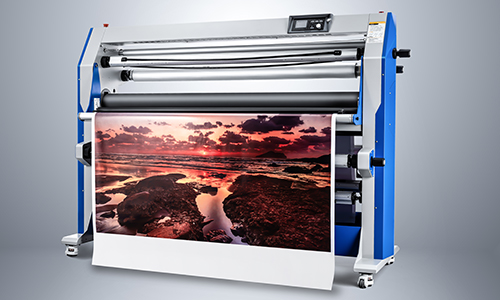
Hot lamination uses heat-activated adhesive films that require both high heat and pressure to create a bond. The laminator features heated rollers (usually the top roller, sometimes both top and bottom) that reach 80–120°C (176–248°F) or higher, fully activating the heat-sensitive adhesive layer on specialty hot lamination film.
How It Works
1.The laminator is turned on and the rollers heat to the target temperature (80–120°C+)
2.Warm-up takes 15–20 minutes
3.The print and hot laminate film (with heat-activated adhesive) are fed together through the heated rollers
4.The high heat fully activates the adhesive, creating a strong, permanent bond
5.Roller pressure ensures even contact; the laminated print exits and cools
Industrial hot laminators like the MEFU MF1700-F2 feature dual heated rollers, front and rear control panels, and digital temperature/speed displays. Some models can perform encapsulation — sealing the print between two layers of film on both front and back.
Pros of Hot Lamination
· Strongest bond: Heat-activated adhesives create the most permanent, aggressive bonds.
· Best outdoor durability: Hot-laminated prints with UV-stabilized film can last 3–5+ years outdoors.
· Fewest bubbles: High heat ensures maximum adhesive flow and wet-out.
· Encapsulation capability: Many hot laminators can laminate both sides (encapsulation), providing maximum protection.
· Widest film selection: Hot lamination supports the broadest range of specialty films — gloss, matte, satin, textured, anti-graffiti, UV-resistant.
Cons of Hot Lamination
· Heat damage risk: At 80–120°C, many inkjet prints, vinyls, and thin papers can warp, shrink, melt, or have ink bleed.
· Longest warm-up: 15–20 minutes before you can start.
· Highest energy consumption: Heating elements draw significant power.
· Most complex operation: Requires careful temperature/speed calibration for different films and substrates.
· Higher equipment cost: Industrial hot laminators with dual heating are the most expensive category.
Best for: Sign shops specializing in long-term outdoor graphics, vehicle wrap installers, and high-volume producers who work primarily with heat-stable materials and need maximum durability.
Cold vs Warm vs Hot: Three-Way Comparison
| Factor | Cold Lamination | Warm / Heat-Assist Lamination | Hot Lamination |
| Adhesive Type | Pressure-Sensitive Adhesive (PSA) | Pressure-Sensitive Adhesive (PSA) | Heat-Activated Adhesive |
| Film Type | Cold laminate film | Cold laminate film (same as cold) | Hot laminate film |
| Operating Temperature | Room temperature (no heat) | 40–60°C / 104–140°F | 80–120°C+ / 176–248°F+ |
| Warm-Up Time | None | 5–10 minutes | 15–20 minutes |
| Typical Speed | 2–5 m/min | 10–20 m/min (up to 50 m/min industrial) | 5–15 m/min |
| Bond Strength | Medium | Medium-High | Highest |
| Outdoor Durability | Poor (short-term only) | Good (1–3 years with proper film) | Excellent (3–5+ years) |
| Bubble Risk | Highest | Low | Lowest |
| Heat-Safe Materials | All materials | Most materials (test ultra-sensitive) | Heat-stable materials only |
| Energy Consumption | Lowest | Low-Medium | Highest |
| Film Cost | Medium (PSA film) | Medium (PSA film) | Higher (hot film) |
| Operation Complexity | Simplest | Simple-Moderate | Most complex |
| Equipment Cost | Lowest | Moderate | Highest |
| Encapsulation | No | Rarely | Yes |
| Typical Applications | Photos, indoor posters, POP displays | Sign shops, print shops, mixed workflow (recommended) | Banners, signage, vehicle wraps, menus |
| Recommendation | Only for ultra-sensitive materials + very low volume | Best choice for most professional print shops — the optimal balance of speed, quality, safety, and cost | Only for long-term outdoor + encapsulation needs + heat-stable materials |
The Key Takeaway
Warm / heat-assist lamination is the sweet spot for most businesses. It delivers 80% of the performance benefits of hot lamination (speed, bond quality, low bubbles) while retaining 90% of the safety and simplicity of cold lamination (heat-safe materials, easy operation, affordable PSA film). This is exactly why warm laminators have become the best-selling category for MEFU — and why most professional print shops worldwide now choose heat-assist over pure cold or pure hot.
Which One Should You Choose?
Use this decision framework to match the laminator to your actual business.
Choose Pure Cold Lamination If:
· You work almost exclusively with ultra-heat-sensitive materials that cannot tolerate even 40°C.
· Your production volume is very low and speed is not a priority.
· You need the absolute lowest equipment cost.
· Your output is entirely indoor, short-term graphics where bubble risk is manageable.
MEFU option: MF1700-B5 PRO — our dedicated cold laminator for businesses that need pure cold operation.
Choose Warm / Heat-Assist Lamination If (RECOMMENDED FOR MOST SHOPS):
· You do a mix of indoor and outdoor work.
· You want fast production speeds (10–20 m/min or higher).
· You need versatility — the ability to handle photos, inkjet prints, vinyl, and standard substrates
· You want professional, bubble-free results without the complexity and risk of hot lamination.
· You want to use affordable, widely available PSA cold laminate film
· You are a growing print shop that needs one machine to handle diverse jobs. This is the category MEFU specializes in. Our warm laminators are designed to deliver maximum versatility and performance for professional print shops.
Choose Hot Lamination If:
· You produce primarily long-term outdoor graphics (3+ years)
· You need encapsulation (double-sided lamination)
· You work almost exclusively with heat-stable materials (PVC, banner vinyl, rigid substrates)
· You require the absolute maximum bond strength and durability
· You have high-volume production and dedicated, trained operators
MEFU option: MF1700-F2 —dual heated rollers, up to 120°C (customizable to 150°C), supports laminating, mounting, and encapsulation.
Our Recommendation for Most Print Shops
Start with a warm / heat-assist laminator. It is the most versatile, cost-effective, and user-friendly choice for the vast majority of print businesses. You get professional speed and quality, you can handle almost any material, and you are not locked into expensive hot lamination film.
If you later find that a significant portion of your work requires true hot lamination (encapsulation, extreme outdoor durability), you can add a dedicated hot machine — but most shops never need to.
Common Mistakes to Avoid
1. Confusing Warm Lamination with Hot Lamination
Warm laminators use PSA cold laminate film at low temperatures (40–60°C). Hot laminators use heat-activated hot film at high temperatures (80–120°C+). Putting hot film in a warm laminator, or vice versa, will produce poor results. Always match the film to the machine type.
2. Running Too Fast on Cold Lamination
Pure cold lamination needs slower speeds (2–5 m/min) to let the PSA adhesive properly bond without heat. If you crank up the speed on a cold laminator, you will get bubbles, poor adhesion, and edge lifting.
3. Setting Warm Lamination Temperature Too High
Warm lamination works best at 40–60°C. Cranking it higher does not improve results — it can damage heat-sensitive materials and may cause the PSA film to shrink or warp. Follow the film manufacturer's recommendations.
4. Using Hot Lamination on Heat-Sensitive Materials
At 80–120°C, many inkjet inks can re-release, vinyl can shrink, and thin papers can warp. Always test a sample first. If in doubt, use warm or cold lamination instead.
5. Skipping Test Runs
New film roll? New substrate? New operator? Always run a test piece first. It takes 30 seconds and can save you from wasting meters of expensive material.
6. Neglecting Roller Maintenance
Silicone rollers are the heart of any laminator. Dust, dried adhesive, and debris cause streaks, uneven pressure, and bubbles. Clean rollers regularly with the manufacturer-recommended solvent. MEFU laminators use premium 130mm diameter silicone rollers designed for heavy-duty use — but they still need regular care.
MEFU Laminator Recommendations
After 18+ years building laminators for print shops in 110+ countries, we have learned that the best machine is the one that fits your actual workflow. Here is how our lineup maps to the three lamination types.
Warm / Heat-Assist Laminators (Our Main Category & Best Sellers)
This is where MEFU excels. Our warm laminators are designed for professional print shops that need speed, versatility, and consistent quality.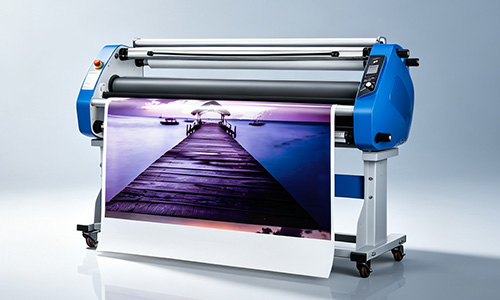
MF1700-C3 — Our Best-Selling Warm Laminator
The MF1700-C3 is the most popular choice for growing print shops. It runs up to 20 m/min with precise heat-assist temperature control, and features front and rear panels that display speed, temperature, and 30-day lamination statistics. It comes with pneumatic active cutting and upgraded ABS covers.· Max speed: 20 m/min
· Heat-assist temperature: adjustable (40–60°C typical)
· Front + rear panels with statistics display
· Pneumatic active cutting
· 30-day lamination records
· Can run in cold mode (heat off)
Ideal for: Growing print shops, mixed workflow, sign makers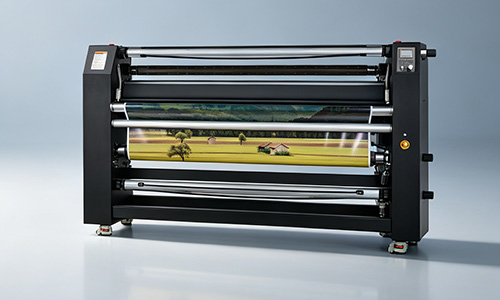
MF1700-F1 PLUS — Industrial High-Speed Warm Laminator
For shops that need maximum throughput, the MF1700-F1 PLUS delivers an incredible 50 m/min lamination speed. It features a smart entry system, swing-in-and-out air shafts for quick roll changes, and a laser positioning system for precision edge cutting.
· Lamination speed: up to 50 m/min
· Laser positioning system for edge cutting
· Swing air shafts for fast roll changes
· Smart PRO precision system
Ideal for: Large print factories, high-volume signage producers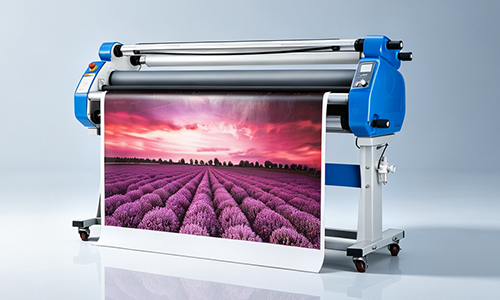
MF1700-M1 PLUS — Professional Warm Laminator
The M1 PLUS offers outstanding finishing with temperature and speed displays, at a price point that fits smaller professional shops. It is the perfect step up from entry-level without the industrial price tag.
· Temperature + speed digital display
· Heat-assist cold lamination
· Premium silicone rollers
Ideal for: Small-to-medium print shops, copy centers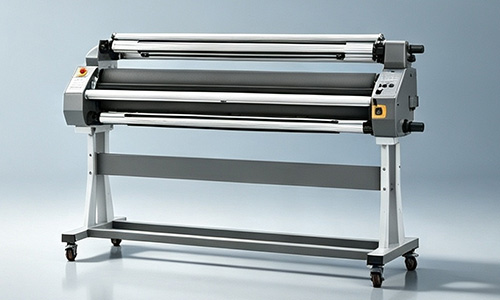
MF1700-M1 LITE — Entry-Level Warm Laminator
Our most affordable warm laminator, designed for shops that are just getting started with professional lamination but do not want to sacrifice quality.
· Budget-friendly professional quality
· Heat-assist cold lamination
Ideal for: Start-ups, small copy shops, entry-level production
Hot Laminators
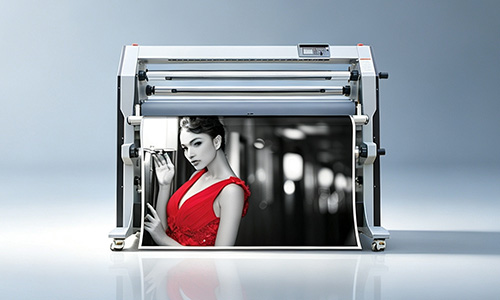
MF1700-F2 — Industrial Hot Laminator with Dual Heating
The MF1700-F2 is our flagship hot laminator, with dual heated rollers reaching up to 120°C (customizable to 150°C). It handles laminating, mounting, and encapsulating up to 1630mm wide, with front and rear control panels and premium 130mm silicone rollers.
· Max width: 1630mm / 64"
· Max temperature: 120°C (customizable to 150°C)
· Dual heated rollers
· Front + rear control panels
· Encapsulation capable
· Safety vertical cutter
Ideal for: Sign shops, large-format printers, high-volume outdoor production
Cold Laminators
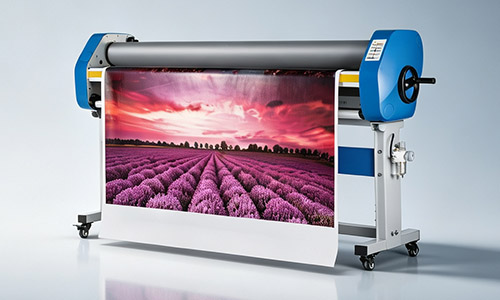
MF1700-B5 PRO — Dedicated Cold Laminator
For businesses that need pure cold operation with no heat, the MF1700-B5 PRO delivers professional cold lamination results with pneumatic pressure and precision silicone rollers.
· Pure cold operation (no heat)
· Pneumatic pressure system
· Premium silicone rollers
Ideal for: Photo labs, ultra-heat-sensitive materials, low-volume cold-only production
Not Sure Which One Fits?
Every print shop is different. Send us an email at info@mefu.cn with details about your typical jobs (materials, sizes, volumes, indoor/outdoor ratio), and our engineering team will recommend the exact model that matches your workflow — with a free, no-obligation quote.
Conclusion
Lamination is not a simple "cold vs hot" decision. There are three distinct categories, each with its own strengths:
1. Cold lamination = no heat, simplest, safest for ultra-sensitive materials, but slowest and lowest bond quality
2. Warm / heat-assist lamination = low heat (40–60°C) with PSA film, the best balance of speed, quality, safety, and cost — the recommended choice for most print shops
3. Hot lamination = high heat (80–120°C+) with hot film, maximum durability and bond strength, but highest cost, complexity, and heat risk. For the vast majority of professional print shops, warm / heat-assist lamination is the smart choice. It gives you professional speeds (10–20 m/min or higher), bubble-free results, compatibility with almost all materials, and the flexibility to use affordable, widely available PSA cold laminate film.
MEFU's warm laminator lineup—from the entry-level M1 LITE to the industrial F1 PLUS—covers every stage of your business growth, with the quality and reliability customers in 110+ countries have trusted for 18+ years.
The biggest mistake is buying a machine based on price alone without matching it to your actual work. Take an honest look at what you print, where it goes, and how much you produce. That will tell you exactly which direction to go.
Ready to find the right laminator for your print shop?
Contact us at info@mefu.cn or visit www.mefu.cn/www.flatbedlaminators.com to explore our full range of warm, hot, and cold laminators, flatbed applicators, and cutting machines.