
Top-Heated vs. Dual-Heated Roll Laminators: A Buyer's Comparison Guide
Date: 2026-10-27 Categories: Industry News Hits: 225
Top-Heated vs. Dual-Heated Roll Laminators: A Buyer's Comparison Guide
When a print finishing operation reaches the evaluation stage for a wide-format roll laminator, the shortlist often narrows to two machines that share a platform but not a purpose. The MEFU MF1700-C3 is an industrial roll laminator with top heating. The MEFU MF1700-F2 is a double-sided roll laminator with dual heating. Both are built on a 1630 mm (64 in) base working width, both accept material up to 28 mm (1.1 in) thick, both are rated at a maximum speed of 20 m/min, and both use pneumatic up/down, front and rear control panels, and the same trimmer blade layout.
That overlap is exactly why this comparison is so often decided on impression rather than on specification. It should be decided on five measurable differences: heating architecture, maximum temperature, available lamination width, power input, and net weight. Everything else on the two datasheets is either identical or a configuration option.
Short answer: specify the MF1700-C3 when heat is needed on one face of the assembly and the site electrical supply is modest — the model is listed at 1600 W or 2600 W with a net weight of 180 kg. Specify the MF1700-F2 when the process needs heat from both sides at up to 120 ℃, when a 2280 mm width option is required, and when a 5200 W supply and a 260 kg machine weight are acceptable.
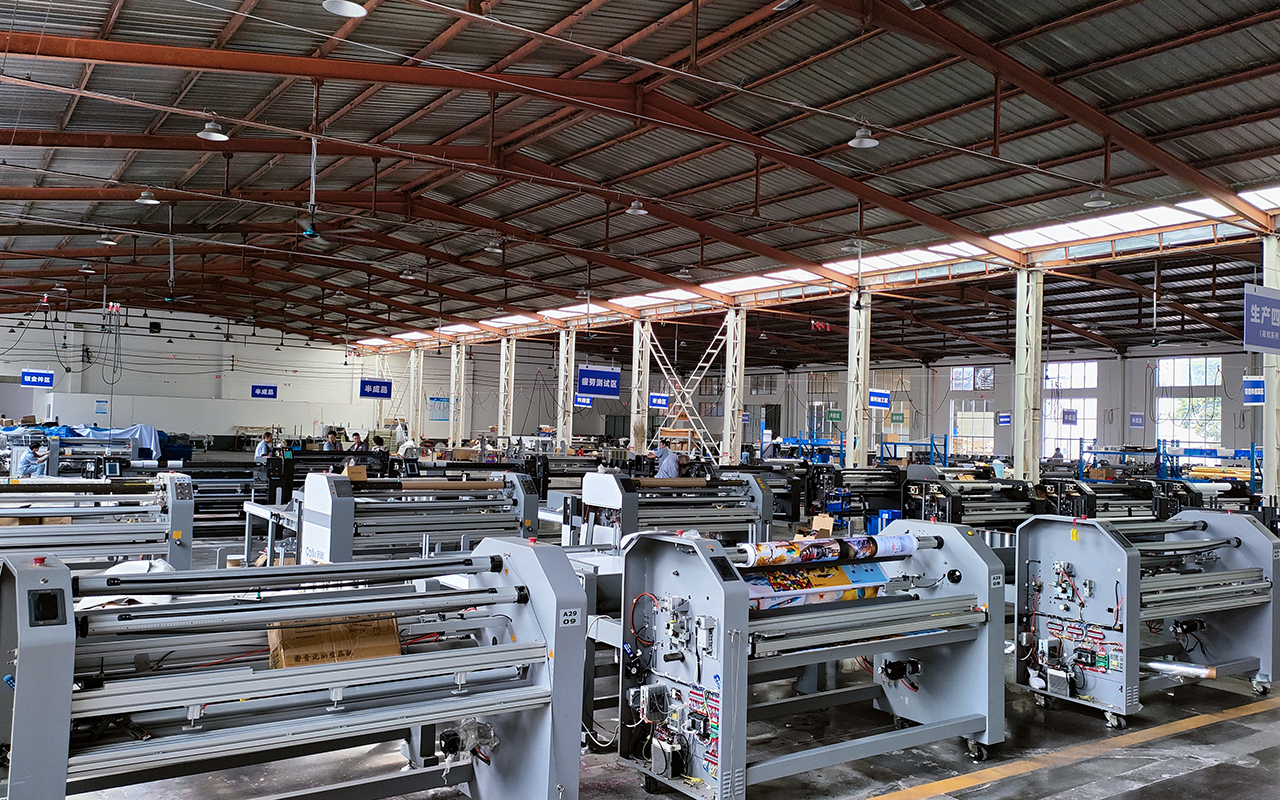
MEFU production floor, Zhengzhou, Henan, China — the manufacturing base for the MF1700-C3 and MF1700-F2 roll laminator platforms.
What "Top-Heated" and "Dual-Heated" Actually Describe
Both machines list the same thermal bill of materials: infrared quartz heating elements, an aluminium alloy heating plate, and silicone rollers at the nip. The build is not what separates them. The number of heated sides is.
A top-heated machine delivers heat from the upper side of the material path. MEFU describes the MF1700-C3 as a heavy-duty, high-speed single-sided hot/cold roll laminator with integrated longitudinal cutting trimmer units. In workflow terms, the heat source supports adhesive activation on one face of the assembly — the configuration most often used when applying protective film, mounting film or an overlaminate to printed roll media before trimming.
A dual-heated machine adds a second heat path from below. The MF1700-F2 is specified with dual heating and a 120 ℃ maximum temperature, and MEFU describes it as a plug-and-play industrial laminator with laminating, mounting, and encapsulating capabilities. Encapsulation and other two-face constructions are the cases where the second heat source changes what the machine can do, not simply how quickly it works.
The practical consequence is straightforward: if the job only needs heat applied to one side, a second heat zone adds power draw and machine weight without adding capability to that job. If the job requires heat on both faces, a single heat zone cannot substitute for it, no matter how the temperature is dialled up.
Where the Two Machines Are Identical
Reading the two datasheets side by side removes most of the variables a buyer might otherwise weigh:
- Maximum lamination thickness: 28 mm (1.1 in) on both models.
- Maximum lamination speed: 20 m/min on both models.
- Working width platform: 1630 mm (64 in) on both models.
- Up/down system: pneumatic on both models.
- Control panels: front and rear on both models.
- Trimmer holder: 2 single blades and 1 double central blade on both models.
- Smart system: the Entry system on both models.
- Listed materials: integrated sheet metal frame, silicone rollers, aluminium alloy heating plate, infrared quartz heating element and tungsten steel cutting blades on both.
Because thickness, speed, trimmer configuration, panel layout and the smart system are matched, a buyer comparing these two models is not trading one capability against another. This is a process decision about heat, width, power and weight — which is a much shorter list to test.
Specification Comparison: MF1700-C3 vs MF1700-F2
The table below uses manufacturer-published specifications only. No derived or estimated values are included.
| Specification | MEFU MF1700-C3 | MEFU MF1700-F2 |
|---|---|---|
| Machine type | Industrial Roll Laminator | Double Sided Roll Laminator |
| Smart system | Entry | Entry |
| Control panel | Front and rear | Front and rear |
| Max lamination width | 1630 mm / 64 in | 1630 mm / 2280 mm |
| Max lamination thickness | 28 mm / 1.1 in | 28 mm / 1.1 in |
| Max speed | 20 m/min | 20 m/min |
| Heating method | Top heated | Dual heated |
| Max temperature | 60 ℃ or 120 ℃ | 120 ℃ |
| Up and down | Pneumatic | Pneumatic |
| Trimmer holder | 2 single and 1 double central blades | 2 single and 1 double central blades |
| Power input | 1600 W or 2600 W | 5200 W |
| Net weight | 180 kg | 260 kg |
| Heating element | Infrared quartz | Infrared quartz |
| Roller material | Silicone | Silicone |
What Each Difference Means on the Production Floor
1. Heating architecture and maximum temperature
Both models list 120 ℃ as a ceiling, but they reach it differently. The MF1700-C3 is listed at 60 ℃ or 120 ℃ depending on the configuration ordered. The MF1700-F2 is listed at 120 ℃ with dual heating as standard architecture. A C3 ordered in its 60 ℃ configuration is not interchangeable with a 120 ℃ machine for a job that requires the higher activation temperature, so the film and adhesive system should be specified first and the machine configuration confirmed against it afterwards.
2. Maximum lamination width
Both machines share a 1630 mm base width, which is the practical ceiling for standard 64 in roll media. The MF1700-F2 is additionally listed at 2280 mm, so it covers jobs that exceed the 1630 mm format without a second pass or a different machine. If oversized graphics are occasional rather than routine, this is a capacity question rather than a daily-production question; if they are routine, it becomes the deciding specification.
3. Power input
The MF1700-C3 is listed at 1600 W or 2600 W depending on configuration; the MF1700-F2 is listed at 5200 W. This is the largest single electrical difference between the two datasheets and the one most likely to affect installation planning. Before ordering, confirm the available circuit capacity at the intended machine position, the supply voltage to be configured, and whether existing distribution can carry the higher input without rework.
4. Net weight
The MF1700-C3 is listed at 180 kg and the MF1700-F2 at 260 kg. Weight affects floor loading, delivery access, unloading equipment, positioning during installation, and how easily the machine can be relocated later. In an upper-floor unit or a shop with restricted door widths, an 80 kg difference is a logistics item that should be priced and planned, not discovered on delivery day.
5. Configuration options
Beyond the standard listings, MEFU offers OEM customization covering size, color, voltage and marking, with a minimum order quantity of 1 unit. Buyers who need a specific voltage for their market or a branded panel should confirm those requirements at quotation stage rather than after the machine is built.
Step-by-Step: How to Evaluate the Two Machines
- Define the finished assembly. Write down what leaves the machine: print plus overlaminate, print plus mounting adhesive, a two-film encapsulated panel, or a board-mounted graphic. The number of faces that need heat follows directly from this description.
- Confirm the activation temperature your film requires. Match it against the 60 ℃/120 ℃ C3 configuration options and the 120 ℃ dual-heated F2. Film chemistry, not machine preference, should set this number.
- Check the widest routine job, not the widest possible job. If routine work stays inside 1630 mm, both machines qualify on width and the F2's 2280 mm listing becomes a contingency rather than a requirement.
- Audit the electrical supply at the machine position. Compare it against 1600 W or 2600 W for the C3 and 5200 W for the F2, and include any distribution or cabling work in the project cost.
- Check floor loading and access. Confirm the route from delivery point to installation position against a 180 kg and a 260 kg machine, including door widths, lifts and turning space.
- Confirm the trimmer workflow. Both models carry 2 single blades and 1 double central blade, so inline trimming is available on either machine; what changes is how the trimmed output is handled downstream.
- Run your own material on the exact model. Speed and temperature figures are machine specifications; the finish on your film, ink and substrate is a process result. Ask for a trial on the configuration you intend to buy.
- Put both configurations in the written RFQ. A specification that says "MF1700-C3, 1600 W or 2600 W, 60 ℃ or 120 ℃ configuration" is verifiable on delivery; "top-heated laminator" is not.
Use Cases: Matching the Machine to the Work
The scenarios below map common advertising and digital printing workflows to the specification that decides them. They describe fit, not ranking: neither machine is better in general, and the correct choice depends on which column below describes your production.
| Work pattern | Model to evaluate | Specification basis |
|---|---|---|
| Single-sided protective or mounting film on printed roll media up to 1630 mm | MF1700-C3 | Top heated; 1630 mm width; 28 mm thickness; 20 m/min |
| Two-face construction, encapsulation, and heat required on both surfaces | MF1700-F2 | Dual heated; 120 ℃ maximum temperature |
| Routine graphics wider than 1630 mm | MF1700-F2 | 2280 mm width option |
| Site with limited electrical capacity | MF1700-C3 | 1600 W or 2600 W power input |
| Mixed production where both 64 in and wider formats are scheduled | MF1700-F2 | 1630 mm and 2280 mm width capability on one platform |
For a shop finishing standard 64 in signage, vehicle graphics and poster work, the top-heated MF1700-C3 covers the format range and the thickness range with a smaller electrical and physical footprint. The value it delivers comes from the combination of 28 mm thickness capacity, 20 m/min maximum speed, pneumatic up/down and front and rear panels — features that are identical on the F2, but delivered at 1600 W or 2600 W and 180 kg.
For a shop producing encapsulated panels, double-sided constructions, or graphics beyond 1630 mm, the dual-heated MF1700-F2 covers work the single-heat machine is not configured to do. The higher power input and 260 kg weight are the price of that capability, and they belong in the installation plan alongside the machine price.
Limits, Trade-offs and When Neither Machine Fits
Honest equipment comparison includes the boundaries.
- Both machines stop at 28 mm. This is generous for roll-to-roll film work but not equivalent to flatbed mounting. Where rigid board and foam board assembly above that thickness is the main workload, MEFU's flatbed applicator range is listed at up to 50 mm maximum lamination thickness on the Standard MF-B4 and Premium MF-B4 platforms.
- 20 m/min is a maximum, not a guaranteed running rate. Published maximum speeds are stated under stated conditions. Film type, adhesive, substrate, temperature and acceptable defect levels all affect the sustainable rate, which is why a material trial is a more reliable planning input than a datasheet figure.
- Dual heat is a power commitment. The MF1700-F2's 5200 W input is more than double the C3's higher 2600 W configuration. If the site cannot support it, the specification cannot be delivered regardless of budget.
- Width beyond 1630 mm costs floor space. A 2280 mm configuration needs clearance proportional to its format, not just a wider machine.
Compliance Evidence to Verify Before Ordering
Compliance is a document check, not a sales conversation. For these two models, the manufacturer's certificate record shows the following.
- CE: certificate number TST20240302124-1SC, issued 18 March 2024 by Dongguan True Safety Testing Co., Ltd., valid to 18 March 2029, for the EU market. The scope names the MF1700-C3 as the main model and includes the MF1700-F2 in the covered series. Cited standards include EN ISO 12100:2010, EN 60204-1:2018, EN IEC 61000-6-2:2019, EN IEC 61000-3-2:2019, EN 61000-3-3:2013+A1:2019 and EN 61000-6-4:2019.
- RoHS: certificate number TST20231102836-3RC, issued 20 November 2023 by Dongguan True Safety Testing Co., Ltd., valid to 20 November 2028, covering MF1700-F2 and MF1700-C3 among the listed laminator models, assessed against the IEC 62321 series.
- Customs classification: industrial laminating machinery is commonly classified under HS code 8477.80. Confirm the exact classification with your customs broker before shipment, since the code drives duty and documentation.
Ask for the certificate copies with the quotation and match the certificate number, model designation and serial details against the nameplate of the machine being shipped. A certificate that covers the series is useful; a certificate that matches the delivered unit is what a buyer actually needs.
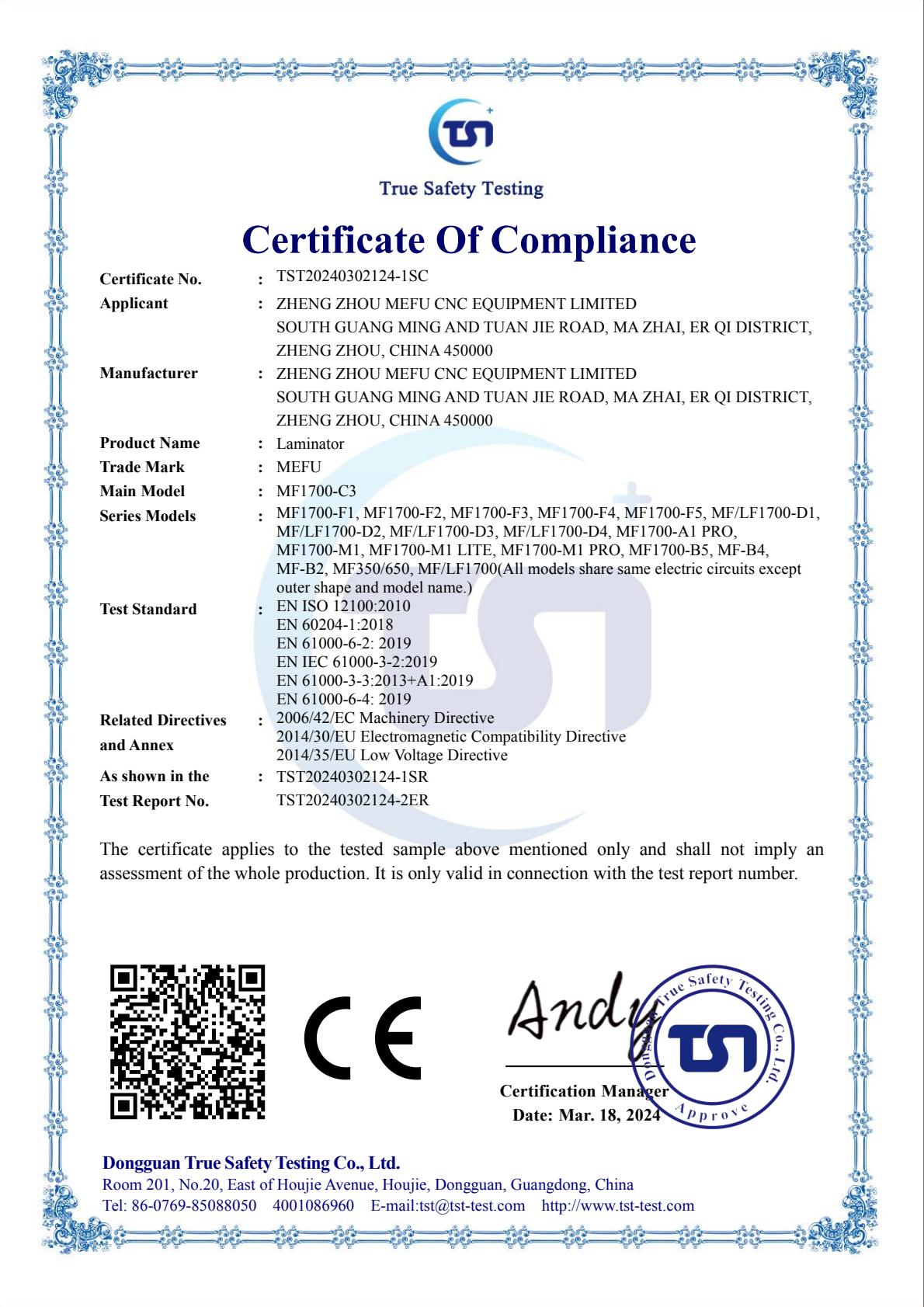
CE certificate TST20240302124-1SC, issued 18 March 2024, covering the MF1700-C3 as main model and the MF1700-F2 within the listed series.
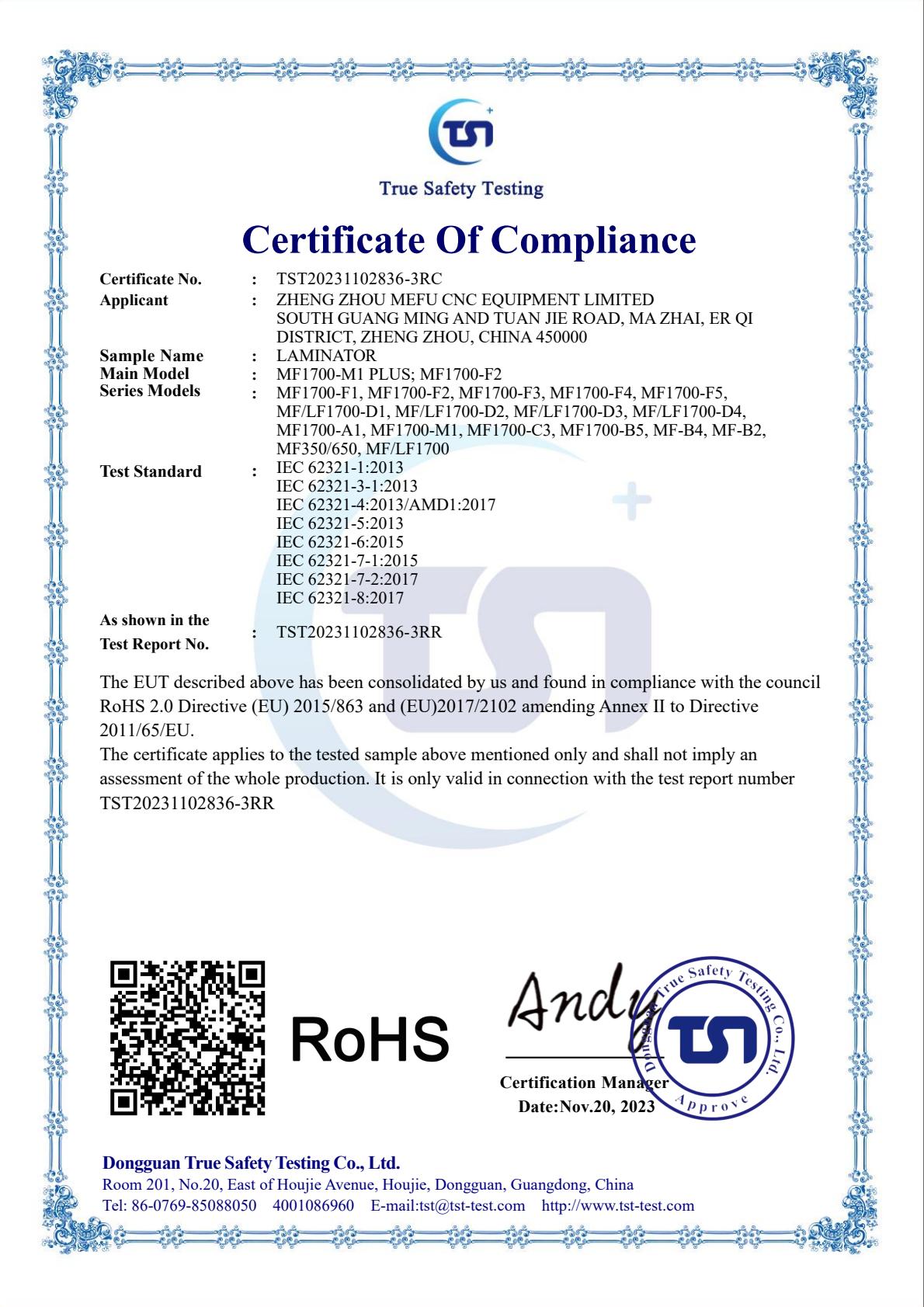
RoHS certificate TST20231102836-3RC, valid to 20 November 2028, covering the MF1700-F2 and MF1700-C3 among listed laminator models.
What to Put in the RFQ
- Model and exact configuration: MF1700-C3 at 60 ℃ or 120 ℃, 1600 W or 2600 W; or MF1700-F2 at 1630 mm or 2280 mm.
- Film and substrate samples with grammage, thickness and adhesive type, plus the finished appearance standard.
- Required sustained throughput for your material mix, separate from the 20 m/min maximum figure.
- Supply voltage and available circuit capacity at the installation position.
- Delivery route constraints against 180 kg (C3) and 260 kg (F2) net weight.
- Spare trimmer blades (tungsten steel), roller care requirements and remote support arrangements.
- Certificate copies: CE TST20240302124-1SC and RoHS TST20231102836-3RC.
- Acceptance criteria and the test record from the 100% pre-shipment inspection.
About MEFU
HENAN MEFU INDUSTRIAL LIMITED is a manufacturer of roll laminators, flatbed laminators, flatbed applicators and XY cutters, based in Zhengzhou, Henan, China, and operating at www.mefulaminator.com. Founded in 2008, the company runs a 10,000 m² factory with 100 employees, a 10-engineer R&D team and an annual output of 6,000 units. Exports represent 40% of output, with main markets in the EU, USA, Japan and Russia, and products shipped to more than 110 countries. OEM customization covers size, color, voltage and marking; the minimum order quantity is 1 unit, lead time is 14 days, monthly capacity is 500 units, and every unit is 100% tested before shipment, with remote support after delivery.
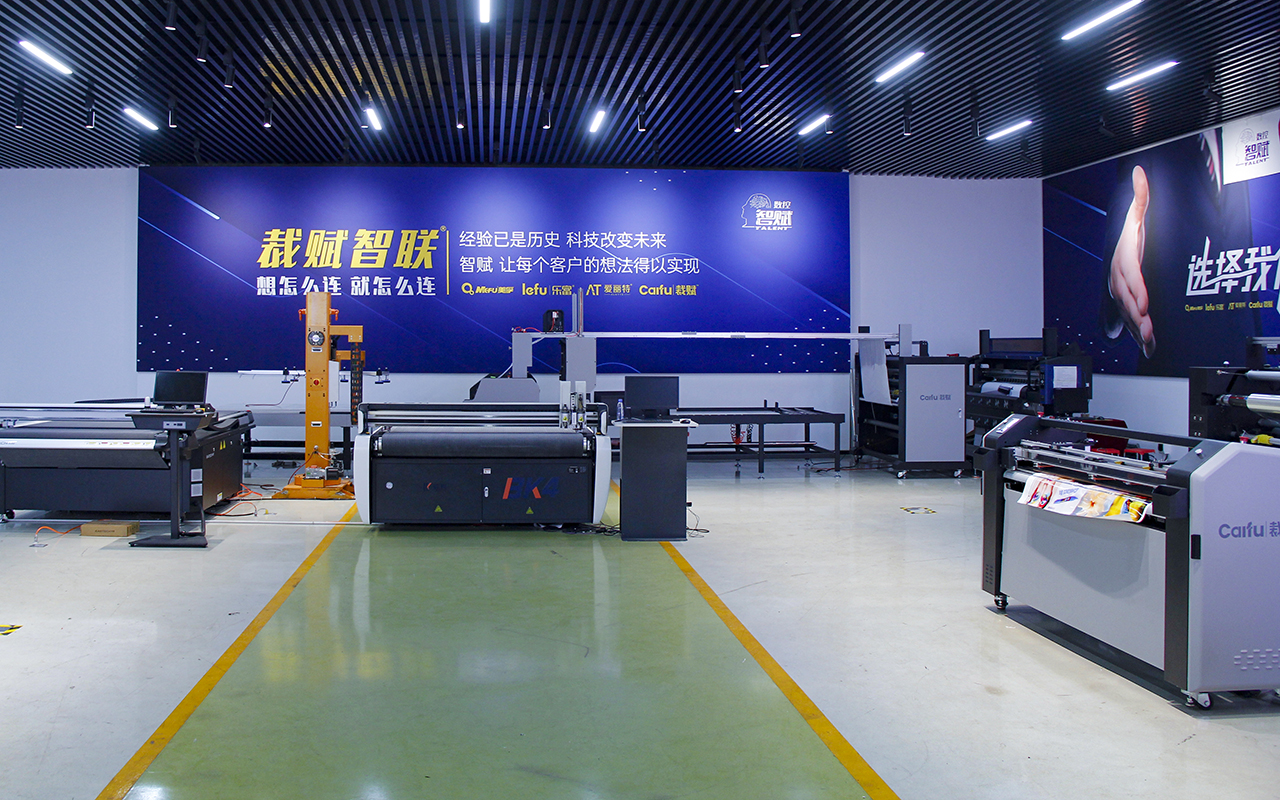
MEFU exhibition hall: the roll laminator, flatbed laminator, flatbed applicator and XY cutter range shown together.
Frequently Asked Questions
Are the MF1700-C3 and MF1700-F2 CE and RoHS certified?
Yes, according to the manufacturer's certificate record. CE certificate TST20240302124-1SC was issued on 18 March 2024 by Dongguan True Safety Testing Co., Ltd. and is valid until 18 March 2029; its scope names the MF1700-C3 as the main model and includes the MF1700-F2 in the covered series, against standards including EN ISO 12100:2010, EN 60204-1:2018 and EN IEC 61000-6-2:2019. RoHS certificate TST20231102836-3RC, issued 20 November 2023 by the same body and valid until 20 November 2028, covers the MF1700-F2 and MF1700-C3 among other laminator models. Always match the certificate to the nameplate of the unit being shipped.
Can the top-heated MF1700-C3 handle the same material thickness as the dual-heated MF1700-F2?
Yes. Both models are listed at a maximum lamination thickness of 28 mm (1.1 in) and a maximum speed of 20 m/min, and both use pneumatic up/down, front and rear control panels, and 2 single plus 1 double central trimmer blades. The differences are heating method (top heated versus dual heated), maximum width (1630 mm versus 1630 mm or 2280 mm), power input (1600 W or 2600 W versus 5200 W) and net weight (180 kg versus 260 kg).
How should a buyer budget the difference between the two models?
Budget the machine and the installation together. The MF1700-F2's 5200 W power input may require distribution or cabling work that the MF1700-C3 at 1600 W or 2600 W does not, and its 260 kg weight may affect delivery access and positioning. On the C3, the choice between 60 ℃ and 120 ℃ configuration, and between 1600 W and 2600 W, also changes the specification quoted. Request a configured quotation for both models rather than comparing headline figures.
How do we validate the choice with our own material?
Send the film, substrate and ink combination you actually run, state the finished appearance standard, and ask for a trial on the exact configuration being quoted. Every MEFU unit is 100% tested before shipment, and the minimum order quantity is 1 unit, so a single-machine evaluation does not require volume commitment. Confirm the sustainable rate you observed during the trial, because the 20 m/min figure is a maximum specification, not a production guarantee.
What is the lead time and minimum order quantity?
MEFU lists a 14-day lead time, a minimum order quantity of 1 unit and a monthly capacity of 500 units, with OEM customization available for size, color, voltage and marking. Remote support is provided after delivery, and products are exported to more than 110 countries. To move from comparison to quotation, request the current MEFU catalogue and send your material and configuration details through the enquiry channel.
Next Step
Both machines are quoted to configuration, so the fastest way to close the comparison is to specify the assembly, the widths and the power supply, then ask for a configured quotation and a material trial on the exact model. Download the MEFU catalogue here: MEFU product catalogue (PDF). For model-specific questions, contact MEFU at info@mefu.cn or +86 15890020566, or visit www.mefulaminator.com.
Conclusion
The choice between the MEFU MF1700-C3 and the MEFU MF1700-F2 is narrower than the model names suggest. Both deliver a 1630 mm base width, 28 mm material thickness, 20 m/min maximum speed, pneumatic up/down, front and rear control panels, identical trimmer blade layout and the same Entry smart system. The genuine differences are four: one heat zone or two, a 120 ℃ ceiling as an option or as standard architecture, 1630 mm or 1630/2280 mm width, and 1600 W or 2600 W against 5200 W with 180 kg against 260 kg behind them.
Match the machine to the number of faces that need heat, confirm the width your routine work demands, verify the electrical and physical installation against the specification, and validate the finish with your own material. That sequence turns a specification comparison into a procurement decision that can be checked on delivery.