Flatbed vs. Roll Laminator: A Buyer’s Comparison Guide for 64-Inch Production
Date: 2026-09-12 Categories: Industry News Hits: 519
Flatbed vs. Roll Laminator: A Buyer’s Comparison Guide for 64-Inch Production
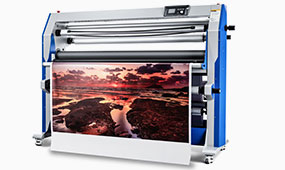
A print shop that invests in a 64-inch (1630 mm) printer eventually faces one finishing decision that shapes everything downstream: laminate on a flat table, or feed material through a roll-to-roll machine. Both approaches rely on the same physical principles — silicone rollers, controlled pressure, and, on most production models, pneumatic up-and-down movement — but they organise the work in fundamentally different ways. That difference decides throughput, the range of substrates a shop can accept, and how much floor space the post-press department consumes.
This comparison guide is written for owners, production managers, and procurement staff in the advertising and digital printing industries who are still in the research stage and need a decision they can defend with published specifications rather than sales claims. It contrasts two MEFU platforms: the flatbed approach represented by the Standard MF-B4, a flatbed vinyl applicator built on a safety-glass table, and the continuous approach represented by the MF1700-F2, a double sided roll laminator rated at up to 20 m/min.
The short answer comes first. Choose a roll laminator when the work is roll-to-roll, high volume, and speed-critical: the MF1700-F2 laminates continuously at up to 20 m/min, and the MF1700-F1 and MF1700-F1 PLUS high speed roll laminators reach up to 50 m/min. Choose a flatbed machine when the work includes rigid boards, mounting, and mixed short runs: the Standard MF-B4 holds material flat on a safety-glass table and accepts sheets up to 50 mm thick. Shops that sell both roll media and rigid signage generally need both formats, so the real question becomes which one is purchased first.
Problem definition: what a 64-inch shop is actually choosing between
This is not a quality question. Published parameters for MEFU machines show that the flatbed and roll families share the same core construction: silicone rollers, an integrated sheet metal frame, and pneumatic pressure on the models that automate lifting. Surface results therefore depend on pressure, temperature, and operator technique rather than on machine format. The genuine problem is workflow fit, and it shows up in three places.
- Substrate rigidity. A roll laminator moves material through a web path. Rigid sheets — acrylic, PVC board, foam board, aluminium composite panel — cannot follow that path. A flatbed machine holds the sheet still on a table while the roller passes over it, which is why it is the format used for rigid board finishing and surface mounting.
- Throughput accounting. A quoted maximum speed is a line speed, not a production rate. On a roll machine, loading and unloading happen at the two ends of one continuous run. On a flatbed, every sheet is loaded, positioned, laminated, and removed individually, so the same nominal speed produces far fewer finished pieces per shift.
- Width discipline. A 64-inch shop works in the 1630 mm class. Flatbed models are published at laminating sizes of 1325 mm and 1630 mm (Standard and Premium MF-B4), while roll models sit at 1630 mm across most of the range and extend to 2280 mm on the MF1700-F2.
A buyer who can answer those three points for their own order book has effectively made the format decision. The rest of this guide supplies the specification detail needed to confirm it and to choose the right model inside the chosen family.
Industry background: a finishing market that keeps expanding in the 64-inch class
Lamination sits inside a finishing equipment market that continues to expand, and the wide-format class is where a large share of that expansion is happening. According to Dataintelo, the global roll laminator market was valued at USD 1.82 billion in 2024 and is projected to reach approximately USD 2.89 billion by 2033. Intel Market Research projects the global laminating machines market to expand at a CAGR of 5.07% from 2026 to 2034, reaching USD 1.07 billion by the end of that period, and values the commercial laminators market at USD 1.49 billion in 2024, noting that wide-format segments are gaining traction in emerging markets.
Those figures should be read as directional rather than precise. Published estimates diverge because they define the market differently: Dataintelo’s USD 1.82 billion covers the roll laminator market, Intel Market Research places commercial laminators at USD 1.49 billion for 2024, and Custom Market Insights narrows the systems-only figure to USD 407.4 million. For a buyer, the useful signal is not the total but the direction — capacity continues to be added in wide-format finishing across both established and emerging markets.
Technology mix shows a similar pattern. Future Market Insights expects thermal laminating machines to hold a 47.0% share of the market by 2025, driven by lower operating costs and strong adhesion. That matters for the flatbed-versus-roll decision because it confirms that heated lamination remains the mainstream production method, and it explains why the MEFU roll range spans cold, heat-assist, hot, and dual-heated configurations rather than a single thermal design.
Product development in the 1650 mm class has continued as well. Neschen Coating launched the ColdLam 1650 SW in 2024, a 1650 mm wide-format laminator designed for sustainable media applications — a launch that sits directly in the width class a 64-inch print shop operates in.
MEFU, registered as HENAN MEFU INDUSTRIAL LIMITED, has built finishing equipment since 2008 and now operates from a 10000 m² facility with approximately 100 staff, including an R&D team of 10 engineers, and an annual output of 6000 units. Products are exported to more than 110 countries, with export business accounting for about 40% of total sales and main markets in the EU, USA, Japan, and Russia. Third-party procurement analysis has described MEFU as a tier-2 market leader and innovator in heat-assist cold laminator technology, with ISO 9001:2015 certification.
How the two formats are built: MEFU flatbed and roll platforms
Flatbed platforms: the sheet stays still, the roller moves
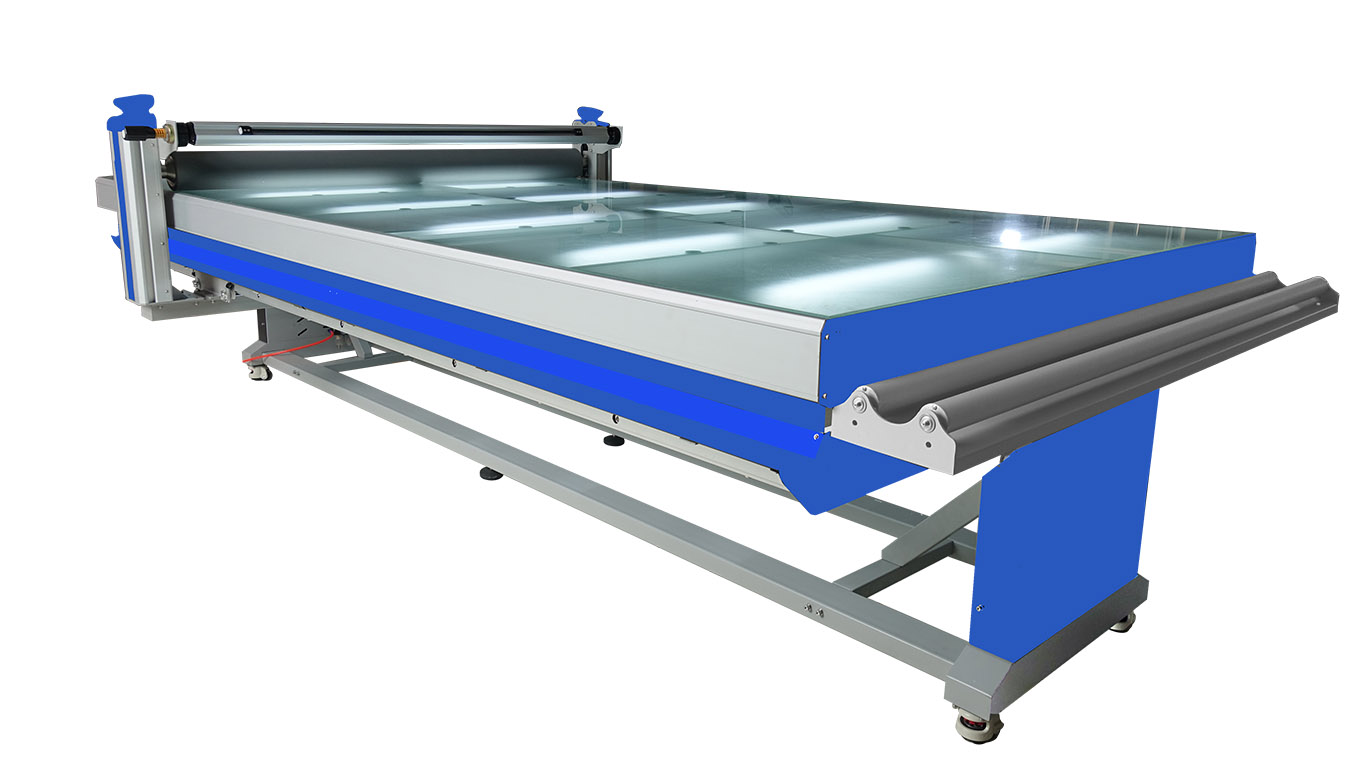
A flatbed machine laminates on a table. The MEFU Standard MF-B4 is classified as a flatbed vinyl applicator, published with laminating sizes of 1325 mm and 1630 mm and a maximum laminating thickness of 50 mm. It uses a safety-glass table with a cutting mat, silicone rollers, pneumatic up-and-down movement, LED illumination, and roll holders at both the beam and the end of the table. It carries no heating system, which places it in cold application and mounting work rather than thermal lamination.
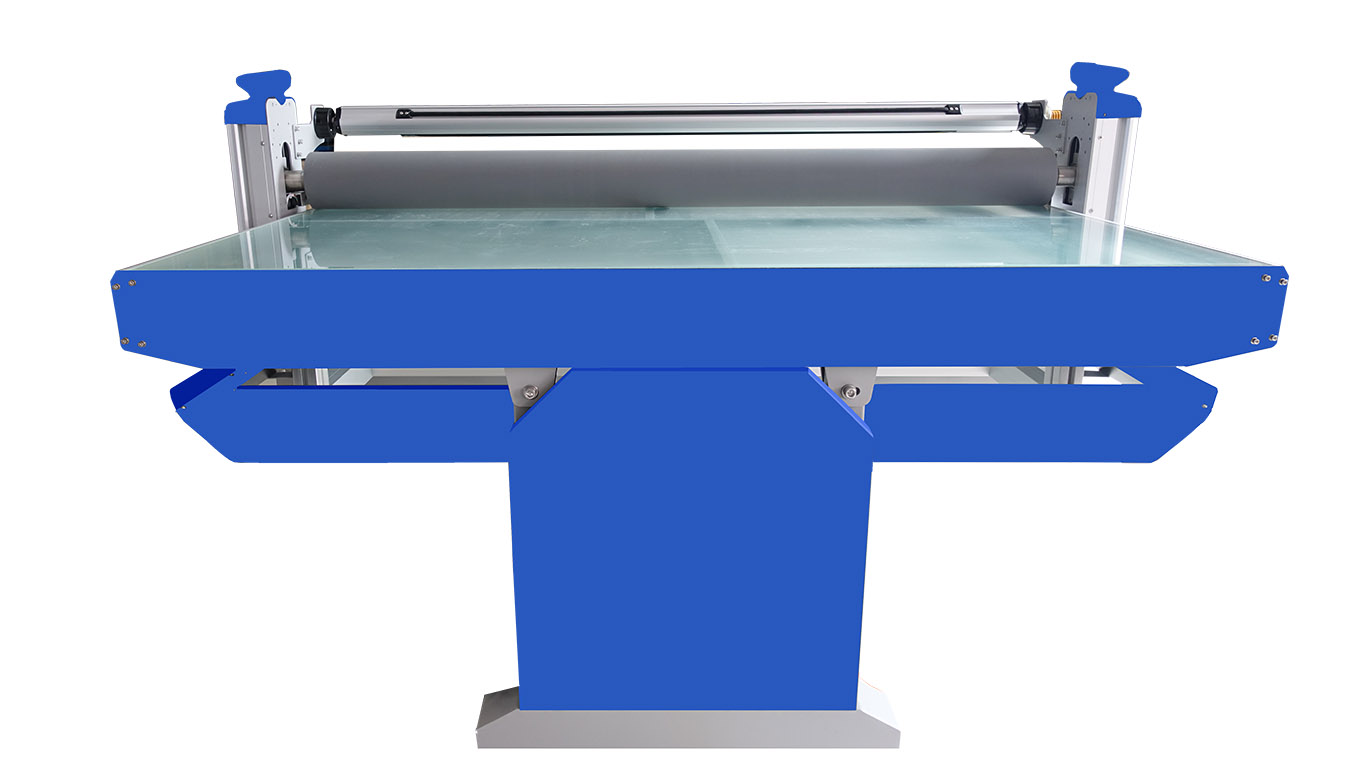
The Premium MF-B4 adds capability to the same architecture. It is classified as a table laminator, published with laminating sizes of 1325 mm, 1630 mm, and 1632 mm, keeps the 50 mm maximum thickness, adds side trays, and raises the temperature ceiling to 60°C. Both B4 models are listed for the advertising and signage industry, the graphic design and digital printing industry, and the industrial and decorative industry.
Two larger flatbed models extend the format into wider and longer work. The MF1350-B2 flatbed applicator covers a maximum laminating width of 1270 mm, a maximum thickness of 25 mm, a maximum speed of 7 m/min, and a maximum temperature of 100°C with infrared heating, 130 mm silicone rollers, four flatbed sections, a total flatbed length of 3.2 m, one emergency button, and a 2500 W power input. The MF1950-B2, classified as a flatbed mounting laminator, scales the same concept up to a 1830 mm maximum laminating width, a 4.8 m flatbed length, and identical 7 m/min and 100°C ratings. Across all four flatbed models, the frame is integrated sheet metal, the rollers are silicone, and the heating plate, where fitted, is aluminium alloy.
Roll platforms: continuous web, heated rollers, higher line speed
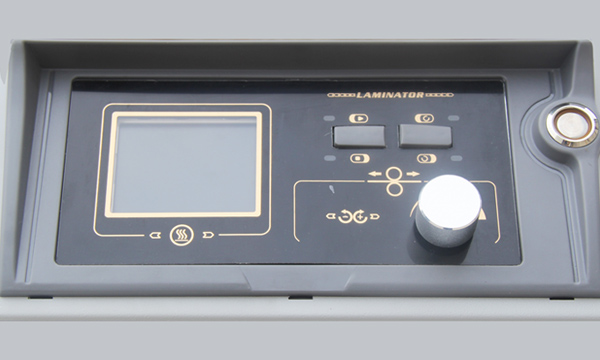
A roll laminator pulls material from a feed roll through the roller nip and winds it onto a take-up roll, which is why the format is also described as roll-to-roll lamination. The MEFU MF1700-F2 is classified as a double sided roll laminator, published with maximum laminating widths of 1630 mm and 2280 mm, a maximum thickness of 28 mm (1.1 inch), a maximum speed of 20 m/min, dual heating, a 120°C maximum temperature, pneumatic up-and-down movement, a trimmer holder carrying two single blades and one double central blade, a 5200 W power input, and a net weight of 260 kg. Its control panel is fitted at both the front and the rear, so the operator can run the machine from either side of the web path.
The 50 m/min ceiling in the MEFU roll range belongs to the MF1700-F1 and MF1700-F1 PLUS, both classified as high speed roll laminators. They share a 1630 mm laminating width, a 28 mm maximum thickness, top heating with a 60°C maximum, two winder shafts and one rewinder with swing-in and swing-out air shafts, a 2000 W power input, and a 350 kg net weight.
Between those two ends, the range covers most production profiles. The MF1700-C3 is classified as an industrial roll laminator, published at 1630 mm (64 inch), 28 mm, and 20 m/min, with top heating at 60°C or 120°C and a choice of 1600 W or 2600 W power input. The MF1700-A1 PRO, a large format laminator, is rated at 1630 mm, 28 mm, and 15 m/min; the MF1700-M1 PRO, a wide format laminator, at 12 m/min; and the MF1700-M5, a pneumatic roll laminator, at 12 m/min with a 23 mm thickness ceiling, hand crank height adjustment, and 1600 W or 2600 W input.
Below the pneumatic line, the range continues with machines that trade automation for cost. The MF1700-M1 is classified as a hot cold roll laminator, published with a manual hand crank, a 0–9 m/min speed range, 120 mm silicone rollers, a 23 mm maximum thickness, top infrared heating to 60°C, a 1600 W input, and a 150 kg net weight. The MF1700-M1 LITE is a roll to roll laminating machine rated at 9 m/min with pneumatic lifting, and the MF1700-M1 PLUS is a heat assist laminator at 9 m/min with a 60°C ceiling. At the entry end, the MF1700-B5 is a vinyl roll laminator with no heating and manual running, the MF1700-B5 PRO is a heavy duty roll laminator rated at 6 m/min with pneumatic lifting and a 120 W input, and the MF1600-B7 is a graphic roll laminator covering a 1520 mm maximum working width.
Downstream cutting belongs to the same decision, because a laminator that outruns the trim station simply moves the bottleneck further along the line. MEFU also builds the MF1700-XY, an XY roll cutting machine with a cutting width up to 1620 mm, a cutting speed of 0–12 m/min, and a precision of ±0.5 mm, plus the MF1700-XA, a roll to roll cutting machine with a 1620 mm maximum width and two-way tungsten steel blades. Both are listed for the advertising and graphics, digital printing and photo, packaging and label, and signage and exhibition industries. This integration is consistent with MEFU’s introduction of the world’s first integrated laminating and cutting system.
Step-by-step: six checks before you commit to a format
Step 1 — Map the substrate mix before the machine
List every material the shop laminated in the past twelve months and mark each item as roll media or rigid sheet. Roll media — self-adhesive vinyl, PVC film, PP paper, photographic paper — can run on either format. Rigid material — acrylic, PVC board, foam board, aluminium composite panel — can only run on a flatbed. If rigid work represents more than a small fraction of the order book, a roll laminator alone will not cover it, regardless of how fast it runs.
Step 2 — Fix the width class against actual job sizes
A 64-inch shop usually works slightly below the machine’s rated width to allow for gripper areas and trimming. Flatbed models are published at laminating sizes of 1325 mm and 1630 mm on the Standard and Premium MF-B4, 1270 mm on the MF1350-B2, and 1830 mm on the MF1950-B2. Roll models are published at 1630 mm across most of the range, with the MF1700-F2 extending to 2280 mm. Match the published width to the largest finished piece, not to the printer’s maximum media width.
Step 3 — Check the thickness ceiling against the thickest board
Thickness is where the two formats separate most sharply. The Standard and Premium MF-B4 accept up to 50 mm, the MF1350-B2 and MF1950-B2 up to 25 mm, and the roll range up to 28 mm on the MF1700-F2, MF1700-C3, MF1700-A1 PRO, and MF1700-M1 PRO, or 23 mm on the MF1700-M5 and MF1700-M1. A shop that regularly mounts 30 mm foam board therefore has a flatbed requirement irrespective of production volume.
Step 4 — Convert line speed into finished pieces per shift
Published maximum speeds are 7 m/min for the heated flatbed models (MF1350-B2 and MF1950-B2), 20 m/min for the MF1700-F2 and MF1700-C3, and up to 50 m/min for the MF1700-F1 and MF1700-F1 PLUS. Those numbers describe the lamination pass only. On a roll machine the pass runs continuously; on a flatbed, each sheet is positioned and removed separately, so the effective hourly output depends on sheet count rather than on metres of film consumed. Cost the labour minutes per finished piece, not the metres per minute.
Step 5 — Select the lamination mode the film actually requires
The MEFU range covers cold application (Standard MF-B4, MF1700-B5, MF1600-B7), heat assist (MF1700-M1 PLUS at 60°C), hot lamination (MF1700-M1 and MF1700-F1 at 60°C), and dual heated operation (MF1700-F2 at 120°C). Cold mounting is the usual method for pressure-sensitive mounting films on rigid boards, while thermal and heat-assist lamination is used where the film needs heat activation. Matching mode to film prevents the same machine from being bought twice.
Step 6 — Verify finishing features and compliance documents
Small features decide daily usability: LED illumination and a cutting mat on the Standard MF-B4, side trays on the Premium MF-B4, an emergency button on the MF1350-B2 and MF1950-B2, trimmer holders with two single and one double central blade on the MF1700-F2, and swing-in air shafts on the MF1700-F1 and MF1700-F1 PLUS. On the compliance side, laminating machines must satisfy EN 60204-1 (Safety of machinery — Electrical equipment of machines) for CE marking in the EU, so the certificate supplied must correspond to the exact configuration being quoted rather than to a general product family.
Use cases: which jobs belong on which format
Rigid signage and exhibition panels — flatbed
Rigid board finishing and surface mounting is the flatbed format’s core application. Acrylic, PVC, foam board, and aluminium composite panel for indoor and outdoor signs and light boxes are loaded flat onto the table, and the roller passes over the board rather than the board passing through rollers. Material thickness up to 50 mm on the Standard and Premium MF-B4 covers the board range used in sign and exhibition work, and the pneumatic lifting system applies even pressure across the sheet.
High-volume roll-to-roll advertising output — roll
Vinyl, PP paper, and PVC film for billboards, posters, vehicle graphics, and outdoor advertising materials are the natural workload of a roll laminator, which is why these machines are listed for high-efficiency continuous large-format production in advertising and graphic arts scenarios. The MF1700-F2’s 20 m/min line speed and dual-heated 120°C capability suit continuous production, while the MF1700-F1 and MF1700-F1 PLUS at up to 50 m/min are aimed at shops where the laminator must keep pace with a high-output printer rather than become the slowest station on the floor.
Photo, poster, and high-end graphic finishing — either format, by film type
Precision cold and heat lamination of photo prints, digital posters, and artworks is used to prevent fading, maintain colour fastness, and provide high-clarity surface protection. This work can run on a heat assist laminator such as the MF1700-M1 PLUS, on a hot cold roll laminator such as the MF1700-M1, or on a flatbed table laminator when prints are handled as individual sheets and need low-tension handling on a rigid support.
Interior design and industrial surface finishing — heavy-duty flatbed
The flatbed range is also used to laminate decorative panels, wooden boards, metal sheets, and ceramic tiles, improving surface aesthetics, scratch resistance, and service life. This is heavy-duty sheet lamination on rigid substrates, an application profile where the MF1950-B2’s 1830 mm width and 4.8 m flatbed length matter more than line speed, and where the MF1350-B2 covers smaller decorative and panel formats at 1270 mm.
Side-by-side comparison: Standard MF-B4, MF1950-B2, and MF1700-F2
The table below compares one cold flatbed applicator, one heated flatbed laminator, and one dual-heated roll laminator, using only published MEFU parameters.
| Parameter (published) | Standard MF-B4 — Flatbed Vinyl Applicator | MF1950-B2 — Flatbed Mounting Laminator | MF1700-F2 — Double Sided Roll Laminator |
|---|---|---|---|
| Machine category | Flatbed vinyl applicator | Flatbed mounting laminator | Double sided roll laminator (roll-to-roll) |
| Maximum laminating width | 1325 mm / 1630 mm | 1830 mm | 1630 mm / 2280 mm |
| Maximum material thickness | 50 mm | 25 mm | 28 mm (1.1 inch) |
| Maximum speed | Not published | 7 m/min | 20 m/min |
| Heating | None (cold application) | Infrared heated | Dual heated |
| Maximum temperature | None | 100°C | 120°C |
| Rollers | Silicone | Silicone, 130 mm | Silicone |
| Table / material path | Safety-glass table with cutting mat | 4 flatbed sections, 4.8 m total length | Continuous roll-to-roll web path |
| Up and down movement | Pneumatic | Pneumatic | Pneumatic |
| Roll handling | Roll holder at beam and at end of table | Not published | Not published for the MF1700-F2; the MF1700-F1 and MF1700-F1 PLUS use two winder and one rewinder swing-in / swing-out air shafts |
| Trimming / cutting on machine | Cutting mat | Not published | Trimmer holder: 2 single and 1 double central blades |
| Power input | Not published | 2500 W | 5200 W |
| Net weight | Not published | Not published | 260 kg |
| Published application industries | Advertising and signage; graphic design and digital printing; industrial and decorative | Advertising and signage; graphic design and digital printing; industrial and decorative | Advertising; digital printing |
Where a field reads “Not published”, MEFU’s published parameter sheet for that model does not state the value; the gap is left open rather than estimated. All values are manufacturer-published specifications and should be confirmed against the configuration quoted for a specific order.
Frequently asked questions
What electrical safety standard applies if a laminator is imported into the EU?
Laminating machines must comply with EN 60204-1, the standard for the safety of machinery with respect to electrical equipment of machines, in order to carry CE marking for the EU market. A buyer should therefore ask for the CE documentation that corresponds to the specific machine being quoted, not a general company certificate. MEFU, registered as HENAN MEFU INDUSTRIAL LIMITED, holds ISO 9001:2015 certification according to third-party procurement analysis, and supplies machines to the EU, USA, Japan, and Russia alongside more than 110 export markets.
Can a roll laminator handle the same rigid boards as a flatbed applicator?
No, and this is the most common mismatch in 64-inch shops. The roll platform moves material through a web path, so published thickness ceilings for MEFU roll models are 23 mm on the MF1700-M5 and MF1700-M1, and 28 mm on the MF1700-F2, MF1700-C3, MF1700-A1 PRO, and MF1700-M1 PRO. The flatbed Standard MF-B4 is rated to 50 mm maximum laminating thickness and uses a safety-glass table, which is what allows acrylic, PVC, foam board, and aluminium composite panel to be mounted flat. Roll machines do reach wider formats where needed — the MF1700-F2 is published at 1630 mm and 2280 mm maximum laminating width — but additional width does not change the rigid-substrate limit.
What drives the cost difference between flatbed and roll laminator systems?
Machine format alone does not set the price; configuration does. Published parameters show the variables that move a laminator between entry and industrial classes: maximum laminating width (from 1270 mm to 2280 mm across the MEFU range), thickness capacity (23 mm to 50 mm), heating type (none, top heated, or dual heated), the number of heated rollers, automation of the lifting system (hand crank versus pneumatic), whether trimmer blades and swing-in air shafts are fitted, total power input (from 120 W on the unheated MF1700-B5 PRO to 5200 W on the dual-heated MF1700-F2), and machine weight (260 kg for the MF1700-F2, 350 kg for the MF1700-F1). Because one platform can be specified in several ways, buyers should request a quotation tied to a written configuration rather than comparing headline model names.
How should a print shop validate a laminator before committing to a purchase?
The practical route is material validation: run the actual media and film combinations the shop sells — self-adhesive vinyl, PVC film, PP paper, photographic prints — through a machine in the same width and heating class as the intended purchase. The MEFU portfolio covers the relevant classes for that test, from cold flatbed application on the Standard MF-B4 through heat-assist lamination on the MF1700-M1 PLUS, hot lamination on the MF1700-M1, and dual-heated roll lamination on the MF1700-F2. Buyers can request sample and configuration support through MEFU’s sales channel at info@mefu.cn, and download the product brochure as the starting point for a specification checklist.
What affects delivery time for a 64-inch laminator?
Lead time is configuration-dependent, and no single figure applies across the range. The factors that change a build include laminating width (1270 mm to 2280 mm across the flatbed and roll families), the heating configuration, whether pneumatic lifting and powered winding shafts are specified, and the volume of a multi-machine order. Because MEFU manufactures in a 10000 m² facility with an annual output of 6000 units and exports to more than 110 countries — with about 40% of sales generated outside China and main markets in the EU, USA, Japan, and Russia — delivery scheduling is confirmed per order rather than published as a standard interval. Buyers should request a written delivery schedule together with the quotation by contacting MEFU at info@mefu.cn or on WhatsApp at +86 15890020566, and align machine arrival with installation and operator training.
Conclusion: decide by substrate first, then by speed
The flatbed-versus-roll decision resolves in a fixed order. Substrate comes first: if the shop laminates rigid boards up to 50 mm, a flatbed applicator such as the Standard MF-B4 is the only format that will do the job, because roll machines are limited to 23 mm and 28 mm material thickness. Volume comes second: if the shop laminates roll media continuously, a roll laminator such as the MF1700-F2 at 20 m/min — or the MF1700-F1 and MF1700-F1 PLUS at up to 50 m/min — is the format that converts printer output into finished work without creating a manual bottleneck. Width and heating configuration then tune the choice inside whichever family has been selected.
For most 64-inch advertising and digital printing operations, the honest conclusion is that the two formats are complementary rather than competing. A shop that buys only a roll laminator will keep sending rigid mounting work out; a shop that buys only a flatbed will under-serve its high-volume roll orders and put pressure on delivery promises. Sequencing matters more than preference — start with the format that covers the work currently outsourced, then add the second capability once volume justifies it.
Specifications in this guide come from MEFU’s published product parameters and from third-party market data attributed in the text. Buyers should re-check the parameter sheet for the exact model and configuration, and confirm compliance documents, before issuing a purchase order.
Next step: confirm the configuration for your own media
MEFU manufactures flatbed applicators, flatbed laminators, roll laminators, and cutting machines at its 10000 m² facility in Zhengzhou, and exports to more than 110 countries. If you are comparing formats for a 64-inch production line, the fastest way to close the question is to send your media list — roll widths, board thicknesses, film types, and daily output — and ask for a configuration-matched quotation.
Product brochure (download): MEFU finishing equipment brochure
Website: www.mefulaminator.com
Email: info@mefu.cn
WhatsApp: +86 15890020566
Address: NO.20 XUEYUAN ROAD, ERQI DISTRICT, ZHENGZHOU, HENAN, CHINA